
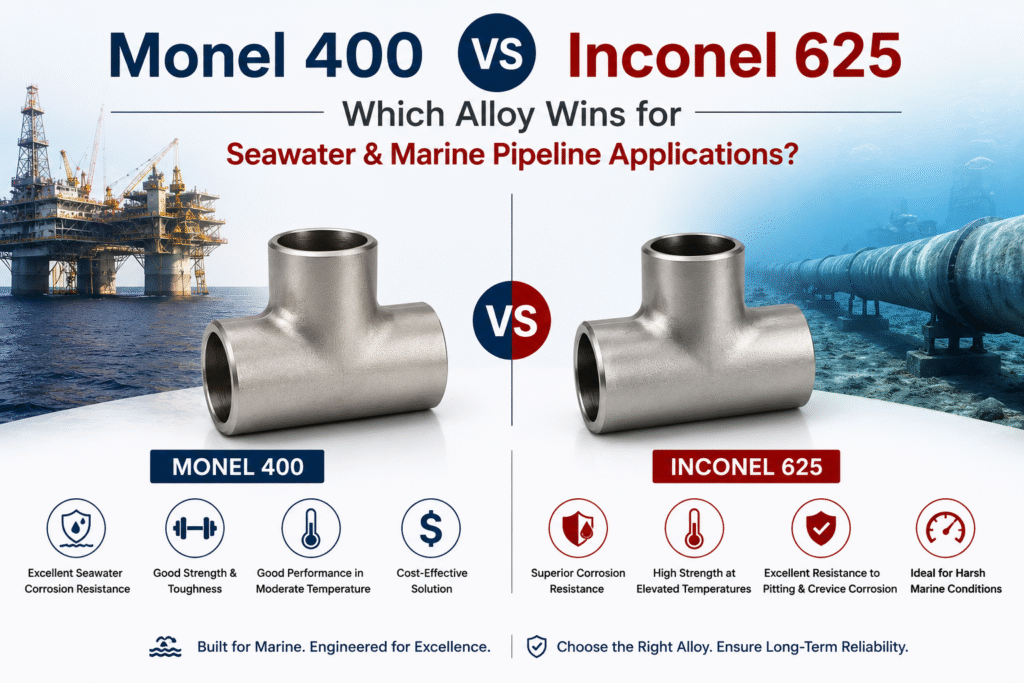
Offshore and marine businesses work in some of the most hostile conditions on the planet. Conventional piping materials can be rapidly damaged by exposure to seawater, salt corrosion, high pressure, and extreme temperatures. For this reason, maritime pipeline applications frequently employ high-performance nickel alloys like Monel 400 and Inconel 625.
Engineers frequently compare Monel 400 and Inconel 625 when choosing an alloy for offshore platforms, desalination plants, shipbuilding, or seawater pipelines in order to ascertain which material offers superior corrosion resistance, strength, durability, and cost-effectiveness.
Both alloys perform exceptionally well in corrosive marine environments, but each has unique advantages depending on the application. Understanding the differences between these nickel-based alloys helps EPC contractors, procurement engineers, and industrial buyers make the right material selection.
What is Monel 400?
Monel 400 is a nickel-copper alloy known for its excellent resistance to seawater corrosion and biofouling. It contains approximately 63% nickel and 28–34% copper, making it highly resistant to saltwater environments.
Key Properties of Monel 400
Excellent seawater corrosion resistance
High resistance to hydrofluoric acid
Good mechanical strength
Resistant to stress corrosion cracking
Excellent toughness in marine environments
Common Applications of Monel 400
Seawater piping systems
Marine valves and pumps
Shipbuilding components
Heat exchangers
Desalination plants
Monel 400 is particularly popular in applications involving continuously flowing seawater.
What is Inconel 625?
Inconel 625 is a nickel-chromium-molybdenum alloy designed for high-temperature and highly corrosive environments. It contains significant amounts of chromium and molybdenum, which provide superior oxidation and pitting resistance.
Key Properties of Inconel 625
Exceptional corrosion resistance
High tensile strength
Excellent resistance to pitting and crevice corrosion
Outstanding performance at elevated temperatures
Superior fatigue resistance
Common Applications of Inconel 625
Offshore oil & gas platforms
Subsea pipelines
Marine exhaust systems
Chemical processing plants
High-pressure offshore systems
Inconel 625 is often selected for demanding offshore and deep-sea environments where both corrosion and high pressure are major concerns.
Chemical Composition Comparison
Monel 400 Composition
Main Elements
Nickel: 63% minimum
Copper: 28–34%
Iron: Small percentage
Manganese: Trace amount
The high copper content improves seawater corrosion resistance.
Inconel 625 Composition
Main Elements
Nickel: 58% minimum
Chromium: 20–23%
Molybdenum: 8–10%
Niobium: 3–4%
The chromium and molybdenum combination provides outstanding resistance against chloride attack and oxidation.
Corrosion Resistance Comparison
Monel 400 in Seawater Applications
Monel 400 performs extremely well in flowing seawater and marine atmospheres. It has excellent resistance to:
Saltwater corrosion
Marine biofouling
Alkaline solutions
Hydrofluoric acid
However, Monel 400 may experience localized corrosion in stagnant seawater conditions.
Inconel 625 in Marine Environments
Inconel 625 offers superior resistance to:
Pitting corrosion
Crevice corrosion
Chloride attack
Oxidation
Sour gas environments
Its high molybdenum content makes it ideal for aggressive offshore applications and subsea systems.
Which Alloy Performs Better?
For highly aggressive offshore environments and chloride-rich conditions, Inconel 625 generally provides better overall corrosion resistance. However, for standard seawater handling systems, Monel 400 remains a highly reliable and cost-effective solution.
Strength & Mechanical Properties
Monel 400 Strength
Monel 400 offers:
Good tensile strength
Excellent toughness
High ductility
Reliable performance at moderate temperatures
It is ideal for marine systems where corrosion resistance is more important than extreme strength.
Inconel 625 Strength
Inconel 625 provides:
Very high tensile strength
Outstanding fatigue resistance
Superior creep resistance
Excellent high-pressure performance
This makes Inconel 625 better suited for deepwater offshore pipelines and high-pressure subsea operations.
Temperature Resistance Comparison
Monel 400 Temperature Performance
Monel 400 works efficiently in moderate temperature environments but is not ideal for extremely high-temperature applications.
Suitable For
Marine pipelines
Seawater systems
Desalination plants
Inconel 625 Temperature Performance
Inconel 625 maintains excellent strength and corrosion resistance at elevated temperatures.
Suitable For
Offshore exhaust systems
High-temperature process piping
Gas turbine components
Chemical processing systems
For applications involving both heat and corrosion, Inconel 625 is the stronger option.
Weldability & Fabrication
Monel 400 Fabrication
Monel 400 is relatively easy to fabricate and weld using standard industrial methods. It offers good machinability and forming characteristics.
Inconel 625 Fabrication
Inconel 625 is also weldable but requires more advanced fabrication expertise because of its higher strength and alloy composition.
Important Considerations
Specialized welding procedures may be required
Machining costs are higher
Fabrication time can increase
Cost Comparison
Monel 400 Cost Advantage
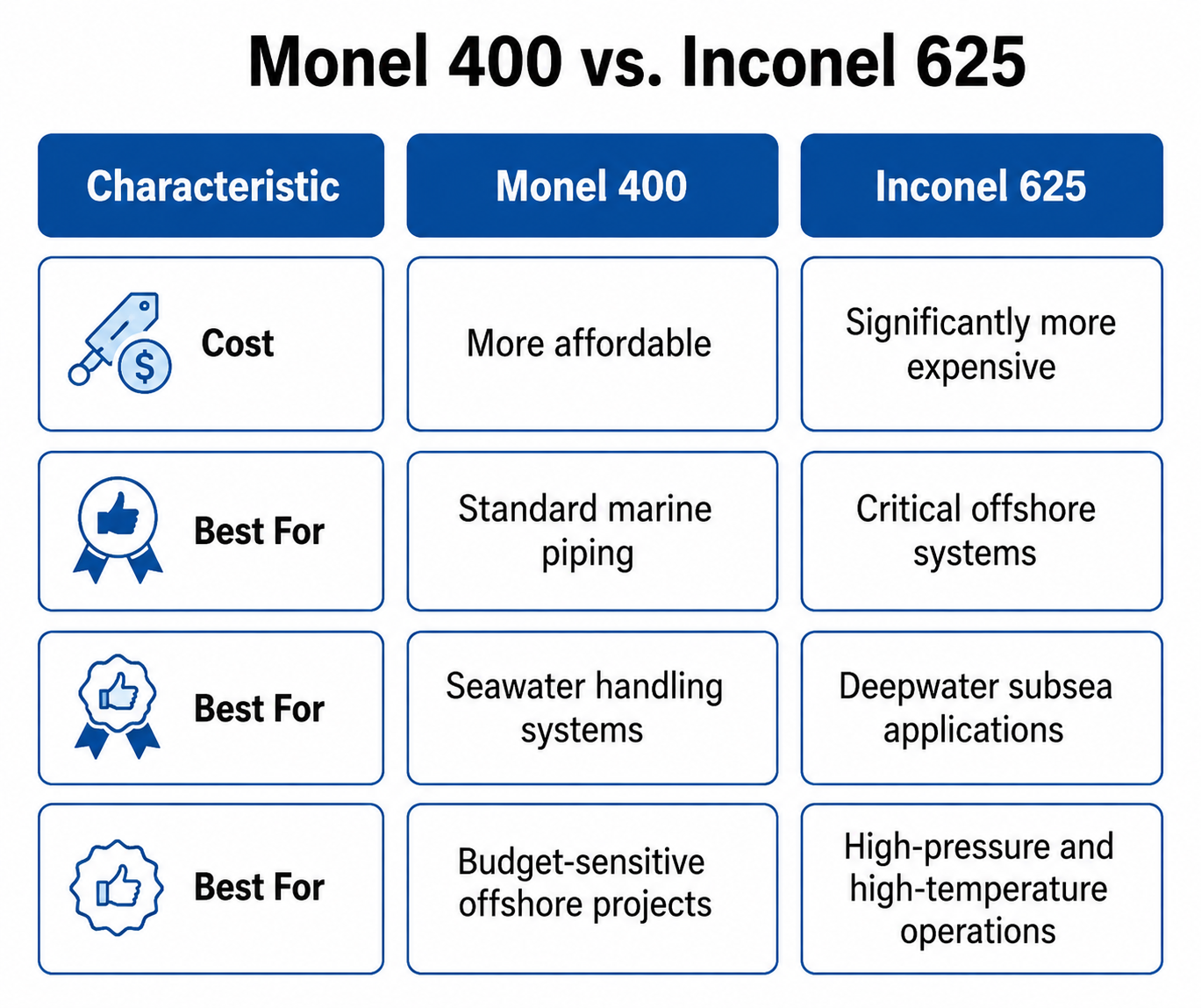
Monel 400 is generally more affordable than Inconel 625 because it contains fewer expensive alloying elements.
Best For
Standard marine piping
Seawater handling systems
Budget-sensitive offshore projects
Inconel 625 Cost
Inconel 625 is significantly more expensive due to its chromium, molybdenum, and niobium content.
Best For
Critical offshore systems
Deepwater subsea applications
High-pressure and high-temperature operations
Best Applications for Each Alloy
When to Choose Monel 400
Monel 400 is ideal for:
Seawater pipelines
Marine pumps
Desalination systems
Shipbuilding components
Saltwater heat exchangers
When to Choose Inconel 625
Inconel 625 is best for:
Subsea pipelines
Offshore oil & gas platforms
High-pressure marine systems
Sour gas applications
High-temperature offshore equipment
Monel 400 vs Inconel 625: Quick Comparison Table
Property | Monel 400 | Inconel 625 |
Main Alloy Type | Nickel-Copper | Nickel-Chromium-Molybdenum |
Corrosion Resistance | Excellent in seawater | Superior in aggressive offshore environments |
Strength | Moderate | Very High |
High Temperature Resistance | Moderate | Excellent |
Chloride Resistance | Good | Outstanding |
Fabrication | Easier | More complex |
Cost | Lower | Higher |
Best Use | Marine seawater systems | Offshore & subsea applications |
People Also Ask (PAA)
Which alloy is better for seawater pipelines?
Monel 400 is highly effective for standard seawater piping systems because of its excellent saltwater corrosion resistance and cost efficiency.
Is Inconel 625 better for offshore oil & gas projects?
Yes, Inconel 625 is preferred for offshore oil & gas applications because it provides superior strength, chloride resistance, and high-pressure performance.
Why is Inconel 625 more expensive than Monel 400?
Inconel 625 contains costly alloying elements such as chromium, molybdenum, and niobium, which improve its corrosion resistance and mechanical properties.
Can Monel 400 handle high temperatures?
Monel 400 performs well at moderate temperatures but is not as effective as Inconel 625 in extreme heat environments.
Related Reports
Inconel vs Hastelloy Fittings: Which High Nickel Alloy is Right for Your Project?
What Is Fusion Bonded Epoxy (FBE) Coating? Benefits for Oil & Gas Pipelines & Fittings
What Is Inconel Used For in Oil and Gas? Grades, Properties & Applications
Types of Stainless Steel Fittings: SS 310, 904L, 317L & When to Use Them
Conclusion
The working environment, pressure circumstances, temperature exposure, and project budget all play a major role in the decision between Monel 400 and Inconel 625.
For seawater pipelines, maritime equipment, and desalination systems where corrosion resistance and affordability are top concerns, Monel 400 is a great option. Conversely, Inconel 625 is the recommended material for demanding offshore and subsea applications that call for outstanding strength, resistance to chloride, and performance at high temperatures.
Choosing the proper nickel alloy for marine and offshore pipeline systems exposed to harsh seawater conditions can increase operational dependability, lower maintenance costs, and prolong service life.
How We Support You
Selecting the right nickel alloy for seawater and marine pipeline applications is critical for ensuring corrosion resistance, structural reliability, and long-term operational performance in offshore and coastal environments across GCC and African markets. Our team helps you choose between Monel 400 and Inconel 625 based on seawater exposure, pressure conditions, temperature requirements, and application performance.
We support you with:
Material selection guidance for Monel 400 and Inconel 625 applications
Recommendations for offshore, subsea, marine, and desalination environments
Support for resistance against seawater corrosion, chlorides, pitting, and stress corrosion cracking
Assistance with ASTM, ASME, ANSI, API, and NACE standard compliance
Guidance for marine pipelines, heat exchangers, valves, pumps, and offshore equipment
Technical documentation and material test certificate support
Recommendations for high-pressure, high-temperature, and corrosive marine service conditions
Custom sizes, fittings, flanges, pipes, and project-specific alloy solutions
Fast quotations and bulk supply support for GCC & African industries
Whether your project involves offshore platforms, subsea pipelines, shipbuilding, desalination plants, or coastal industrial infrastructure, we provide reliable nickel alloy solutions tailored to your operational, environmental, and corrosion-resistance requirements.