
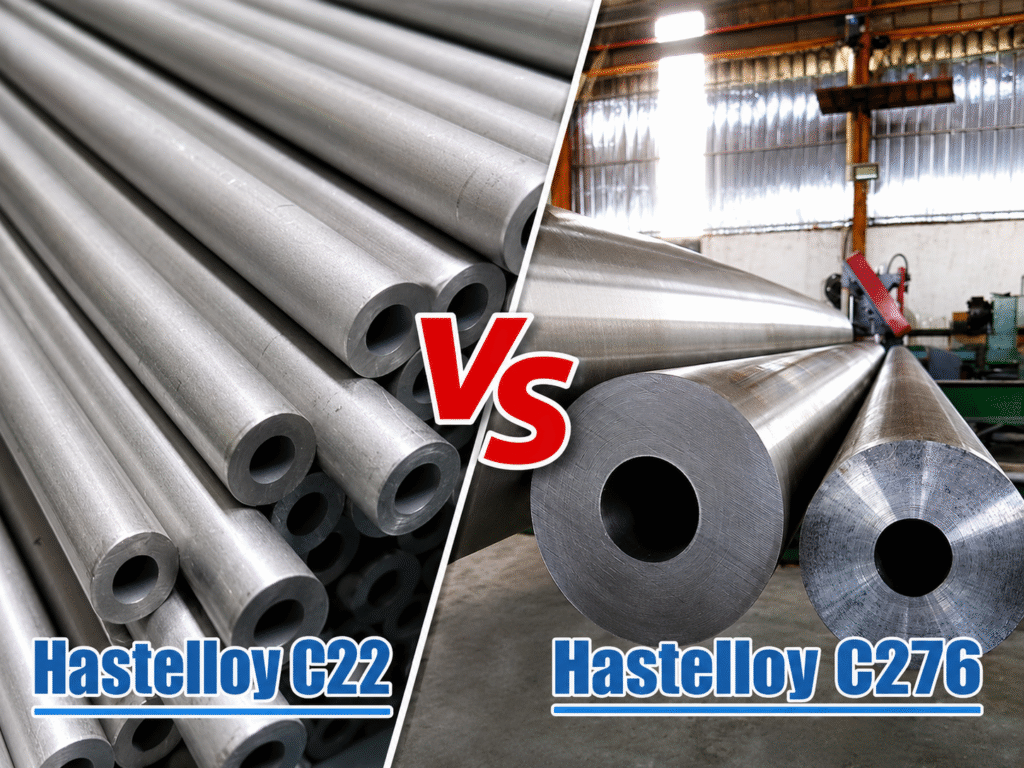
Material selection is one of the most important decisions in chemical processing and petrochemical industries because equipment and piping systems often operate in highly corrosive environments involving aggressive chemicals, acidic media, chloride exposure, oxidizing compounds, and high-temperature process conditions. Choosing the wrong alloy can result in corrosion failures, unplanned shutdowns, safety hazards, contamination risks, and expensive maintenance costs.
To handle these demanding conditions, industries frequently rely on high-performance nickel alloys such as Hastelloy C276 and Hastelloy C22. Both alloys are widely recognized for their exceptional corrosion resistance and are commonly used in chemical plants, petrochemical facilities, offshore systems, pharmaceutical manufacturing, and pollution control applications.
However, many buyers, EPC procurement teams, and plant engineers often struggle to understand the practical differences between Hastelloy C276 and Hastelloy C22. While both alloys belong to the nickel-chromium-molybdenum alloy family, they differ in corrosion behavior, oxidation resistance, fabrication characteristics, and application suitability.
Understanding these differences helps chemical and petrochemical plant buyers select the most reliable and cost-effective alloy for long-term industrial performance.
What Is Hastelloy C276?
Hastelloy C276 is a nickel-molybdenum-chromium alloy designed for outstanding resistance to severe corrosive environments.
The alloy contains:
Nickel
Molybdenum
Chromium
Iron
Tungsten
Hastelloy C276 is widely known for its ability to resist:
Strong acids
Chloride attack
Pitting corrosion
Crevice corrosion
Reducing chemicals
Oxidizing environments
Because of its versatility, C276 is one of the most widely used corrosion-resistant alloys globally.
Key Features of Hastelloy C276
Hastelloy C276 provides:
Excellent resistance to aggressive chemicals
Strong resistance to pitting and crevice corrosion
Good weldability
High durability in mixed chemical environments
Resistance to wet chlorine gas
Strong performance in acidic systems
It is widely used where severe corrosion resistance is required.
What Is Hastelloy C22?
Hastelloy C22 is also a nickel-chromium-molybdenum alloy but contains higher chromium content compared to C276.
The alloy includes:
Nickel
Chromium
Molybdenum
Iron
Tungsten
Hastelloy C22 was specifically developed to improve resistance in highly oxidizing corrosive environments.
It performs exceptionally well against:
Oxidizing acids
Chloride-containing chemicals
Mixed industrial chemicals
Process contamination risks
C22 is often selected for advanced chemical processing applications requiring superior versatility.
Key Features of Hastelloy C22
Hastelloy C22 offers:
Exceptional oxidation resistance
Superior pitting resistance
Excellent crevice corrosion protection
Strong weldability
Resistance to process contamination
High reliability in aggressive chemical environments
Its corrosion performance is considered among the best in modern nickel alloys.
Chemical Composition Differences
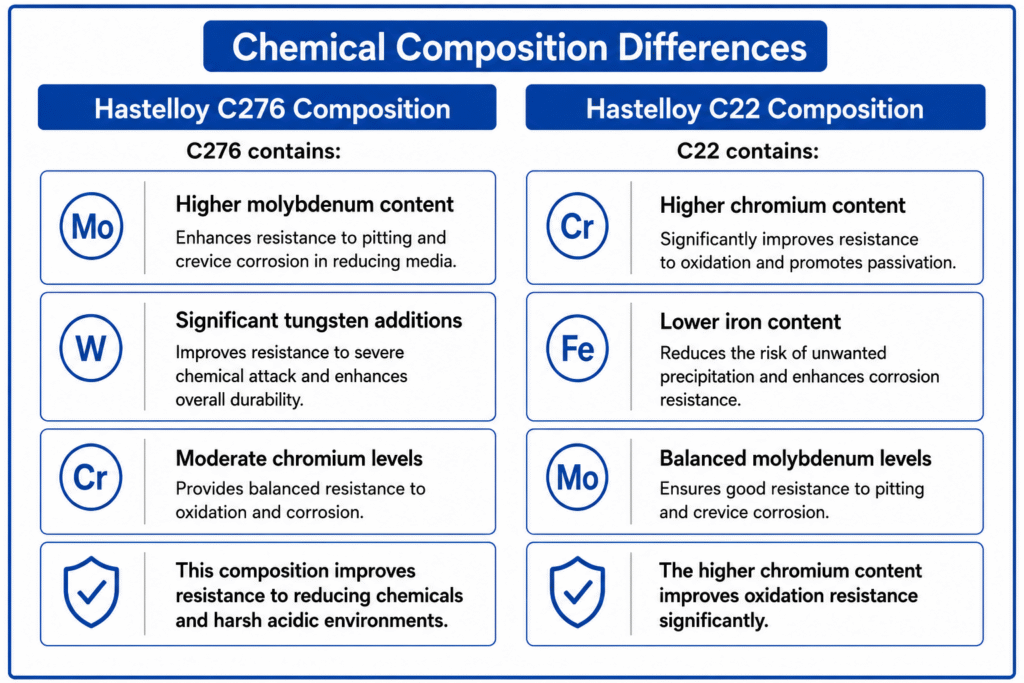
Hastelloy C276 Composition
C276 contains:
Higher molybdenum content
Significant tungsten additions
Moderate chromium levels
This composition improves resistance to reducing chemicals and harsh acidic environments.
Hastelloy C22 Composition
C22 contains:
Higher chromium content
Lower iron content
Balanced molybdenum levels
The higher chromium content improves oxidation resistance significantly.
Corrosion Resistance Comparison
Hastelloy C276: Strong in Reducing Environments
Hastelloy C276 performs exceptionally well in:
Hydrochloric acid
Sulfuric acid
Wet chlorine gas
Acidic chemical systems
Reducing process environments
It is widely trusted in chemical plants handling aggressive acids.
Hastelloy C22: Superior in Oxidizing Environments
Hastelloy C22 offers enhanced resistance against:
Oxidizing acids
Ferric chloride
Chlorine-contaminated systems
Mixed chemical processing environments
C22 generally performs better in environments where oxidizing chemicals are present.
Pitting and Crevice Corrosion Resistance
Hastelloy C22 Offers Better Resistance
Although both alloys provide excellent corrosion protection, Hastelloy C22 generally provides:
Better pitting resistance
Improved crevice corrosion protection
Enhanced localized corrosion resistance
This is especially important in chloride-rich process systems.
Oxidation Resistance Comparison
Hastelloy C22 Has Better Oxidation Resistance
Due to its higher chromium content, C22 performs better in:
Oxidizing process environments
High-temperature oxidizing systems
Mixed industrial chemical exposure
This makes C22 highly suitable for complex chemical processing plants.
Hastelloy C276 Performs Better in Certain Reducing Conditions
C276 remains highly effective where:
Strong reducing acids exist
Wet corrosive gases are present
Acidic chloride systems dominate
Weldability and Fabrication
Both alloys provide excellent weldability compared to many high-performance metals.
Hastelloy C276
Advantages include:
Reliable fabrication
Good weld integrity
Strong corrosion resistance after welding
Hastelloy C22
Advantages include:
Excellent weldability
Reduced risk of heat-affected zone corrosion
Better resistance to weld-related degradation
Both materials are suitable for complex fabrication projects.
Mechanical Properties Comparison
Both alloys offer:
High tensile strength
Good thermal stability
Excellent durability
Long operational lifespan
However, mechanical differences between C276 and C22 are generally less significant than corrosion-performance differences.
Temperature Performance
Hastelloy C276
Performs effectively in:
High-temperature chemical processing
Acidic process systems
Industrial heat applications
Hastelloy C22
Also performs well under elevated temperatures, particularly where oxidizing conditions exist.
Both alloys are suitable for high-temperature industrial operations.
Common Applications of Hastelloy C276
Hastelloy C276 is commonly used in:
Chemical processing plants
Flue gas desulfurization systems
Acid production plants
Waste treatment facilities
Pharmaceutical manufacturing
Petrochemical processing systems
It is especially valuable in highly acidic environments.
Common Applications of Hastelloy C22
Hastelloy C22 is widely used in:
Advanced chemical reactors
Pharmaceutical equipment
Chlorination systems
Pollution control systems
Specialty chemical plants
Mixed-acid processing facilities
It is preferred for highly complex corrosive environments.
Cost Comparison
Hastelloy C276
Often slightly more economical in certain industrial applications because of broader commercial availability.
Hastelloy C22
Can be more expensive due to:
Enhanced corrosion resistance
Higher chromium content
Specialized chemical applications
Pricing depends on:
Alloy availability
Pipe size and thickness
Project specifications
Market nickel prices
Which Alloy Should Plant Buyers Choose?
Choose Hastelloy C276 If:
Reducing acids dominate the process environment
Hydrochloric acid exposure exists
Severe acidic corrosion is expected
Budget optimization is important
Choose Hastelloy C22 If:
Oxidizing chemicals are present
Mixed corrosive environments exist
Higher pitting resistance is required
Process contamination risks must be minimized
The correct choice depends entirely on the operating environment and chemical exposure conditions.
Importance for Chemical & Petrochemical Buyers
Chemical plants often operate continuously under highly corrosive conditions.
Improper alloy selection can lead to:
Equipment failure
Production shutdowns
Corrosion damage
Product contamination
Increased maintenance costs
Safety risks
This is why corrosion-resistant alloy selection is critical for long-term plant reliability.
Industries Using Hastelloy C276 and C22
These alloys are widely used in:
Chemical industries
Petrochemical plants
Pharmaceutical manufacturing
Oil & gas processing
Pollution control systems
Marine applications
Power generation facilities
Both alloys remain essential for modern industrial infrastructure.
Future Demand for High-Performance Nickel Alloys
Global industrial growth continues increasing demand for:
Corrosion-resistant process systems
Hydrogen processing infrastructure
LNG projects
Advanced chemical manufacturing
High-purity industrial operations
Nickel alloys such as Hastelloy C276 and C22 will remain critical for future industrial development.
Related Reports
Inconel vs Hastelloy Fittings: Which High Nickel Alloy is Right for Your Project?
What Is Fusion Bonded Epoxy (FBE) Coating? Benefits for Oil & Gas Pipelines & Fittings
What Is Inconel Used For in Oil and Gas? Grades, Properties & Applications
Types of Stainless Steel Fittings: SS 310, 904L, 317L & When to Use Them
Conclusion
Both Hastelloy C276 and Hastelloy C22 are exceptional nickel-based alloys designed for highly corrosive industrial environments. Hastelloy C276 is widely recognized for its strong performance in reducing acids and aggressive chemical systems, while Hastelloy C22 offers superior oxidation resistance, enhanced pitting protection, and outstanding versatility in mixed chemical environments. For chemical and petrochemical plant buyers, selecting the right alloy requires careful evaluation of chemical exposure, temperature conditions, corrosion risks, fabrication requirements, and long-term operational reliability. Proper alloy selection helps improve plant safety, reduce maintenance costs, and extend equipment lifespan in demanding industrial operations.
How We Support You
Selecting the right nickel alloy material is critical for ensuring corrosion resistance, process reliability, and long-term performance in chemical processing and petrochemical plants across GCC and African markets. Our team helps you choose between Hastelloy C276 and Hastelloy C22 based on your operating environment, chemical exposure, temperature conditions, and project requirements.
We support you with:
Material selection guidance for Hastelloy C276 and Hastelloy C22 applications
Recommendations for highly corrosive chemical and petrochemical environments
Support for resistance against chlorides, oxidizing acids, reducing chemicals, and aggressive media
Assistance with ASTM, ASME, ANSI, DIN, and NACE standard compliance
Guidance for reactors, heat exchangers, pressure vessels, piping systems, and scrubbers
Technical documentation and material test certificate support
Recommendations for welded, fabricated, and high-temperature service applications
Custom sizes, schedules, fittings, flanges, and project-specific alloy solutions
Fast quotations and bulk supply support for GCC & African industries
Whether your project involves chemical processing plants, fertilizer facilities, petrochemical units, offshore systems, or acid handling applications, we provide reliable nickel alloy solutions tailored to your operational and corrosion-resistance requirements.