
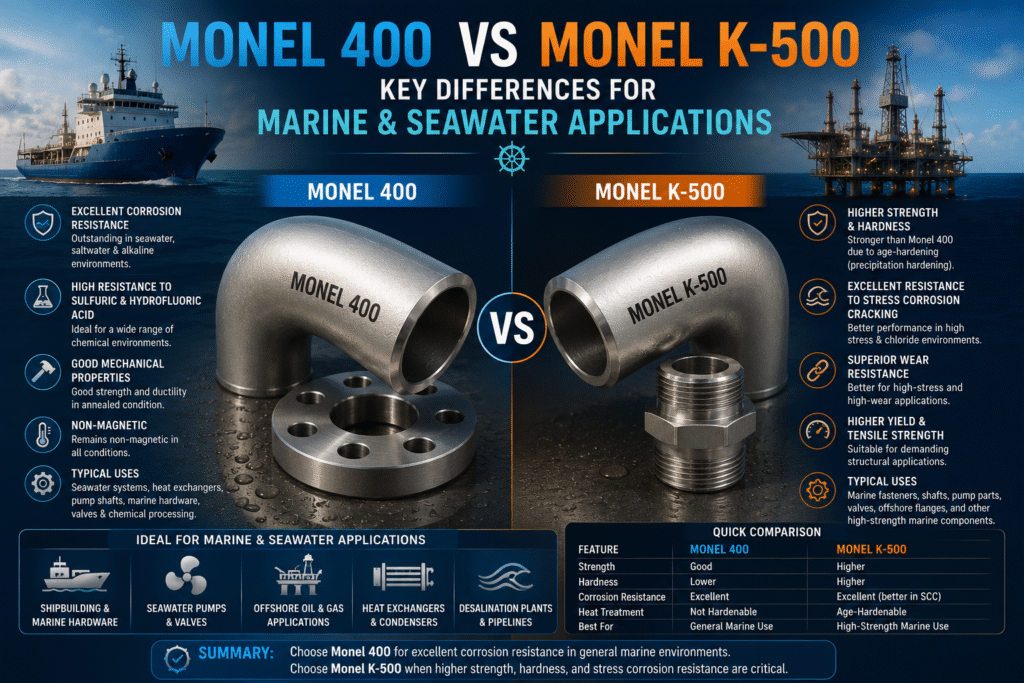
Piping systems and industrial equipment face some of the most difficult operating conditions in marine and ocean environments. Conventional metals can be quickly degraded by prolonged exposure to saltwater, high humidity, biofouling, and chloride-rich conditions. This can result in corrosion, expensive maintenance, and early equipment failure.
High-performance nickel-copper alloys are used by sectors such offshore oil and gas, shipbuilding, desalination, marine engineering, and power production to overcome these obstacles. Monel 400 and Monel K-500 are two of the most popular materials.
Although both alloys provide remarkable resistance to seawater corrosion, there are notable differences in their mechanical features and performance traits. Choosing the appropriate material for marine and seawater applications requires an understanding of these distinctions.
What Are Monel Alloys?
Monel alloys are nickel-copper materials known for their outstanding resistance to corrosion in marine environments. Their high nickel content provides excellent protection against chloride-induced corrosion, while copper enhances resistance to seawater and acidic environments.
Monel alloys are widely used in:
Offshore platforms
Seawater piping systems
Marine hardware
Desalination plants
Heat exchangers
Pumps and valves
Among the various Monel grades available, Monel 400 and Monel K-500 are the most commonly specified for critical applications.
What Is Monel 400?
Monel 400 is a solid-solution nickel-copper alloy known for its excellent corrosion resistance and good mechanical properties across a broad temperature range.
Its typical chemical composition includes:
Nickel: 63% minimum
Copper: 28–34%
Iron: 2.5% maximum
Manganese: 2% maximum
Monel 400 offers excellent resistance to:
Seawater corrosion
Hydrofluoric acid
Alkaline solutions
Sulfuric acid under specific conditions
Chloride stress corrosion cracking
Because it is not precipitation-hardened, Monel 400 provides moderate strength but excellent ductility and weldability.
What Is Monel K-500?
Monel K-500 is a precipitation-hardened nickel-copper alloy developed by adding aluminum and titanium to the composition of Monel 400.
Its typical chemical composition includes:
Nickel: 63% minimum
Copper: 27–33%
Aluminum: 2.3–3.15%
Titanium: 0.35–0.85%
The addition of aluminum and titanium enables age-hardening, significantly increasing strength and hardness while maintaining the excellent corrosion resistance associated with Monel 400.
Monel K-500 offers:
Higher tensile and yield strength
Improved wear resistance
Enhanced fatigue resistance
Superior galling resistance
These properties make it suitable for high-load marine applications.
Monel 400 vs Monel K-500: Key Differences
Mechanical Strength
The most significant difference between Monel 400 and Monel K-500 is their mechanical strength.
Monel K-500 delivers substantially higher:
Tensile strength
Yield strength
Hardness
Fatigue resistance
This improved strength results from the precipitation-hardening process.
Monel 400, while offering good mechanical properties, is better suited for moderate-load applications.
Winner: Monel K-500
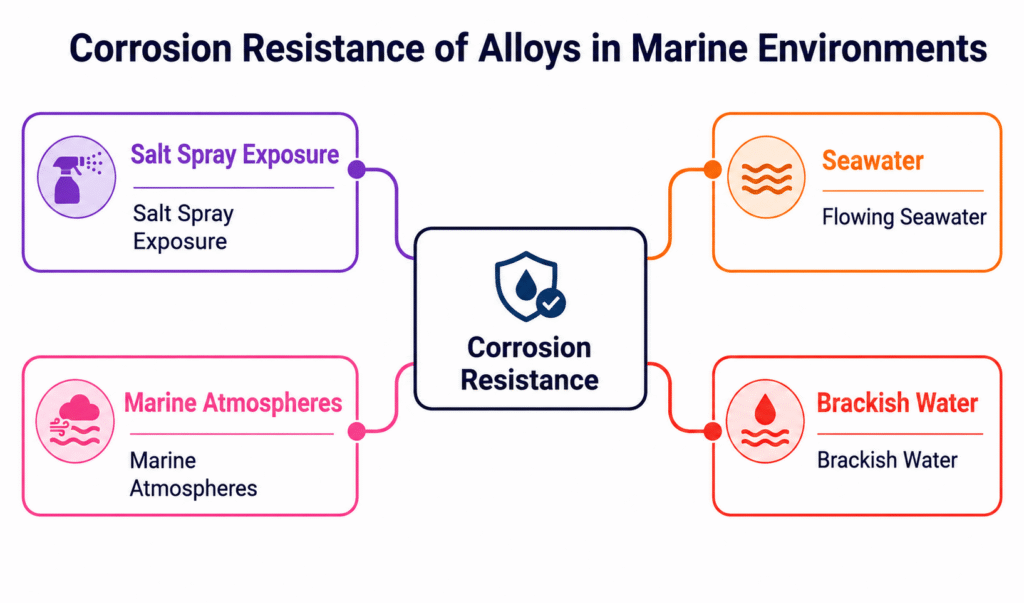
Corrosion Resistance
Both alloys provide exceptional resistance to seawater and marine environments.
They perform well in:
Flowing seawater
Brackish water
Marine atmospheres
Salt spray exposure
However, Monel K-500 can be more susceptible to stress corrosion cracking in certain stagnant or high-temperature environments.
Monel 400 generally offers slightly better resistance in some highly corrosive conditions due to its simpler composition.
Winner: Monel 400 (slight advantage)
Resistance to Biofouling
Algae, barnacles, and microbes are examples of marine creatures that can build up on submerged equipment, decreasing performance and raising maintenance costs.
Both alloys are appropriate for long-term seawater service because to their exceptional resistance to marine biofouling.
Result: Comparable performance
Wear and Galling Resistance
Components operating under high loads or frequent movement require excellent wear resistance.
Monel K-500 offers superior:
Abrasion resistance
Galling resistance
Wear performance
This makes it ideal for moving parts and mechanical components.
Winner: Monel K-500
Fabrication and Weldability
Monel 400 is easier to fabricate and weld because it does not require age-hardening heat treatment.
Monel K-500 requires more controlled fabrication procedures to maintain its mechanical properties.
Winner: Monel 400
Cost Considerations
Monel K-500 is generally more expensive due to its additional alloying elements and heat treatment requirements.
Monel 400 offers a more economical solution when higher strength is not necessary.
Winner: Monel 400
Monel 400 vs Monel K-500: Comparison Table
Property | Monel 400 | Monel K-500 |
Alloy Type | Nickel-Copper | Precipitation-Hardened Nickel-Copper |
Primary Alloying Elements | Nickel, Copper | Nickel, Copper, Aluminum, Titanium |
Corrosion Resistance | Excellent | Excellent |
Seawater Resistance | Outstanding | Outstanding |
Mechanical Strength | Moderate | High |
Fatigue Resistance | Good | Excellent |
Wear Resistance | Good | Excellent |
Galling Resistance | Good | Excellent |
Weldability | Excellent | Good |
Heat Treatment Required | No | Yes |
Relative Cost | Lower | Higher |
Applications of Monel 400 in Marine and Seawater Systems
Monel 400 is commonly used in:
Seawater piping systems
Heat exchangers
Desalination plants
Marine valves
Pump components
Condenser tubes
Chemical processing equipment
Its corrosion resistance and ease of fabrication make it ideal for general marine service.
Applications of Monel K-500 in Marine and Seawater Systems
Monel K-500 is preferred for applications requiring both corrosion resistance and high strength.
Common applications include:
Pump shafts
Propeller shafts
Fasteners
Valve stems
Marine springs
Subsea components
Offshore drilling equipment
Its superior mechanical properties make it particularly suitable for high-stress applications.
Which Alloy Is Best for Marine and Seawater Applications?
The choice between Monel 400 and Monel K-500 depends primarily on the mechanical demands of the application.
Choose Monel 400 when:
Corrosion resistance is the primary requirement
Components operate under moderate loads
Ease of fabrication is important
Budget considerations are a priority
Choose Monel K-500 when:
High strength is required
Components experience cyclic loading
Wear resistance is critical
Moving parts are exposed to seawater
For static seawater systems such as pipelines, heat exchangers, and process equipment, Monel 400 often provides the best balance of performance and cost.
For high-load applications involving shafts, fasteners, and subsea equipment, Monel K-500 is generally the preferred choice.
Related Reports
Inconel vs Hastelloy Fittings: Which High Nickel Alloy is Right for Your Project?
What Is Fusion Bonded Epoxy (FBE) Coating? Benefits for Oil & Gas Pipelines & Fittings
What Is Inconel Used For in Oil and Gas? Grades, Properties & Applications
Types of Stainless Steel Fittings: SS 310, 904L, 317L & When to Use Them
Conclusion
Monel 400 and Monel K-500 are both excellent materials for offshore and coastal applications because of their remarkable resistance to marine corrosion and seawater conditions.
While Monel K-500 offers noticeably better strength, fatigue resistance, and wear performance, Monel 400 is notable for its superior corrosion resistance, ease of production, and affordability.
Operating circumstances, mechanical loads, fabrication requirements, and lifespan costs must all be carefully considered when choosing an alloy. Engineers can guarantee dependable performance and long service life in demanding marine conditions by matching material qualities to application demands.
How We Support You
Selecting the right Monel alloy is essential for ensuring long-term reliability, superior seawater corrosion resistance, and optimal performance in demanding marine environments.
Our team helps you determine whether Monel 400 or Monel K-500 is the best choice based on mechanical strength requirements, operating conditions, seawater exposure, and project specifications.
Our Support Includes:
Expert guidance on selecting between Monel 400 and Monel K-500 for marine and seawater applications
Recommendations based on operating pressure, temperature, flow conditions, and mechanical load requirements
Technical support for applications involving seawater, brackish water, salt spray, and chloride-rich environments
Assistance with evaluating resistance to seawater corrosion, pitting, crevice corrosion, erosion-corrosion, and stress corrosion cracking
Guidance on material selection for seawater piping systems, desalination plants, offshore platforms, marine heat exchangers, and shipbuilding applications
Support in choosing the right components, including pipes, fittings, flanges, valves, fasteners, and pump components
Assistance with compliance to ASTM, ASME, ANSI, API, NACE, and project-specific standards
Support with material test certificates (MTCs), quality documentation, traceability requirements, and third-party inspections
Custom solutions for sizes, pressure ratings, wall thicknesses, and project-specific fabrication requirements
Fast quotations and dependable bulk supply support for projects across the marine, offshore, desalination, oil & gas, and industrial sectors
Whether your project involves offshore production facilities, seawater intake systems, marine pipelines, desalination plants, shipbuilding projects, or coastal infrastructure, we provide reliable Monel alloy solutions tailored to your environmental conditions, corrosion challenges, and long-term performance requirements.