
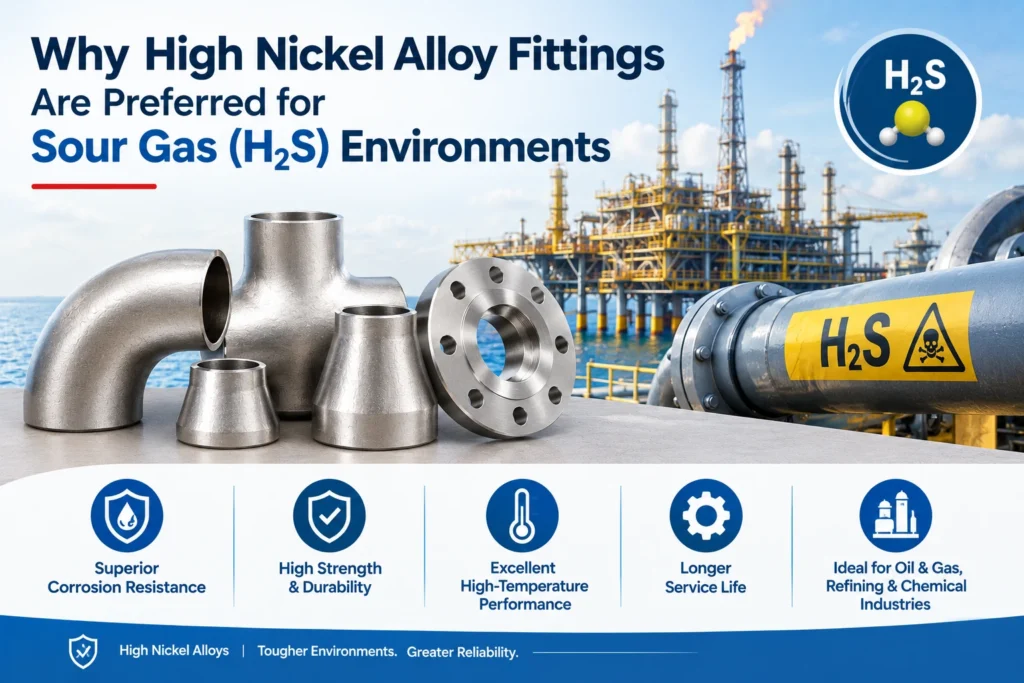
Some of the most difficult circumstances for piping components are found in sour gas systems. Hydrogen sulfide (H2S)-containing gas can contribute to cracking mechanisms in vulnerable materials and provide serious corrosion hazards.
Because of this, material selection is crucial in refineries, upstream oil and gas extraction, gas processing, and other sour-service applications. When traditional carbon steels or stainless steels are unable to offer the necessary mix of corrosion resistance and cracking resistance, high nickel alloys, such as specific grades of Inconel, Hastelloy, and other nickel-based alloys, are frequently taken into consideration.
However, a fitting is not always appropriate for sour service just because it has a high nickel concentration. It is necessary to assess the entire alloy, heat treatment, hardness, production process, environment, and relevant sour-service requirements.
What Makes H₂S Environments Dangerous?
Hydrogen sulfide is a toxic and corrosive gas that can occur in natural gas and crude oil production.
When H₂S is present with water, it can contribute to several forms of corrosion and material degradation, including:
General corrosion
Pitting
Sulfide stress cracking (SSC)
Hydrogen-induced cracking (HIC)
Stress corrosion-related damage
Corrosion fatigue in certain conditions
The severity depends on factors such as H₂S partial pressure, temperature, pH, chloride concentration, water availability, material condition and mechanical stress.
This makes material selection much more important than simply choosing a corrosion-resistant alloy based on its nominal composition.
Why Nickel Alloys Are Considered
Excellent corrosion resistance is provided by high nickel alloys in a variety of harsh situations.
In situations where ordinary steels could corrode more quickly, nickel helps keep the alloy’s protective surface stable.
Depending on the grade, nickel alloys may also contain significant amounts of:
Chromium
Molybdenum
Iron
Tungsten
Copper
Niobium
These alloying elements provide different combinations of corrosion resistance, strength and resistance to localized attack.
Resistance to Sour-Service Corrosion
One of the main reasons nickel alloys are selected for demanding sour-service applications is their resistance to corrosion in aggressive environments.
For example, selected nickel-chromium-molybdenum alloys can provide strong resistance to:
Pitting
Crevice corrosion
Acidic environments
Chloride-containing environments
Wet H₂S conditions
High-temperature corrosive fluids
This can help extend component service life when the alloy is properly selected for the actual operating environment.
Protection Against Sulfide Stress Cracking
Sulfide stress cracking is a major concern in sour-service piping.
SSC occurs when susceptible metallic materials are exposed to an environment containing hydrogen sulfide while subjected to tensile stress.
Material susceptibility depends on several factors, including:
Material composition
Hardness
Microstructure
Heat treatment
Applied stress
H₂S conditions
Temperature
pH
Nickel-based alloys can offer improved resistance to certain sour-service cracking mechanisms compared with many conventional steels, but not every nickel alloy is automatically resistant to SSC.
The selected material must be qualified according to the applicable project requirements.
Common High Nickel Alloys Used in Demanding Applications
Inconel 625
Inconel 625 is a nickel-chromium-molybdenum alloy known for strong resistance to corrosion and pitting.
Its combination of nickel, chromium and molybdenum makes it useful in:
Oil and gas
Offshore systems
Chemical processing
Seawater applications
Sour-service components
Fittings made from suitable Inconel 625 material can be considered where corrosion resistance is a major design requirement.
Inconel 825
Inconel 825 contains nickel, chromium, molybdenum and copper and is designed for resistance to a range of corrosive environments.
It can be considered for:
Acidic process systems
Chemical processing
Oil and gas equipment
Corrosive piping systems
The suitability for a specific sour-service application must still be verified against the relevant requirements.
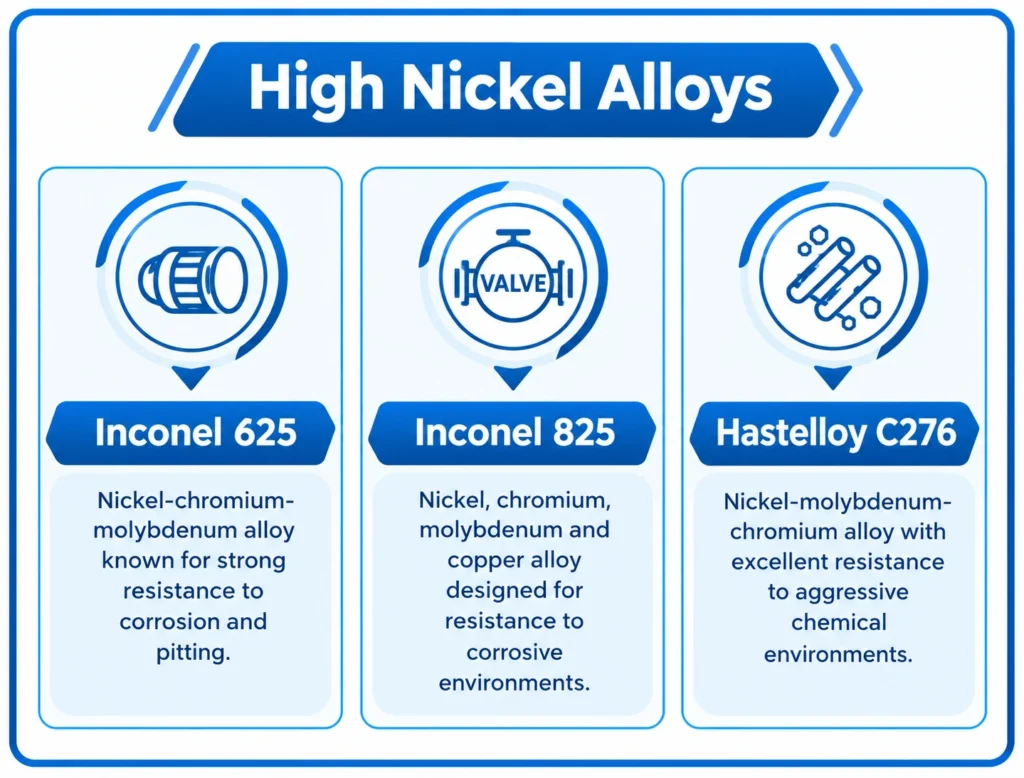
Hastelloy C276
Hastelloy C276 is a nickel-molybdenum-chromium alloy with excellent resistance to a broad range of aggressive chemical environments.
It is commonly associated with demanding chemical-processing applications where resistance to localized corrosion is important.
High Nickel Alloys vs Conventional Materials
Material | Corrosion Resistance | Sour-Service Considerations | Typical Application |
Carbon Steel | Moderate to low in aggressive environments | Requires careful qualification and protection | General oil & gas |
316L Stainless Steel | Good in many environments | May have limitations depending on H₂S/chlorides | Process piping |
Duplex 2205 | High | Can be suitable for selected sour conditions | Oil & gas/offshore |
Super Duplex | Very high | Requires project-specific qualification | Offshore/subsea |
Inconel 625 | Very high | Used for demanding corrosive environments | Sour/offshore/chemical |
Hastelloy C276 | Extremely high in many aggressive environments | Selected for severe corrosion conditions | Chemical/sour environments |
This is a general comparison. Actual suitability depends on the specific fluid composition, temperature, pressure, H₂S conditions and applicable material requirements.
Why Fittings Require Special Attention
Elbows, tees, reducers and other fittings can experience significant stresses and changes in flow direction.
In sour-service systems, fittings must therefore be evaluated for:
Material chemistry
Heat treatment
Hardness
Microstructure
Wall thickness
Welding
Forming process
Residual stress
NDT
Dimensional accuracy
Poor manufacturing control can compromise the performance of even a high-quality alloy.
Standards for Sour-Service Material Selection
Industry guidelines and specifications pertaining to material selection and crack resistance are frequently mentioned in sour-service projects.
NACE MR0175/ISO 15156, which covers products for use in H2S-containing environments in oil and gas production, is a crucial source.
The standard says more than just “high nickel alloys are suitable.” Rather, alloy grade, metallurgical state, and environmental constraints determine material applicability.
Project specifications may also impose additional requirements for:
Hardness
Heat treatment
Testing
Corrosion resistance
Welding procedures
Product form
Environmental limits
Therefore, the latest applicable edition and project-specific requirements should always be checked.
Manufacturing Quality Is Critical
High nickel alloy fittings are considerably more demanding to manufacture than many conventional steel fittings.
Important manufacturing controls can include:
Controlled Heat Treatment
Correct solution treatment or other specified heat treatment may be necessary to achieve the required microstructure and corrosion properties.
PMI Testing
Positive Material Identification helps confirm that the correct alloy has been supplied.
Hardness Testing
Hardness may be particularly important in sour-service applications where cracking resistance is a concern.
Non-Destructive Testing
Depending on the specification, NDT may include:
Ultrasonic testing
Radiographic testing
Dye penetrant testing
Magnetic particle testing where applicable
Traceability
Each fitting should be traceable to its material heat and relevant manufacturing and inspection records.
When Should You Specify High Nickel Alloy Fittings?
High nickel alloy fittings may be considered when the piping system involves:
Wet H₂S
High H₂S concentration
High chloride levels
Acidic process fluids
High temperature
Severe pitting or crevice-corrosion risk
Offshore or subsea service
Long required service life
High consequences of corrosion-related failure
They are generally more expensive than carbon steel and many stainless-steel alternatives. Therefore, they should be selected based on engineering requirements rather than simply specifying the most corrosion-resistant material available.
Related Reports
Inconel vs Hastelloy Fittings: Which High Nickel Alloy is Right for Your Project?
What Is Fusion Bonded Epoxy (FBE) Coating? Benefits for Oil & Gas Pipelines & Fittings
What Is Inconel Used For in Oil and Gas? Grades, Properties & Applications
Types of Stainless Steel Fittings: SS 310, 904L, 317L & When to Use Them
Conclusion
Because particular nickel-based alloys can offer exceptional resistance to corrosion, pitting, localized attack, and specific cracking mechanisms, high nickel alloy fittings are utilized in harsh sour-gas conditions.
For extreme oil and gas and chemical-service environments, materials like Inconel 625, Inconel 825, and Hastelloy C276 may be taken into consideration. However, the entire operating environment must be taken into consideration when choosing an alloy, not only the nickel concentration.
Buyers should confirm material grade, heat treatment, hardness, H2S conditions, temperature, chloride exposure, NACE/ISO requirements, NDT, PMI, and full material traceability for sour-service pipe.
For dependable long-term performance in H2S-containing settings, the proper mix of alloy selection and production quality is crucial.
How We Support You
Selecting the right pipe fitting material is critical for sour gas applications where hydrogen sulfide (H₂S), pressure, temperature, and corrosive conditions can affect piping performance. We help you select suitable high nickel alloy fittings based on H₂S exposure, operating conditions, material compatibility, and applicable sour-service requirements.
Our Support Includes:
Guidance on selecting high nickel alloy fittings for sour gas and H₂S-containing environments
Material selection support for Inconel, Hastelloy, Monel, Nickel alloys, and other corrosion-resistant alloys
Recommendations based on H₂S concentration, temperature, pressure, chloride exposure, and process conditions
Technical support for applications requiring resistance to sulfide stress cracking, pitting, crevice corrosion, and general corrosion
Assistance with elbows, tees, reducers, caps, crosses, bends, stub ends, and other high-performance pipe fittings
Support for oil & gas, refineries, petrochemical plants, gas processing facilities, offshore platforms, and chemical processing systems
Guidance on applicable NACE, ISO, ASTM, ASME, API, and project-specific sour-service requirements
Assistance with Material Test Certificates (MTCs), PMI, heat treatment records, mechanical testing, dimensional inspection, and material traceability
Support for custom sizes, wall thicknesses, pressure classes, fitting configurations, and special alloy requirements
Reliable assistance with bulk supply, project documentation, third-party inspection, export packaging, and delivery requirements
Whether your project involves sour gas pipelines, gas processing plants, offshore production facilities, refineries, petrochemical units, or H₂S-containing process systems, we provide high nickel alloy fitting solutions selected according to corrosion conditions, operating parameters, sour-service requirements, and project specifications.