
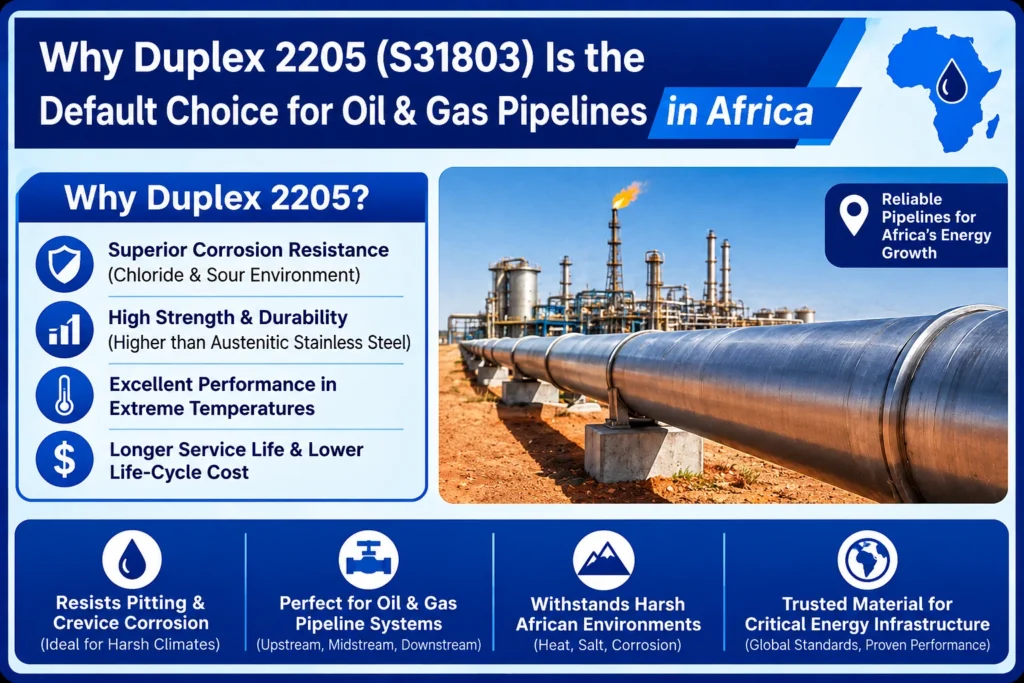
Some of the most challenging pipeline conditions in the world are found in Africa’s oil and gas sector. Chlorides, seawater, hydrogen sulfide, carbon dioxide, generated water, high pressure, and temperature fluctuations can all be present in production and transportation systems. Therefore, selecting the appropriate piping material is crucial for preserving pipeline integrity and reducing lifecycle expenses.
Duplex 2205 (UNS S31803) is a popular stainless steel grade for oil and gas applications due to its exceptional corrosion resistance and strong mechanical strength. It is a desirable substitute for traditional austenitic stainless steels and, where circumstances allow, more heavily alloyed super duplex grades due to its performance, affordability, and availability.
What Is Duplex 2205 (UNS S31803)?
Nitrogen is a crucial alloying ingredient in Duplex 2205, a ferritic-austenitic stainless steel with roughly 22% chromium, 5% nickel, and 3% molybdenum. Both ferritic and austenitic stainless steel properties are combined in its duplex microstructure.
The typical alloying system provides:
High mechanical strength
Good toughness
Excellent resistance to chloride stress corrosion cracking
Good resistance to pitting and crevice corrosion
Good resistance to general corrosion
Good resistance to erosion-corrosion
Good weldability when properly processed
The approximate chromium and nickel content is referred to as 2205, and the grade’s original UNS classification is S31803.
Compared to the original S31803 specification, modern 2205 goods are also frequently offered under UNS S32205, which has stricter chemical criteria. The 2205 family is commonly linked to both designations.
Why Africa’s Oil & Gas Pipelines Need Corrosion-Resistant Materials
Oil and gas pipelines in Africa can operate across diverse environments, from offshore West African fields to onshore production facilities and desert-based processing plants.
Common corrosion challenges include:
Chloride exposure
Seawater
Produced water
Hydrogen sulfide
Carbon dioxide
Wet gas
High humidity
Erosion
Temperature fluctuations
Conventional carbon steel can require extensive corrosion-control measures in these environments. Duplex 2205 provides significantly greater inherent corrosion resistance while maintaining high strength.
Excellent Chloride Corrosion Resistance
Chloride-containing environments are particularly challenging for stainless steel.
Chlorides can cause localized forms of corrosion such as:
Pitting corrosion
Crevice corrosion
Stress corrosion cracking
Because Duplex 2205 contains nitrogen, molybdenum, and chromium, it is very resistant to these mechanisms.
One of its main advantages over traditional austenitic stainless steels like 304L and 316L is its resistance to chloride stress corrosion cracking.
Because of this, 2205 is especially helpful for pipelines carrying fluids that contain a lot of water and chlorides.
High Resistance to Stress Corrosion Cracking
In oil and gas pipes, stress corrosion cracking can pose a significant risk, especially when tensile tension, high temperatures, and fluids containing chloride are present at the same time.
Compared to traditional austenitic grades, Duplex 2205 has significantly superior resistance to chloride SCC.
This is particularly valuable for:
Offshore pipelines
Produced-water systems
Seawater systems
Process piping
Oil and gas production equipment
However, material suitability must always be evaluated against the actual operating environment and applicable project requirements.
High Mechanical Strength
The high yield strength of duplex 2205 is one of its main benefits.
Depending on the product form and relevant specification, its yield strength is about double that of common austenitic stainless steels like 316L.
Higher strength can provide opportunities for:
Reduced wall thickness
Lower component weight
Lower material consumption
Easier transportation
Reduced structural loads
For large oil and gas pipelines, reducing component weight can provide significant benefits during fabrication, transportation, and installation.
Better Lifecycle Economics
Material cost is only one part of pipeline economics.
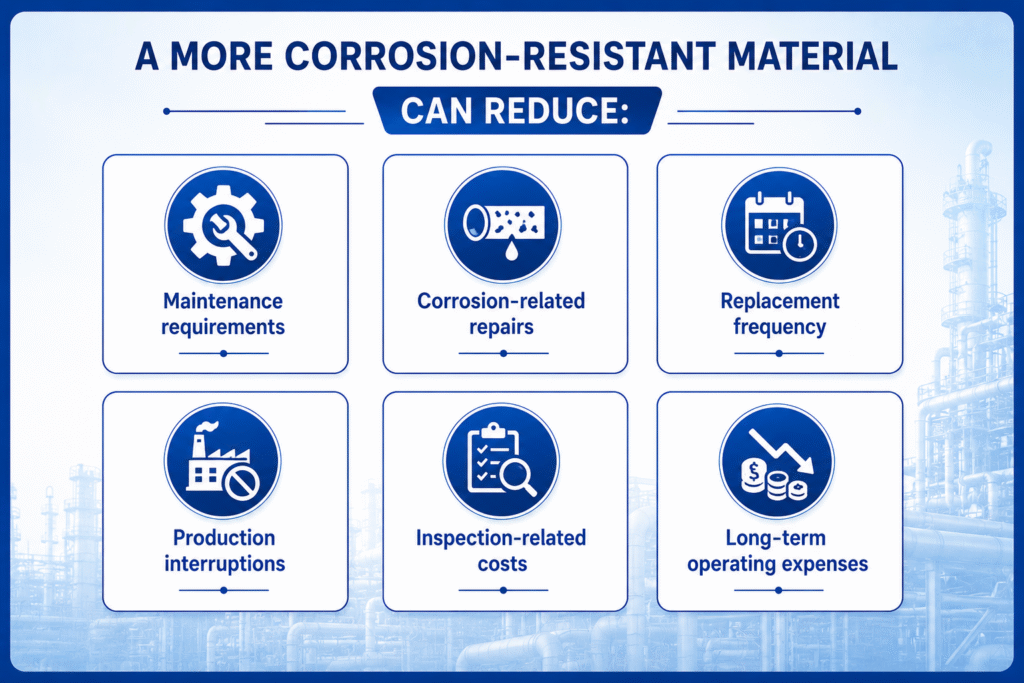
A more corrosion-resistant material can reduce:
Maintenance requirements
Corrosion-related repairs
Replacement frequency
Production interruptions
Inspection-related costs
Long-term operating expenses
Therefore, even though Duplex 2205 costs more to buy initially than carbon steel, it can nevertheless have a positive lifecycle cost.
It is frequently utilized as a substitute for traditional austenitic stainless steels in demanding industrial applications because of its strength and resistance to corrosion.
Duplex 2205 for Offshore African Projects
Offshore oil and gas production exposes piping to seawater, marine atmospheres, chlorides, and potentially corrosive process fluids.
Duplex 2205 is used in applications such as:
Offshore process piping
Flowlines
Produced-water systems
Subsea components
Heat exchangers
Seawater-related systems
Wellhead equipment
Its resistance to chloride corrosion and high mechanical strength make it particularly attractive for offshore applications.
Performance in Sour-Service Applications
Hydrogen sulfide (H2S) can cause sour-service conditions in some African oil and gas sites.
Different types of cracking and material deterioration can be caused by hydrogen sulfide.
Although Duplex 2205 has been identified for use in H2S-containing environments, not all 2205 products or conditions are inherently appropriate for all sour-service applications.
Engineers must verify:
H₂S partial pressure
Temperature
Chloride concentration
pH
Material hardness
Heat treatment
Welding procedure
Applicable NACE/ISO requirements
Where required, the material should comply with the applicable NACE MR0175/ISO 15156 requirements.
Duplex 2205 vs 316L
One of the most common comparisons in pipeline material selection is Duplex 2205 versus 316L.
Property | 316L Stainless Steel | Duplex 2205 |
Structure | Austenitic | Ferritic-Austenitic |
Strength | Moderate | High |
Chloride SCC Resistance | Lower | Excellent |
Pitting Resistance | Good | Very Good |
Crevice Corrosion Resistance | Good | Very Good |
Seawater Suitability | Limited depending on conditions | Better |
Weight Reduction Potential | Lower | Higher |
Oil & Gas Applications | Common | Widely used |
Lifecycle Performance | Good | Excellent in suitable environments |
The main advantage of 2205 is that it offers a stronger combination of strength and corrosion resistance for many demanding applications.
Duplex 2205 vs Super Duplex 2507
Not every hostile setting is a good fit for Duplex 2205.
Super duplex grades, such UNS S32750 and S32760, are more resistant to pitting and have higher concentrations of nitrogen, molybdenum, and chromium.
Property | Duplex 2205 | Super Duplex 2507 |
Chromium | Approximately 22% | Approximately 25% |
Molybdenum | Approximately 3% | Approximately 4% |
PREN | Around mid-30s | Generally above 40 |
Strength | High | Very High |
Corrosion Resistance | Excellent | Outstanding |
Typical Application | General demanding service | More aggressive service |
Relative Cost | Lower | Higher |
Therefore, 2205 is often selected where its corrosion resistance is sufficient, while super duplex is considered when chloride levels, temperature, seawater exposure, or other service conditions exceed the practical limits of 2205.
Common Product Forms
Duplex 2205 is available in many forms required for pipeline construction.
These include:
Seamless pipes
Welded pipes
Tubes
Butt-weld fittings
Forged fittings
Flanges
Valves
Plates
Bars
Common product standards include ASTM A790 for seamless and welded pipe, ASTM A789 for tubing, ASTM A182 for forgings and flanges, and ASTM A815 for certain wrought fittings.
Manufacturing and Welding Considerations
Despite its great capabilities, duplex 2205 needs careful production and fabrication.
Because the ferrite-austenite balance and corrosion performance might be adversely affected by high heat input, inappropriate cooling rates, or improper welding techniques, the duplex microstructure must be appropriately maintained.
Important manufacturing controls include:
Solution annealing
Controlled heat treatment
Proper welding procedures
Interpass temperature control
Appropriate welding consumables
Ferrite-phase evaluation
PMI
NDT
Dimensional inspection
For critical pipeline projects, the manufacturer’s quality system and inspection documentation should be reviewed carefully.
Why 2205 Is Attractive for African Procurement
For African EPC contractors and pipeline operators, procurement involves more than selecting a corrosion-resistant material.
Important considerations include:
Global availability
Manufacturer experience
International standards
Documentation
Material traceability
Inspection capabilities
Delivery schedules
Replacement availability
Lifecycle cost
Duplex 2205 has an established supply chain and is widely recognized across the international oil and gas industry, making sourcing and replacement comparatively straightforward.
Is Duplex 2205 Always the Best Choice?
No.
Calling 2205 a “default choice” should not mean that it is automatically suitable for every African oil and gas pipeline.
Material selection should consider:
Chloride concentration
H₂S concentration
CO₂ concentration
Temperature
Pressure
pH
Flow velocity
Erosion risk
Water chemistry
Design life
Welding requirements
For extremely aggressive seawater or high-chloride environments, super duplex or nickel-based alloys may be more appropriate.
For less aggressive services, carbon steel with an appropriate corrosion-control strategy may be more economical.
Related Reports
Inconel vs Hastelloy Fittings: Which High Nickel Alloy is Right for Your Project?
What Is Fusion Bonded Epoxy (FBE) Coating? Benefits for Oil & Gas Pipelines & Fittings
What Is Inconel Used For in Oil and Gas? Grades, Properties & Applications
Types of Stainless Steel Fittings: SS 310, 904L, 317L & When to Use Them
Conclusion
Due to its exceptional blend of corrosion resistance, mechanical strength, fabrication capabilities, and lifecycle economics, Duplex 2205 (UNS S31803) is frequently employed in the oil and gas industry.
It is ideal for many African oil and gas applications due to its resistance to chloride stress corrosion, cracking, pitting, crevice corrosion, and general corrosion, especially in situations involving generated water, seawater, or corrosive process fluids. When compared to traditional austenitic stainless steels, its greater strength can also enable more effective designs.
Nonetheless, the actual service environment and project specifications should always be taken into consideration while choosing the appropriate material. Although Duplex 2205 is a great working grade, more extreme circumstances can call for super duplex or other corrosion-resistant alloys.
Duplex 2205’s strength, endurance, corrosion performance, and lifespan value are what make it such a popular material for challenging pipeline systems in Africa, rather than just its corrosion resistance.
How We Support You
Selecting the right duplex stainless steel grade is essential for achieving high strength, excellent corrosion resistance, and long-term reliability in demanding oil & gas pipeline applications across Africa. Our team helps you determine whether Duplex 2205 (UNS S31803) is the right solution based on operating conditions, chloride exposure, pressure, temperature, and project specifications.
Our Support Includes:
Expert guidance on selecting Duplex 2205 (UNS S31803) for oil & gas pipeline applications
Recommendations based on operating pressure, temperature, fluid composition, chloride exposure, and corrosion risks
Technical support for resistance against pitting, crevice corrosion, erosion-corrosion, and stress corrosion cracking
Assistance with material selection for onshore pipelines, offshore platforms, flowlines, gathering systems, and process piping
Guidance on selecting Duplex 2205 elbows, tees, reducers, flanges, bends, valves, and other piping components
Support with compliance to ASTM, ASME, ANSI, API, NORSOK, NACE, and project-specific standards
Assistance with Material Test Certificates (MTCs), PMI reports, heat treatment records, dimensional inspection, and third-party inspection
Recommendations for sour service, high-pressure systems, seawater exposure, and corrosive oil & gas environments
Custom solutions for sizes, wall thicknesses, pressure ratings, fitting configurations, and project-specific requirements
Fast quotations and dependable bulk supply support for projects across Nigeria, Angola, Egypt, Ghana, Kenya, Tanzania, South Africa, and other African markets
Whether your project involves crude oil pipelines, natural gas transmission systems, offshore production facilities, refineries, petrochemical plants, or FPSO infrastructure, we provide reliable Duplex 2205 (S31803) piping solutions engineered to deliver high mechanical strength, superior corrosion resistance, and dependable long-term performance in demanding African oil & gas environments.