
Materials used in high-temperature industrial applications must be able to endure intense heat, oxidation, thermal cycling, and corrosive conditions without losing strength or dependability. Stainless steel flanges and fittings that can function reliably at high temperatures are essential to many industries, including power generation, petrochemicals, refineries, heat treatment, furnaces, and chemical processing.
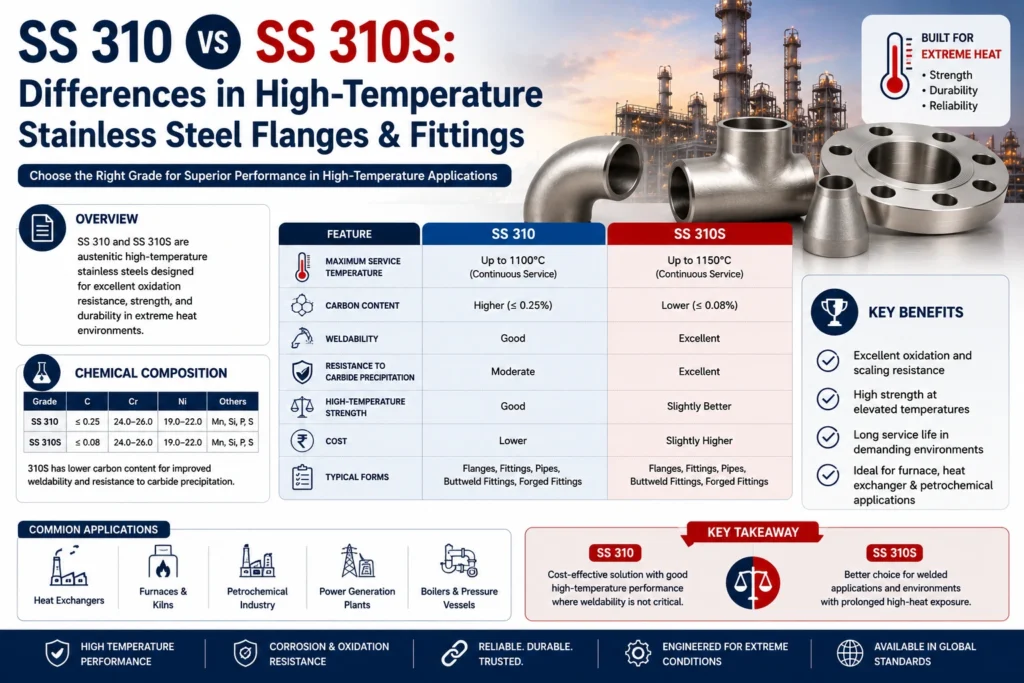
SS 310 and SS 310S are two of the most popular heat-resistant stainless steels. Both grades have outstanding resistance to oxidation and scaling at high temperatures and are members of the austenitic stainless steel family. Despite their many similarities, each grade is appropriate for a particular use due to variations in mechanical characteristics and carbon content.
This article compares SS 310 and SS 310S, highlighting their composition, properties, performance, applications, and key differences to help you choose the right material for high-temperature stainless steel flanges and fittings.
What Is SS 310?
SS 310 is an austenitic chromium-nickel stainless steel designed for high-temperature service. It contains high levels of chromium and nickel, providing outstanding resistance to oxidation, corrosion, and thermal fatigue.
Typical chemical composition:
Chromium (Cr): 24–26%
Nickel (Ni): 19–22%
Carbon (C): Up to 0.25%
Manganese (Mn): Up to 2.0%
Silicon (Si): Up to 1.5%
Iron (Fe): Balance
The higher carbon content contributes to improved strength at elevated temperatures but may increase the risk of carbide precipitation during welding.
What Is SS 310S?
SS 310S is the low-carbon version of SS 310. The reduced carbon content minimizes carbide precipitation during welding, resulting in better resistance to intergranular corrosion and improved weldability.
Typical chemical composition:
Chromium (Cr): 24–26%
Nickel (Ni): 19–22%
Carbon (C): Maximum 0.08%
Manganese (Mn): Up to 2.0%
Silicon (Si): Up to 1.5%
Iron (Fe): Balance
Because of its lower carbon content, SS 310S is widely preferred for fabricated components that require extensive welding.
Key Differences Between SS 310 and SS 310S
Carbon Content
The primary difference between the two grades is carbon content.
SS 310: Up to 0.25% Carbon
SS 310S: Maximum 0.08% Carbon
The lower carbon content in SS 310S reduces the formation of chromium carbides during welding, helping maintain corrosion resistance in the heat-affected zone.
High-Temperature Strength
Because of its higher carbon content, SS 310 provides marginally greater strength at higher temperatures.
In applications where there is constant exposure to high temperatures and mechanical loads, it works remarkably well.
Although SS 310S has somewhat less high-temperature strength, it offers comparable heat resistance.
SS 310 was the winner.
Weldability
One of the main benefits of SS 310S is its weldability.
The reduced carbon content facilitates fabrication and eliminates the requirement for post-weld heat treatment in many applications by lowering the risk of sensitization and intergranular corrosion following welding.
SS 310 can also be effectively welded, although welding techniques need to be paid more attention to.
SS 310S was the winner.
Oxidation Resistance
Both grades offer outstanding oxidation resistance at elevated temperatures.
Their high chromium content forms a protective oxide layer that prevents rapid oxidation and scaling.
Both materials perform well in:
Continuous high-temperature service
Intermittent heating cycles
Furnace atmospheres
Heat treatment equipment
Result: Comparable performance
Corrosion Resistance
Good resistance to oxidation and high-temperature corrosion is offered by both SS 310 and SS 310S.
However, due to its reduced carbon content, SS 310S often provides higher resistance to intergranular corrosion following welding.
This makes it better suited for manufactured equipment and welded piping systems.
SS 310S was the winner.
Fabrication
Because of its enhanced weldability and less likelihood of carbide precipitation, SS 310S is simpler to produce.
It is frequently chosen for intricate piping systems with plenty of welded joints.
When greater mechanical strength takes precedence over fabrication concerns, SS 310 is the material of choice.
Comparison Table
Property | SS 310 | SS 310S |
Stainless Steel Type | Austenitic | Austenitic (Low Carbon) |
Carbon Content | Up to 0.25% | Maximum 0.08% |
High-Temperature Strength | Higher | Slightly Lower |
Weldability | Good | Excellent |
Oxidation Resistance | Excellent | Excellent |
Intergranular Corrosion Resistance | Good | Excellent |
Fabrication | Good | Excellent |
Continuous High-Temperature Service | Excellent | Excellent |
Thermal Cycling Resistance | Excellent | Excellent |
Typical Cost | Slightly Lower | Slightly Higher |
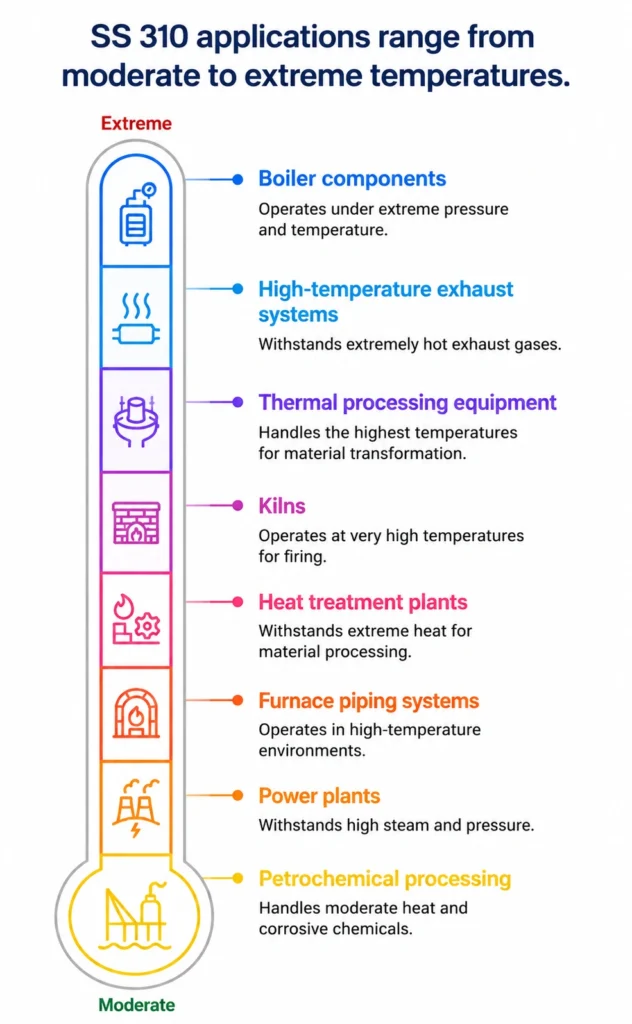
Applications of SS 310 Flanges and Fittings
SS 310 is commonly used in industries where components are exposed to prolonged high temperatures and mechanical stress.
Typical applications include:
Furnace piping systems
Heat treatment plants
Kilns
Thermal processing equipment
Power plants
Petrochemical processing
High-temperature exhaust systems
Boiler components
Its higher carbon content provides improved strength for demanding thermal environments.
Applications of SS 310S Flanges and Fittings
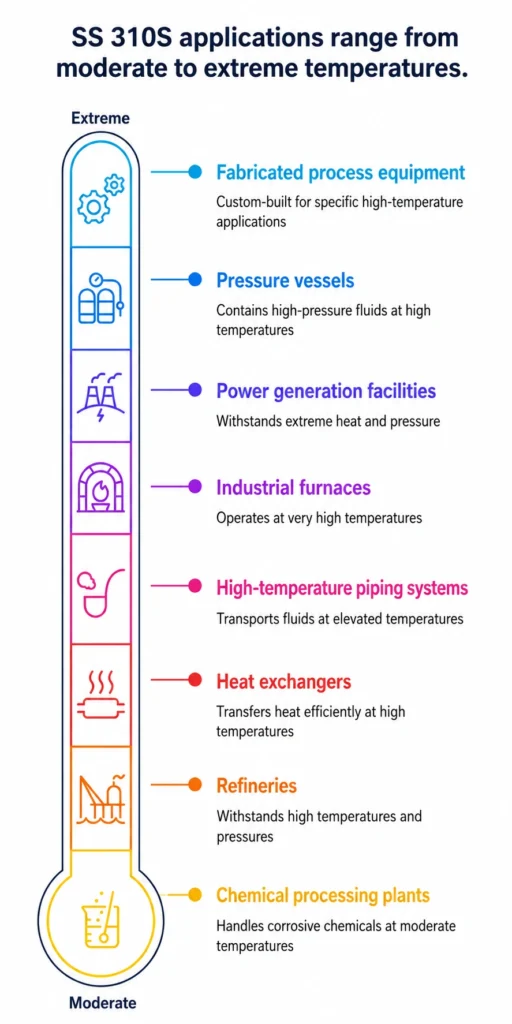
SS 310S is widely used where extensive welding and excellent corrosion resistance are required.
Common applications include:
Chemical processing plants
Refineries
Heat exchangers
High-temperature piping systems
Industrial furnaces
Power generation facilities
Pressure vessels
Fabricated process equipment
Its superior weldability makes it ideal for complex piping assemblies.
Pressure Ratings and Standards
SS 310 and SS 310S flanges and fittings are manufactured according to internationally recognized standards.
Common standards include:
Flanges
ASME B16.5
ASME B16.47
EN 1092-1
Pressure classes typically include:
Class 150
Class 300
Class 600
Class 900
Class 1500
Class 2500
Butt Weld Fittings
ASME B16.9
MSS SP-43
Available in various pipe schedules such as:
SCH 10
SCH 40
SCH 80
SCH 160
XXS
Forged Fittings
ASME B16.11
Pressure ratings include:
Class 2000
Class 3000
Class 6000
Class 9000
Factors to Consider When Choosing Between SS 310 and SS 310S
When selecting the appropriate grade, consider:
Operating temperature
Pressure requirements
Welding requirements
Corrosive environment
Mechanical loading
Fabrication complexity
Maintenance expectations
Project budget
If maximum strength at elevated temperatures is the priority, SS 310 is often the preferred option.
If the application involves extensive welding and requires superior resistance to intergranular corrosion, SS 310S is generally the better choice.
Benefits of SS 310 and SS 310S Flanges & Fittings
Both grades offer several advantages in high-temperature applications:
Excellent oxidation resistance
High thermal stability
Good mechanical strength
Resistance to thermal fatigue
Long service life
Reliable performance under cyclic heating
Good corrosion resistance
Compatibility with demanding industrial environments
These characteristics make both grades suitable for critical process piping systems.
Related Reports
Inconel vs Hastelloy Fittings: Which High Nickel Alloy is Right for Your Project?
What Is Fusion Bonded Epoxy (FBE) Coating? Benefits for Oil & Gas Pipelines & Fittings
What Is Inconel Used For in Oil and Gas? Grades, Properties & Applications
Types of Stainless Steel Fittings: SS 310, 904L, 317L & When to Use Them
Conclusion
Premium heat-resistant stainless steels like SS 310 and SS 310S are frequently utilized for high-temperature flanges and fittings in a variety of industries, including power generation, petrochemicals, refineries, chemical processing, and heat treatment. Their carbon content is the primary distinction between them, despite the fact that they both have outstanding oxidation resistance and thermal stability.
Applications requiring extended exposure to intense heat and mechanical stress are a good fit for SS 310 because of its marginally higher high-temperature strength. Because of its reduced carbon content, SS 310S is the material of choice for welded pipe systems and fabricated equipment because it offers better resistance to intergranular corrosion and greater weldability.
Engineers can choose the best stainless steel grade to guarantee dependable performance, a longer service life, and economical operation in high-temperature industrial applications by assessing operating temperature, fabrication requirements, corrosion exposure, and mechanical demands.
How We Support You
Selecting the right high-temperature stainless steel grade is essential for ensuring excellent oxidation resistance, mechanical strength, and long-term reliability in demanding industrial environments. Our team helps you determine whether SS 310 or SS 310S is the best choice based on operating temperature, fabrication requirements, corrosion exposure, and project specifications.
Our Support Includes:
Expert guidance on selecting between SS 310 and SS 310S for high-temperature applications
Recommendations based on operating temperature, pressure, oxidation resistance, and fabrication requirements
Technical support for applications involving furnaces, heat treatment plants, boilers, kilns, petrochemical processing, and power generation systems
Assistance with evaluating resistance to high-temperature oxidation, scaling, thermal cycling, carburization, and corrosion
Guidance on selecting stainless steel flanges, elbows, tees, reducers, caps, and other high-temperature piping components
Support with compliance to ASTM, ASME, ANSI, API, EN, and project-specific standards
Assistance with material test certificates (MTCs), PMI reports, quality documentation, and third-party inspection requirements
Recommendations for applications requiring excellent weldability, thermal stability, and long-term heat resistance
Custom solutions for sizes, wall thicknesses, pressure classes, flange types, and project-specific fabrication requirements
Fast quotations and reliable bulk supply support for projects across the petrochemical, power generation, heat treatment, steel processing, cement, and industrial manufacturing sectors
Whether your project involves high-temperature process pipelines, furnace systems, heat exchangers, boilers, exhaust systems, or industrial processing plants, we provide dependable SS 310 and SS 310S flange and fitting solutions engineered to deliver outstanding heat resistance, durability, and long-term performance in extreme operating conditions.