
When choosing stainless steel for oil and gas, marine, desalination, chemical processing, mining, and offshore applications, pitting corrosion is one of the most significant corrosion problems. The integrity of pipes, fittings, flanges, valves, and other pressure-carrying components may eventually be compromised by localized, hard-to-detect attacks caused by surroundings containing chloride.
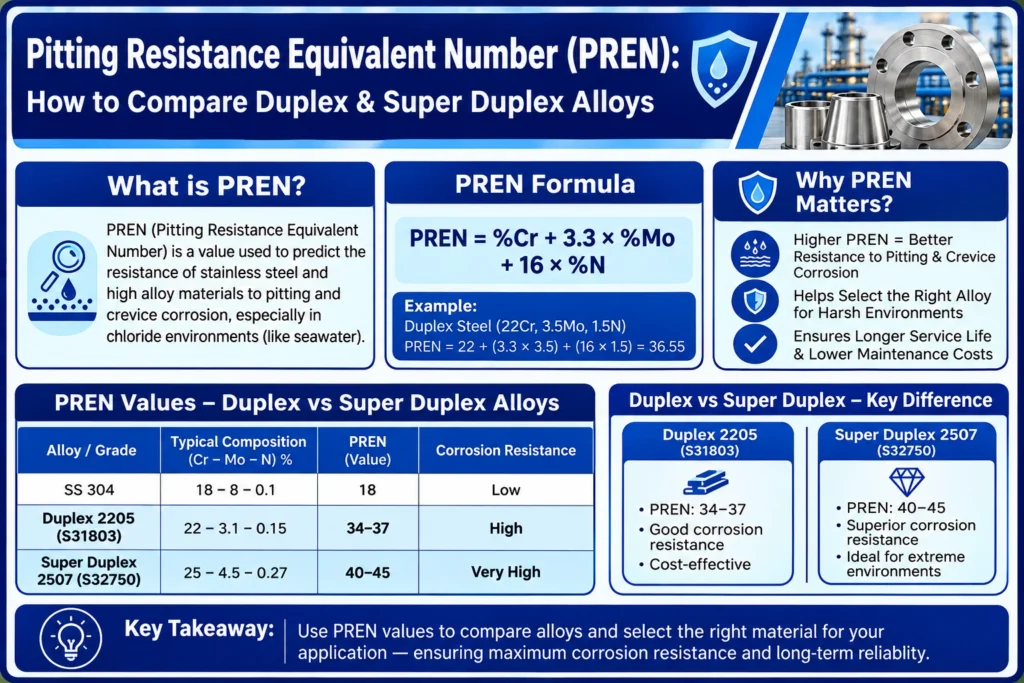
The Pitting Resistance Equivalent Number (PREN) is a widely used technique for assessing the resistance of stainless steel alloys to localized pitting corrosion.
Based mostly on the chromium, molybdenum, and nitrogen content of various stainless steel types, PREN offers a practical means of comparing their theoretical pitting resistance. When comparing duplex and super duplex stainless steels, it is very helpful.
PREN is not a comprehensive corrosion-performance forecast, though. Temperature, chloride concentration, manufacturing quality, surface condition, heat treatment, and the particular operating environment all affect actual service performance.
What Is PREN?
The Pitting Resistance Equivalent Number is an empirical index used to compare the resistance of stainless steels to localized pitting corrosion.
For many duplex and super duplex stainless steels, a commonly used formula is:
PREN = %Cr + 3.3 × %Mo + 16 × %N
Where:
Cr = Chromium percentage
Mo = Molybdenum percentage
N = Nitrogen percentage
The formula demonstrates why these three alloying elements are important.
The passive oxide layer that shields stainless steel is formed in part by chromium. Molybdenum increases resistance to localized corrosion, especially in settings that contain chlorides. Nitrogen enhances mechanical strength, helps stabilize the duplex microstructure, and increases pitting resistance.
Greater theoretical resistance to pitting corrosion is typically indicated by a higher PREN.
Why Is PREN Important for Duplex Stainless Steel?
Duplex stainless steels contain both ferritic and austenitic phases. Their corrosion resistance comes from a carefully controlled alloy composition and microstructure.
Common duplex grades include:
UNS S31803
UNS S32205
UNS S32101
UNS S32304
Super duplex grades include:
UNS S32750
UNS S32760
These alloys are commonly selected for environments where conventional stainless steels may not provide sufficient corrosion resistance.
PREN helps engineers make an initial comparison between these grades before conducting a more detailed material-selection analysis.
PREN Comparison of Common Grades
Stainless Steel Grade | Approximate PREN Range | Material Category |
304L | ~18–20 | Austenitic |
316L | ~23–27 | Austenitic |
Duplex 2304 | ~25–30 | Lean Duplex |
Duplex 2205 | ~30–38 | Duplex |
Super Duplex 2507 | ~40–45+ | Super Duplex |
UNS S32760 | ~40–45+ | Super Duplex |
The exact PREN value depends on the actual chemical composition of the material. Therefore, these figures should be treated as approximate ranges rather than fixed values.
How Chromium Affects PREN
Chromium is the primary element responsible for stainless steel’s passive corrosion-resistant surface.
When exposed to oxygen, chromium forms a thin protective oxide film. This passive layer significantly reduces the rate of corrosion.
In the PREN formula, chromium contributes directly:
PREN = %Cr + 3.3 × %Mo + 16 × %N
For instance, a larger PREN is directly caused by increasing chromium from around 22% in duplex 2205 to about 25% in super duplex 2507.
However, improved corrosion performance is not always ensured by merely raising chromium. It is also necessary to take into account the entire alloy chemistry and microstructure.
How Molybdenum Affects PREN
Resistance to localized corrosion is especially strongly influenced by molybdenum.
The traditional PREN formula’s 3.3 multiplier reflects this.
For instance, the PREN value increases by about 3.3 points for every 1% rise in molybdenum.
For this reason, in highly chlorinated settings, super duplex grades typically perform better than regular duplex grades.
Super duplex grades like 2507 often include about 4% molybdenum, whereas duplex 2205 usually contains about 3%.
How Nitrogen Affects PREN
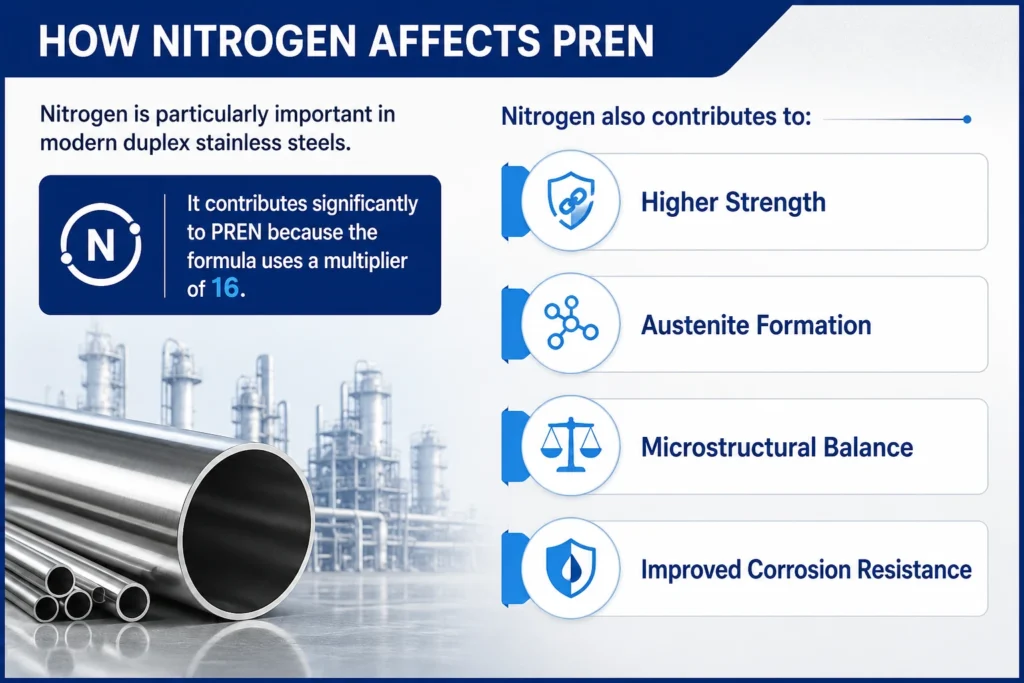
Nitrogen is particularly important in modern duplex stainless steels.
It contributes significantly to PREN because the formula uses a multiplier of 16.
Nitrogen also contributes to:
Higher strength
Austenite formation
Microstructural balance
Improved corrosion resistance
This is one reason duplex and super duplex alloys can achieve both high mechanical strength and strong corrosion resistance.
Duplex 2205 vs Super Duplex 2507
One of the most common material comparisons is Duplex 2205 vs Super Duplex 2507.
Duplex 2205
Duplex 2205 typically contains approximately:
22% chromium
5% nickel
3% molybdenum
Nitrogen
Its PREN is commonly around the mid-30s, depending on chemistry.
2205 provides an excellent combination of:
Strength
Corrosion resistance
Availability
Fabrication
Cost effectiveness
It is widely used in:
Oil and gas pipelines
Process piping
Offshore equipment
Chemical processing
Desalination
Heat exchangers
Mining applications
Super Duplex 2507
Super duplex 2507 typically contains approximately:
25% chromium
6–7% nickel
4% molybdenum
Higher nitrogen than standard duplex grades
Its PREN is generally above 40.
The higher alloy content provides improved resistance to:
Pitting
Crevice corrosion
Chloride exposure
Seawater
Aggressive process environments
2507 is commonly used in:
Offshore oil and gas
Subsea systems
Seawater piping
Desalination plants
Chemical processing
High-chloride applications
What Does a Higher PREN Actually Mean?
A higher PREN generally means that an alloy has greater theoretical resistance to localized pitting corrosion.
For example:
316L → lower PREN
2205 → higher PREN
2507 → significantly higher PREN
Because of this, PREN is helpful when screening products for environments that contain chloride.
It does not, however, imply that in every practical situation, an alloy with a PREN of 42 will always perform better than an alloy with a PREN of 40.
Numerous more factors affect actual performance.
PREN Is Not a Guarantee of Corrosion Performance
One of the most important limitations of PREN is that it is a comparative indicator, not a guarantee of service performance.
Two materials with similar PREN values may perform differently because of:
Heat treatment
Phase balance
Surface condition
Welding
Heat-affected zones
Fabrication contamination
Chloride concentration
Temperature
Fluid velocity
pH
Oxygen concentration
For example, a properly manufactured and heat-treated duplex fitting can perform significantly better than a poorly fabricated component made from a theoretically higher-PREN alloy.
PREN and Welding
Welding is particularly important for duplex and super duplex stainless steels.
Incorrect welding conditions can disturb the balance between ferrite and austenite. Excessive ferrite or unwanted intermetallic phases can reduce corrosion resistance and toughness.
Important welding controls include:
Heat input
Interpass temperature
Welding consumable selection
Cooling rate
Shielding gas
Post-weld treatment where applicable
Therefore, when comparing duplex and super duplex fittings, flanges, or pipes, buyers should not look at PREN alone.
They should also review:
Welding procedures
Ferrite measurements
Heat-treatment records
NDT results
PMI reports
Material Test Certificates
PREN and Oil & Gas Applications
Oil and gas systems frequently contain chloride-bearing water, produced water, seawater, CO₂, and other corrosive components.
Duplex and super duplex materials are therefore widely considered for:
Flowlines
Process piping
Offshore pipelines
Water injection systems
Produced-water systems
Seawater systems
Subsea components
For moderately aggressive conditions, duplex 2205 can provide an excellent balance between performance and cost.
For more severe chloride environments, super duplex grades may offer a larger corrosion-resistance margin.
PREN and Desalination
Desalination systems can expose materials to highly concentrated chloride environments.
Applications include:
Seawater intake piping
Reverse osmosis systems
Brine piping
High-pressure piping
Pumps
Valves
Heat exchangers
When screening stainless steel grades, PREN might be a helpful first-stage comparison because localized corrosion is a significant concern in these systems.
However, it is also necessary to assess the equipment design, flow conditions, oxygen content, chloride concentration, and real operating temperature.
How to Select Between Duplex and Super Duplex
A practical approach is to begin with the required corrosion resistance.
Consider Duplex 2205 When:
Chloride exposure is moderate to high
High mechanical strength is required
The operating environment is within the grade’s capabilities
Cost optimization is important
Standard duplex performance is sufficient
Consider Super Duplex 2507 or S32760 When:
Chloride levels are particularly high
Seawater exposure is significant
Pitting resistance requirements are demanding
Higher corrosion resistance is needed
The environment is too aggressive for standard duplex
The final choice should be based on the complete service environment rather than PREN alone.
PREN and Supplier Selection
When purchasing duplex or super duplex pipes, fittings, and flanges, buyers should verify the actual chemical composition rather than relying only on the nominal material grade.
Important documentation includes:
Material Test Certificate
Heat number
Chemical composition
Mechanical properties
Heat-treatment records
PMI results
Ferrite measurements where required
NDT reports
Dimensional inspection reports
The actual chromium, molybdenum, and nitrogen values can be used to calculate the material’s approximate PREN.
This provides an additional quality-control check.
Can PREN Be Used for Every Stainless Steel?
When evaluating stainless steels made for localized corrosion resistance, notably duplex and super duplex grades, PREN is extremely helpful.
However, different alloy families and applications have distinct PREN equations. Tungsten and other elements are included in some computations.
As a result, engineers ought to apply the formula given by the applicable engineering practice, project specification, or material standard.
Related Reports
Inconel vs Hastelloy Fittings: Which High Nickel Alloy is Right for Your Project?
What Is Fusion Bonded Epoxy (FBE) Coating? Benefits for Oil & Gas Pipelines & Fittings
What Is Inconel Used For in Oil and Gas? Grades, Properties & Applications
Types of Stainless Steel Fittings: SS 310, 904L, 317L & When to Use Them
Conclusion
Pitting Resistance Equivalent Number (PREN) is a useful tool for comparing the theoretical resistance of duplex and super duplex stainless steels to localized pitting corrosion.
The conventional formula:
PREN = %Cr + 3.3 × %Mo + 16 × %N
shows how chromium, molybdenum, and nitrogen contribute to corrosion resistance.
In general, Duplex 2205 offers a strong combination of corrosion resistance, strength, availability, and cost, while Super Duplex 2507 and UNS S32760 provide higher resistance for more aggressive chloride and seawater environments.
PREN should never, however, be the only consideration when choosing a material. Chemistry, temperature, chloride concentration, microstructure, heat treatment, manufacturing, welding, surface condition, and operating circumstances all affect actual performance.
The optimum material-selection approach for mining, oil and gas, desalination, maritime, and chemical projects is to use PREN as a first comparison tool before assessing the entire service environment and relevant specifications.
PREN can assist engineers in choosing duplex and super duplex alloys with the ideal ratio of corrosion resistance, strength, dependability, and lifespan cost when paired with appropriate manufacturing controls, inspection, traceability, and engineering analysis.
How We Support You
Selecting the right duplex or super duplex stainless steel alloy requires more than comparing PREN values. Understanding Pitting Resistance Equivalent Number (PREN) helps assess resistance to chloride-induced pitting and make a more informed material choice for demanding applications.
Our team helps you evaluate suitable duplex and super duplex grades based on PREN, chloride exposure, temperature, seawater conditions, operating pressure, and project specifications.
Our Support Includes:
Expert guidance on comparing PREN values across duplex and super duplex stainless steel grades
Recommendations for grades such as UNS S31803, S32205, S32750, and S32760 based on application requirements
Technical support for applications exposed to seawater, chlorides, brine, and other corrosive environments
Assistance in evaluating resistance to pitting, crevice corrosion, erosion-corrosion, and stress corrosion cracking
Guidance on selecting pipes, elbows, tees, reducers, flanges, bends, valves, and other duplex piping components
Support with understanding how chromium, molybdenum, and nitrogen content influence pitting resistance
Assistance with compliance to ASTM, ASME, ANSI, API, NORSOK, NACE, ISO, and project-specific standards
Support with Material Test Certificates (MTCs), PMI reports, chemical composition verification, inspection documentation, and traceability
Custom solutions for sizes, wall thicknesses, pressure ratings, material grades, and project-specific requirements
Fast quotations and dependable bulk supply support for projects across the oil & gas, offshore, marine, desalination, chemical processing, mining, and petrochemical sectors
Whether your project involves offshore platforms, subsea pipelines, desalination plants, marine systems, chemical processing facilities, or mining infrastructure, we provide reliable duplex and super duplex steel solutions selected according to corrosion conditions, mechanical requirements, applicable standards, and the required level of pitting resistance.