
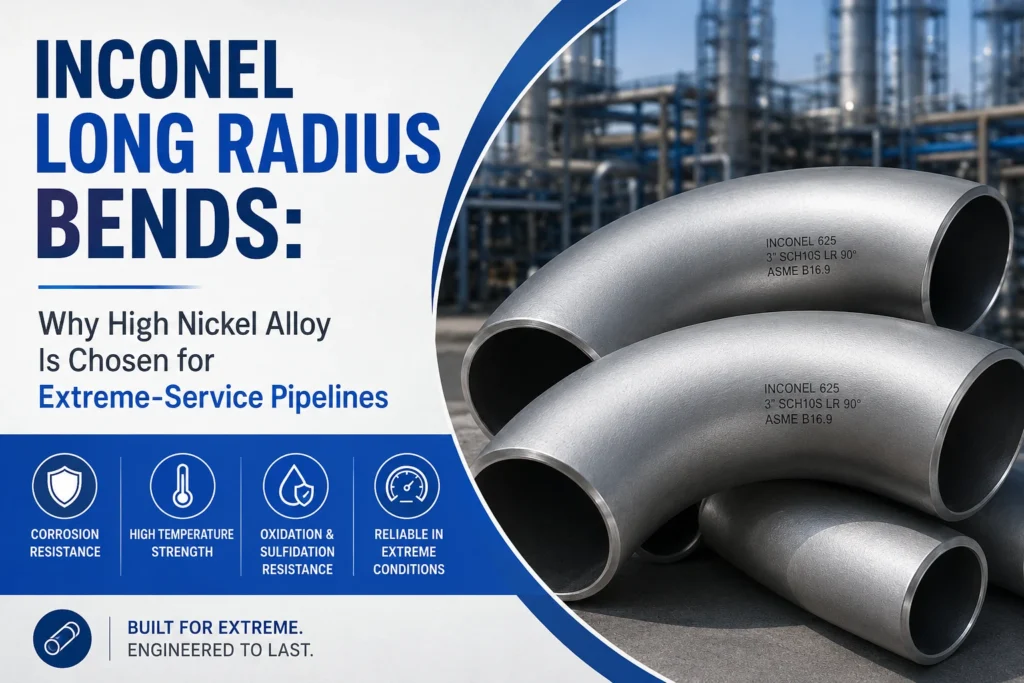
Extreme-service pipelines function in environments where regular stainless steel and carbon steel might not be reliable enough. Piping components can be gradually harmed by high temperatures, severe corrosion, pressure changes, harsh chemicals, and thermal cycling. In these applications, Inconel long radius bends provide a combination of mechanical strength, thermal stability, and corrosion resistance, making them appropriate for challenging process environments.
Fluids can change direction more gradually in long radius bends because they have a larger centerline radius than short radius bends. These bends can offer dependable performance in applications where both flow behavior and material durability are crucial when they are made from nickel-based alloys like Inconel 600, 625, or 718.
What Are Inconel Long Radius Bends?
A pipe fitting made of an alloy based on nickel and chromium that is intended to alter the direction of a piping system is called an Inconel long radius bend.
A long radius bend has a greater curve than a typical short-radius elbow. As a result, the flowing medium transitions more smoothly.
Common configurations include:
45-degree bends
90-degree bends
180-degree bends
Customized bend angles
Seamless bends
Welded bends
Induction bends
Fabricated bends
Depending on the application, the bend can be manufactured according to relevant ASME, ASTM, or project-specific dimensional and material requirements.
Why Nickel Alloys Are Used in Extreme-Service Pipelines
When the working environment exceeds the realistic capabilities of traditional materials, nickel-based alloys are chosen.
Inconel alloys are renowned for their great resistance to a variety of corrosive conditions and their capacity to retain mechanical qualities at high temperatures.
Important characteristics include:
High-temperature strength
Excellent oxidation resistance
Corrosion resistance
Resistance to chloride-related attack
Good resistance to thermal cycling
High mechanical strength
Good resistance to stress corrosion cracking in suitable grades
This makes Inconel attractive for pipelines used in chemical processing, oil and gas, power generation, aerospace-related systems, and other high-performance industrial applications.
Advantages of Long Radius Geometry
The material is only part of the performance equation. Bend geometry also affects pipeline operation.
A long radius bend provides a smoother change in flow direction compared with a short-radius elbow.
Potential advantages include:
Reduced turbulence
Lower localized pressure losses
Reduced flow separation
Lower erosion risk
Smoother pigging
Reduced stress concentration
Better suitability for high-flow applications
This is particularly valuable when the pipeline transports high-velocity fluids, abrasive particles, multiphase flow, or corrosive process media.
Inconel 625 Long Radius Bends
Inconel 625 is one of the most widely recognized nickel alloys for corrosion-resistant applications.
Its alloying system includes significant amounts of nickel and chromium, along with molybdenum and niobium.
These elements contribute to its resistance to:
Pitting
Crevice corrosion
General corrosion
Chloride-containing environments
Oxidation
High-temperature degradation
Inconel 625 is particularly attractive when a piping system requires both corrosion resistance and high mechanical strength.
Potential applications include:
Offshore piping
Subsea systems
Chemical processing
Seawater systems
Flue-gas equipment
High-temperature process piping
Oil and gas production systems
Inconel 600 Long Radius Bends
Inconel 600 is another nickel-chromium alloy known for corrosion and heat resistance.
It can be considered for applications involving:
High temperatures
Oxidizing environments
Chemical processing
Heat-treatment equipment
Furnace systems
Petrochemical applications
Its high nickel content helps provide good resistance to chloride-ion stress corrosion cracking and various corrosive environments.
However, the appropriate grade should always be selected based on the exact chemical and thermal conditions of the pipeline.
Inconel 718 Long Radius Bends
Inconel 718 is a precipitation-hardenable nickel-based alloy designed for very high mechanical strength.
It maintains strong mechanical properties at elevated temperatures and is commonly associated with demanding aerospace and industrial applications.
Inconel 718 may be considered when the piping component requires:
Very high strength
Elevated-temperature capability
Resistance to mechanical loading
Good fatigue performance
Dimensional stability
It is generally more specialized than Inconel 625 and should be selected where its enhanced mechanical properties justify the additional material and manufacturing requirements.
Inconel vs Stainless Steel
A common question is why an expensive nickel alloy should be used when stainless steel is available.
The answer depends on the operating environment.
Property | 316L Stainless Steel | Duplex 2205 | Inconel 625 |
Corrosion Resistance | Good | Excellent | Very High |
High-Temperature Performance | Moderate | Good | Excellent |
Chloride Resistance | Good | Very Good | Excellent |
Mechanical Strength | Moderate | High | Very High |
Material Cost | Lower | Medium | Higher |
Extreme-Service Capability | Limited | High | Very High |
Inconel is not intended to replace stainless steel in every application. It is normally selected when the operating conditions justify the higher material cost.
Applications in Oil & Gas
Oil and gas pipelines can experience high pressure, elevated temperature, corrosive fluids, and sour-service conditions.
Inconel bends may be used in:
Offshore production systems
Refinery piping
Gas processing plants
High-temperature process lines
Subsea equipment
Chemical injection systems
Exhaust and flare systems
Corrosive fluid transportation
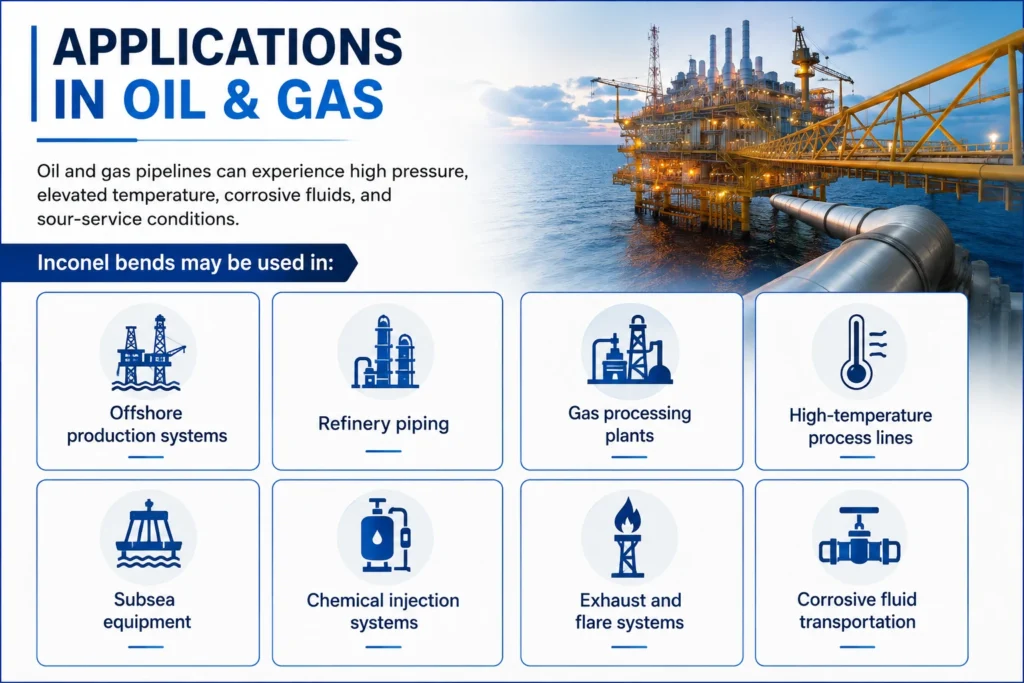
In these applications, the fitting must withstand not only internal pressure but also external environmental exposure and thermal stresses.
Applications in Chemical Processing
Piping may be exposed to strong acids, alkalis, chlorides, and other chemicals in chemical facilities.
Because nickel alloys may withstand corrosion in conditions where traditional stainless steel may experience localized or widespread corrosion, they are frequently taken into consideration.
In chemical process lines, where smooth flow and less turbulence are desired, long radius bends are especially helpful.
High-Temperature Performance
One of the biggest advantages of nickel-based alloys is their ability to maintain useful mechanical properties at elevated temperatures.
High-temperature piping can experience:
Thermal expansion
Creep
Oxidation
Thermal fatigue
Strength reduction
Inconel alloys are designed to handle demanding temperature conditions better than many conventional stainless steels.
However, different Inconel grades have different temperature capabilities. Therefore, engineers should select the grade based on the actual design temperature and mechanical requirements rather than using the Inconel name alone.
Resistance to Thermal Cycling
Extreme-service pipelines may repeatedly transition between hot and cold operating conditions.
This thermal cycling can cause:
Expansion and contraction
Fatigue
Stress concentration
Joint movement
Distortion
Long radius bends can help manage directional changes while reducing abrupt geometric transitions.
When combined with a suitable nickel alloy, the fitting can provide reliable service under repeated temperature changes.
Manufacturing Methods
Inconel long radius bends can be manufactured using different processes depending on size, thickness, alloy, and project requirements.
Common methods include:
Hot Forming
The fitting is formed at an elevated temperature to achieve the required geometry.
Induction Bending
Localized heating is used to bend the pipe while maintaining controlled geometry.
Cold Bending
Cold forming may be possible for certain dimensions and alloys, although the material’s work-hardening characteristics must be considered.
Fabricated Bends
For large sizes or unusual configurations, bends may be fabricated from pipe sections or plates.
The manufacturing method should be selected based on the alloy, wall thickness, diameter, dimensional tolerances, and applicable specification.
Quality Inspection of Inconel Bends
Because Inconel fittings are often used in high-value and safety-critical systems, quality control is extremely important.
Typical inspection requirements may include:
Chemical composition testing
PMI
Tensile testing
Hardness testing
Heat-treatment verification
Dimensional inspection
Ultrasonic testing
Radiographic testing
Dye penetrant testing
Visual inspection
Material Test Certificates
For critical projects, third-party inspection may also be required.
Supplier Selection
Selecting a reliable Inconel bend supplier is essential because manufacturing quality can significantly affect component performance.
Buyers should evaluate:
Manufacturing experience with nickel alloys
Applicable certifications
Material traceability
Heat-treatment capabilities
Forming capabilities
Welding qualifications
Testing facilities
Previous oil and gas projects
Quality-control procedures
Inspection capabilities
Export experience
The supplier should also be able to provide complete documentation corresponding to the purchase specification.
Why Long Radius Bends Are Preferred for Extreme Service
The combination of long-radius geometry and high-performance nickel alloy provides several benefits.
Long radius geometry can help with:
Flow efficiency
Reduced turbulence
Lower pressure losses
Lower erosion potential
Pigging
Stress distribution
Inconel contributes:
Corrosion resistance
High-temperature strength
Oxidation resistance
Mechanical durability
Resistance to aggressive environments
Together, these characteristics make Inconel long radius bends suitable for demanding pipeline systems.
Related Reports
Inconel vs Hastelloy Fittings: Which High Nickel Alloy is Right for Your Project?
What Is Fusion Bonded Epoxy (FBE) Coating? Benefits for Oil & Gas Pipelines & Fittings
What Is Inconel Used For in Oil and Gas? Grades, Properties & Applications
Types of Stainless Steel Fittings: SS 310, 904L, 317L & When to Use Them
Conclusion
Because Inconel large radius bends combine the corrosion resistance and high-temperature strength of nickel-based alloys with smooth-flow shape, they are preferred for extreme-service pipelines.
Different combinations of mechanical strength, thermal capacity, and corrosion resistance are available in grades including Inconel 600, 625, and 718. Among these, Inconel 718 is chosen when extraordinarily high mechanical strength is needed, and Inconel 625 is especially well-known for demanding corrosion-resistant applications.
When compared to more abrupt directional shifts, the wider bend radius can also lessen erosion, localized pressure losses, turbulence, and stress concentration.
But just because the application is demanding doesn’t mean Inconel should be chosen right away. Before choosing an alloy, engineers should consider temperature, pressure, fluid chemistry, chloride concentration, corrosion processes, flow velocity, mechanical loading, and design life.
For some of the most difficult pipeline applications in oil and gas, chemical processing, offshore, power generation, and other extreme-service industries, Inconel long radius bends can offer the durability, corrosion resistance, and high-temperature performance needed when properly specified and manufactured.
How We Support You
Selecting the right Inconel long radius bends is essential for maintaining flow efficiency, mechanical integrity, and long-term reliability in extreme-service pipeline applications. Our team helps you choose the most suitable high-nickel alloy bend solutions based on operating temperature, pressure, corrosive media, flow conditions, and project specifications.
Our Support Includes:
Expert guidance on selecting suitable Inconel grades for long radius bends and extreme-service piping applications
Recommendations based on operating temperature, pressure, fluid composition, and corrosion exposure
Technical support for resistance against oxidation, pitting, crevice corrosion, erosion-corrosion, and stress corrosion cracking
Assistance with applications involving high-temperature gases, acids, chlorides, seawater, sour service, and aggressive process media
Guidance on selecting long radius bends, elbows, pipes, tees, reducers, flanges, and other high-performance piping components
Support for applications in oil & gas, petrochemical, chemical processing, power generation, offshore, and marine industries
Assistance with compliance to ASTM, ASME, ANSI, API, NACE, ISO, and project-specific standards
Support with Material Test Certificates (MTCs), PMI reports, dimensional inspection, heat treatment records, and third-party inspection documentation
Custom solutions for bend radius, bend angle, pipe diameter, wall thickness, pressure ratings, and project-specific requirements
Fast quotations and dependable bulk supply support for projects across the GCC, Africa, Europe, and international markets
Whether your project involves high-temperature process pipelines, offshore production systems, chemical plants, refinery units, power generation facilities, or subsea infrastructure, we provide reliable Inconel long radius bend solutions engineered to withstand extreme temperatures, aggressive corrosion environments, and demanding pressure conditions while supporting efficient and reliable pipeline operation.