
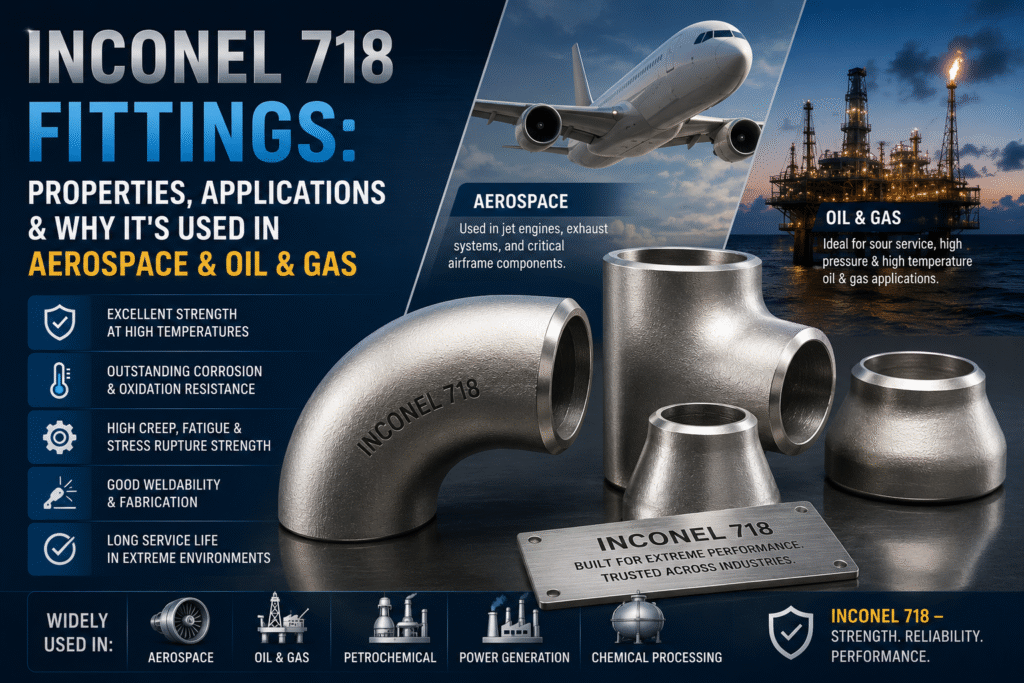
Materials that can tolerate high temperatures, tremendous pressure, corrosive media, and demanding mechanical loads are necessary for industries that operate in harsh environments. Standard stainless steels frequently fall short of providing the required performance and dependability in industries like aerospace, oil and gas, power generation, and petrochemical processing.
Inconel 718 fittings are essential in this situation. Inconel 718 fittings are widely used in some of the most demanding applications in the world because of its remarkable strength, great corrosion resistance, and amazing performance at elevated temperatures.
One of the most reliable nickel-based superalloys for vital piping components is Inconel 718, which is used in everything from aviation engines and rocket systems to offshore platforms and high-pressure oil and gas pipelines.
What Is Inconel 718?
Inconel 718 is a nickel-chromium superalloy strengthened through precipitation hardening. Unlike many conventional alloys, it retains excellent mechanical properties across a broad temperature range, from cryogenic conditions to temperatures of approximately 700°C.
Its unique composition provides an exceptional balance of:
High tensile strength
Superior fatigue resistance
Excellent creep resistance
Outstanding oxidation resistance
Good weldability
Strong corrosion resistance
These characteristics make Inconel 718 an ideal material for applications where failure is not an option.
Chemical Composition of Inconel 718
The performance of Inconel 718 is largely attributed to its carefully balanced chemical composition.
Typical composition ranges include:
Nickel: 50–55%
Chromium: 17–21%
Iron: Balance
Niobium: 4.75–5.50%
Molybdenum: 2.80–3.30%
Titanium: 0.65–1.15%
Aluminum: 0.20–0.80%
The addition of niobium, titanium, and aluminum enables precipitation hardening, which significantly increases the alloy’s strength and high-temperature performance.
What Are Inconel 718 Fittings?
Inconel 718 fittings are piping components manufactured from Inconel 718 alloy and designed to connect, control, or redirect the flow of fluids and gases within piping systems.
Common fitting types include:
Elbows
Tees
Reducers
Caps
Couplings
Stub ends
Unions
Crosses
These fittings are typically manufactured according to international standards such as:
ASME B16.9
ASME B16.11
MSS SP-75
ASTM B366
Key Properties of Inconel 718 Fittings
Exceptional High-Temperature Strength
One of the defining features of Inconel 718 is its ability to maintain high strength at elevated temperatures.
The alloy retains excellent mechanical properties up to approximately 700°C, making it suitable for high-temperature process systems and aerospace applications.
Excellent Corrosion Resistance
Inconel 718 provides strong resistance to a wide range of corrosive environments, including:
Chloride-containing solutions
Seawater
Acidic environments
Sour gas conditions
Oxidizing atmospheres
Its high nickel and chromium content helps protect against localized corrosion and oxidation.
Superior Creep and Fatigue Resistance
Pipeline components operating under cyclic loading and fluctuating temperatures require materials capable of resisting fatigue and creep deformation.
Inconel 718 offers:
Excellent fatigue strength
High resistance to thermal fatigue
Outstanding creep resistance under sustained loads
These characteristics make it suitable for applications involving pressure fluctuations and repeated thermal cycling.
Good Weldability
Many high-strength nickel alloys require complicated heat treatment techniques or are challenging to weld without breaking.
Compared to other precipitation-hardened superalloys, Inconel 718 has comparatively good weldability, which simplifies and lowers the cost of manufacture.
Excellent Cryogenic Performance
In addition to its high-temperature capabilities, Inconel 718 retains toughness and strength at extremely low temperatures.
This makes it suitable for cryogenic applications, including liquefied natural gas (LNG) systems and aerospace fuel handling equipment.
Advantages of Inconel 718 Fittings
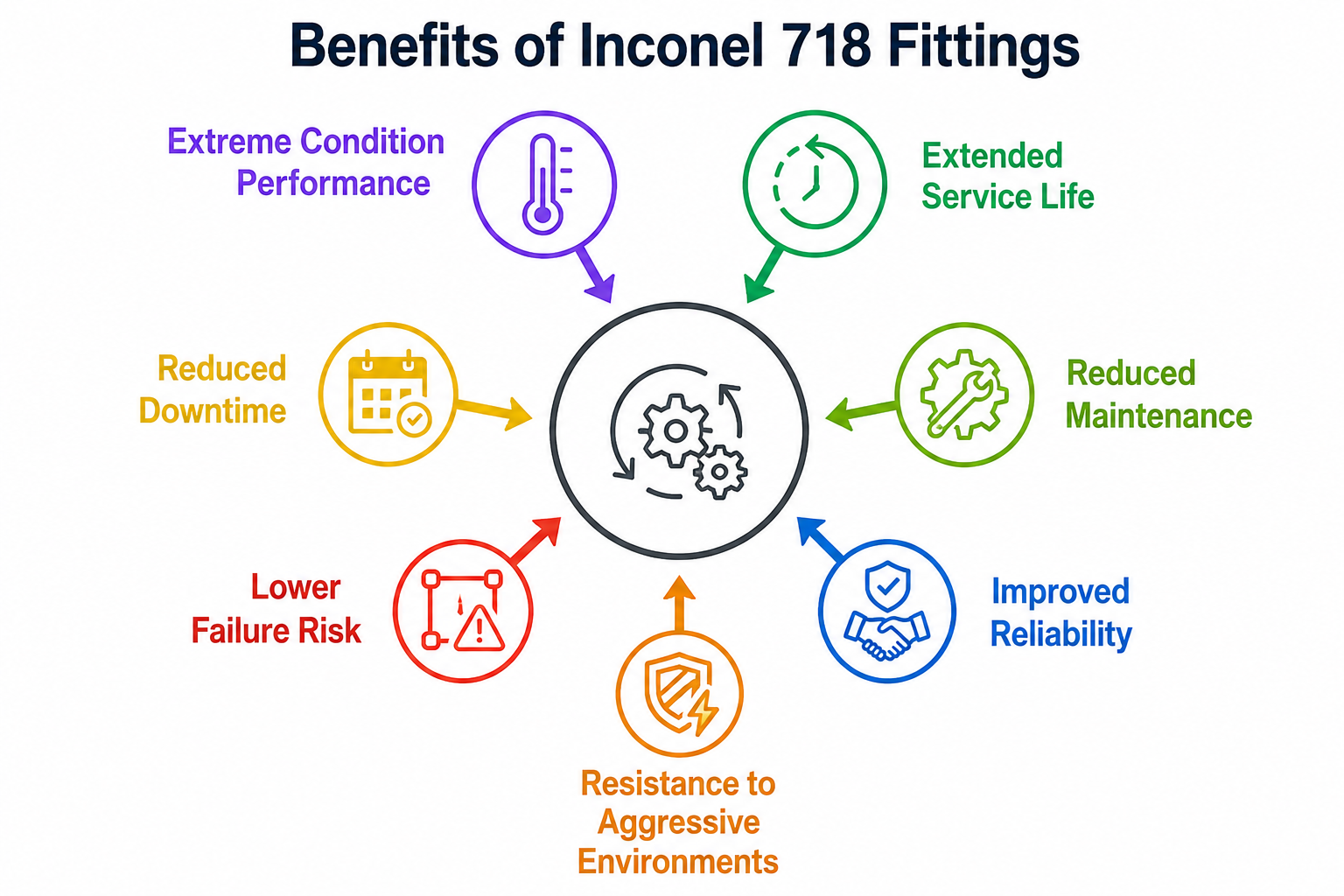
The use of Inconel 718 fittings provides several operational benefits:
Extended service life
Reduced maintenance requirements
Improved operational reliability
Enhanced resistance to aggressive environments
Lower risk of component failure
Reduced downtime
Excellent performance under extreme pressure and temperature conditions
Although the initial material cost is higher than conventional alloys, the long-term performance benefits often justify the investment.
Applications of Inconel 718 Fittings in Aerospace
The aerospace industry demands materials capable of performing reliably under extreme mechanical and thermal conditions.
Inconel 718 fittings are widely used in:
Aircraft Engine Systems
Jet engines operate at extremely high temperatures and pressures.
Inconel 718 fittings are used in:
Fuel delivery systems
Exhaust systems
Hydraulic lines
Compressor sections
Their ability to maintain strength at elevated temperatures ensures long-term reliability.
Rocket Propulsion Systems
Spacecraft and rocket engines require materials that can withstand severe thermal cycling and high mechanical stress.
Inconel 718 fittings are commonly used in:
Propellant lines
Cryogenic fuel systems
Engine components
High-pressure fluid systems
Aerospace Hydraulic Systems
Hydraulic systems in aircraft operate under high pressure and must maintain performance under varying temperatures.
The high fatigue resistance of Inconel 718 makes it ideal for these critical applications.
Applications of Inconel 718 Fittings in Oil and Gas
Oil and gas operations often involve harsh environments that expose equipment to high pressures, corrosive fluids, and extreme temperatures.
Inconel 718 fittings are widely used in:
Offshore and Subsea Systems
Marine environments create significant corrosion challenges due to continuous exposure to seawater and chlorides.
Inconel 718 fittings are commonly found in:
Subsea pipelines
Umbilical systems
Riser systems
Offshore production facilities
Sour Gas Applications
Hydrogen sulfide and carbon dioxide can accelerate corrosion and increase the risk of material failure.
Inconel 718 provides excellent resistance in sour service environments.
High-Pressure, High-Temperature Wells
Exploration and production activities increasingly involve high-pressure, high-temperature (HPHT) conditions.
Inconel 718 fittings deliver the mechanical strength and corrosion resistance required for:
Downhole tools
Wellhead systems
Production equipment
Injection systems
LNG and Cryogenic Facilities
Liquefied natural gas processing and transportation involve extremely low temperatures.
The excellent cryogenic properties of Inconel 718 make it suitable for LNG applications.
Why Inconel 718 Is Preferred Over Conventional Alloys
Compared to carbon steel, stainless steel, and many standard nickel alloys, Inconel 718 offers a unique combination of properties:
Higher mechanical strength
Better high-temperature performance
Improved corrosion resistance
Superior fatigue resistance
Excellent cryogenic toughness
These advantages make it a preferred material for mission-critical applications where reliability and safety are essential.
Related Reports
Inconel vs Hastelloy Fittings: Which High Nickel Alloy is Right for Your Project?
What Is Fusion Bonded Epoxy (FBE) Coating? Benefits for Oil & Gas Pipelines & Fittings
What Is Inconel Used For in Oil and Gas? Grades, Properties & Applications
Types of Stainless Steel Fittings: SS 310, 904L, 317L & When to Use Them
Conclusion
One of the most adaptable nickel-based superalloys on the market today, Inconel 718 fittings offer a remarkable blend of strength, corrosion resistance, weldability, and high-temperature performance.
In aerospace and oil & gas applications, where equipment reliability directly affects safety, efficiency, and operating costs, their capacity to endure harsh operating conditions has made them important.
Inconel 718 fittings provide long-term performance in settings where traditional materials cannot satisfy the needs of contemporary industry, whether they are utilized in aircraft engines, subsea systems, LNG facilities, or high-pressure oil and gas operations.
How We Support You
Selecting the right Inconel 718 fittings is essential for ensuring exceptional strength, corrosion resistance, and long-term reliability in demanding aerospace, oil & gas, and high-temperature industrial applications.
Our team helps you choose the most suitable Inconel 718 solutions based on operating temperatures, pressure conditions, mechanical loading, corrosion exposure, and project-specific requirements.
Our Support Includes:
Expert guidance on selecting Inconel 718 fittings for high-temperature and high-pressure service environments
Recommendations based on operating temperature, pressure ratings, fatigue resistance, and mechanical performance requirements
Technical support for applications involving extreme temperatures, corrosive media, high cyclic loads, and severe operating conditions
Assistance with evaluating resistance to oxidation, pitting, crevice corrosion, stress corrosion cracking, and thermal fatigue
Guidance on selecting elbows, tees, reducers, couplings, flanges, and custom-engineered fitting configurations
Recommendations for use in aerospace engines, gas turbines, subsea systems, offshore platforms, wellhead equipment, and downhole tools
Support with compliance to ASTM, ASME, AMS, API, NACE, and project-specific standards
Assistance with material test certificates (MTCs), quality documentation, traceability requirements, and third-party inspections
Custom solutions for sizes, wall thicknesses, pressure ratings, machining requirements, and project-specific specifications
Fast quotations and dependable bulk supply support for projects across the aerospace, oil & gas, power generation, and industrial sectors
Whether your project involves aircraft engine systems, gas turbines, subsea production equipment, offshore installations, high-pressure processing units, or critical industrial infrastructure, we provide reliable Inconel 718 fitting solutions designed to deliver superior performance, durability, and corrosion resistance in the most demanding environments.