
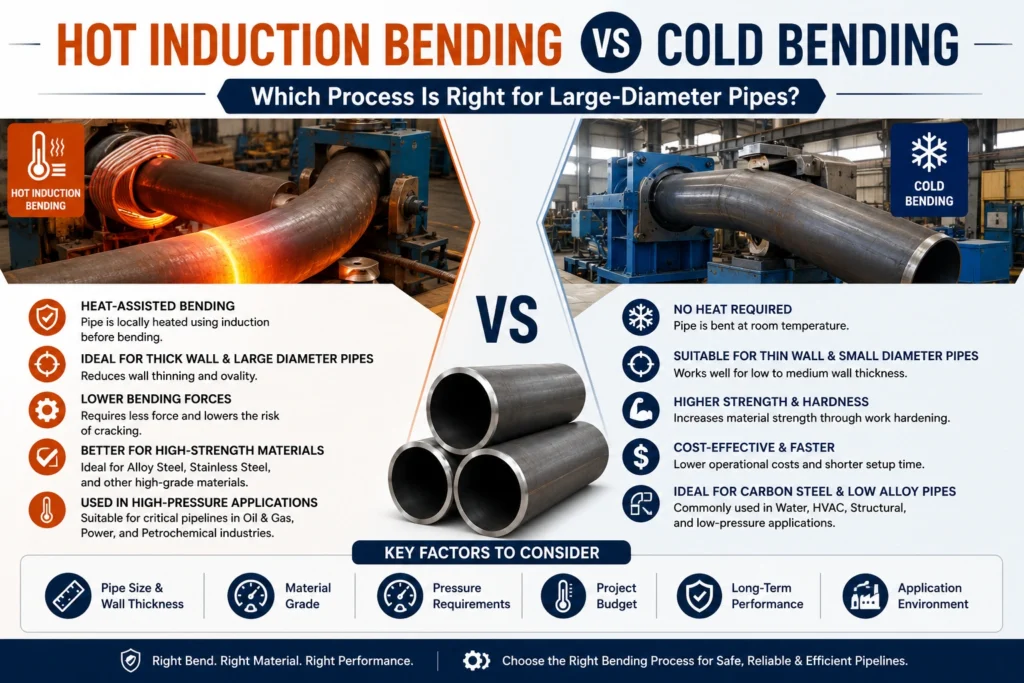
Oil and gas, petrochemicals, electricity generation, water transmission, offshore platforms, mining, and infrastructure projects are just a few of the many sectors that require large-diameter pipes. In order to manage direction changes while preserving effective flow and reducing pressure loss, these pipelines frequently need bends. Because it directly affects the pipeline’s strength, durability, dimensional accuracy, and overall performance, selecting the proper pipe bending technique is essential.
Hot Induction Bending and Cold Bending are the two most popular techniques for producing pipe bends. Although the intended pipe curvature is achieved by both methods, their production processes, tools, uses, and performance traits are very different.
This article compares Hot Induction Bending vs Cold Bending to help engineers, contractors, and project managers determine the best solution for large-diameter pipeline projects.
Understanding Pipe Bending
Pipe bending is the process of permanently deforming a straight pipe into a specific radius or angle without compromising its structural integrity. Properly manufactured bends reduce the need for multiple welded elbows, improve flow efficiency, and increase pipeline reliability.
Large-diameter bends are commonly used in:
Oil and gas transmission pipelines
Offshore and subsea pipelines
Water transmission projects
Hydroelectric power plants
Petrochemical facilities
District cooling networks
Mining slurry pipelines
The bending process selected depends on factors such as pipe diameter, wall thickness, material grade, bend radius, and service conditions.
What Is Hot Induction Bending?
A controlled procedure called “hot induction bending” involves heating a small portion of the pipe with an induction coil while hydraulic machinery progressively bends the pipe to the desired radius and angle.
The rest of the pipe remains comparatively cool; just the bending zone is heated. The heated part is cooled under regulated conditions after bending, and depending on the material specifications, it may be subjected to heat treatment.
Carbon steel, stainless steel, alloy steel, duplex steel, and nickel alloy pipes can all be bent using hot induction.
Advantages of Hot Induction Bending
Hot induction bending offers several benefits for large-diameter piping systems:
Excellent dimensional accuracy
Ability to produce right bend radius
Suitable for thick-wall and large-diameter pipes
Minimal wall thinning
Reduced ovality
High structural integrity
Consistent mechanical properties
Lower number of welded joints
These advantages make it the preferred choice for critical industrial applications.
What Is Cold Bending?
The process of cold bending involves not heating the pipe. Using rollers or hydraulic equipment, mechanical force is applied to gradually bend the pipe until the desired curvature is reached.
The pipe keeps its original metallurgical structure because there is no heating involved. However, especially in larger pipes, severe bending may result in residual tensions and minor deformation.
For large-radius pipeline projects when only small directional modifications are needed, cold bending is frequently utilized.
Advantages of Cold Bending
Cold bending offers several practical advantages:
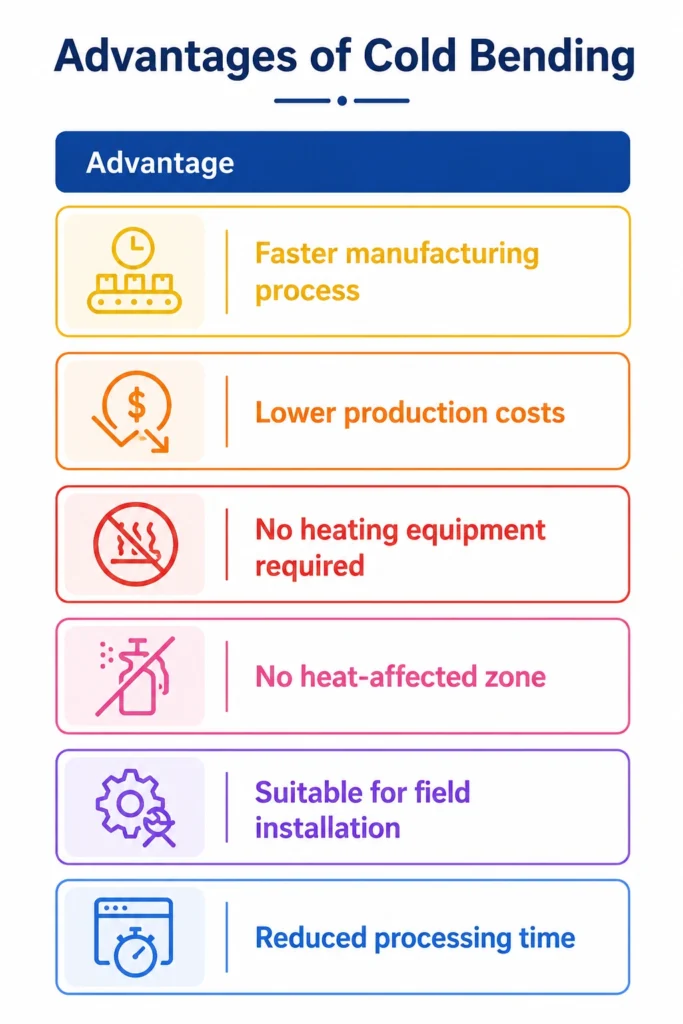
Faster manufacturing process
Lower production costs
No heating equipment required
No heat-affected zone
Suitable for field installation
Reduced processing time
It is particularly useful for on-site pipeline construction where minor directional adjustments are needed.
Hot Induction Bending vs Cold Bending: Key Differences
Manufacturing Process
Hydraulic bending equipment and localized heating are used in hot induction bending. The pipe can be bent without experiencing undue mechanical stress because the heated segment becomes more ductile.
Because cold bending only uses mechanical force, it works well for bends with greater radii but less well for tight bends or materials with thick walls.
Winner: Hot Induction Bending for intricate and precise bends.
Bend Radius Capability
The feasible bend radius is one of the main distinctions between the two approaches.
With good dimensional control, hot induction bending may create bends with comparatively small radii.
Larger bend radii are typically needed for cold bending in order to prevent severe deformation and wall thinning.
Hot Induction Bending was the winner.
Pipe Size and Wall Thickness
High-pressure transmission systems frequently use pipelines with large diameters and thick walls.
The best uses for hot induction bending are:
Large diameters
Thick-wall pipes
High-strength alloy materials
As pipe diameter and wall thickness rise, cold bending becomes more challenging.
Hot Induction Bending was the winner.
Mechanical Properties
In order to restore material qualities, hot induction bending is usually followed by controlled cooling and, if necessary, post-bend heat treatment.
Cold bending could result in:
Residual stresses
Slight work hardening
Increased spring-back
Hot induction bending often offers more reliable mechanical performance under difficult service circumstances.
Hot Induction Bending was the winner.
Wall Thickness Distribution
The inner wall compresses and the outside wall stretches during any bending action.
Hot induction bending improves control over:
Wall thinning
Wall thickening
Ovality
Cross-sectional distortion
More variance may result from cold bending, particularly in pipes with thick walls.
Hot Induction Bending was the winner.
Cost
Due to its shorter manufacturing periods and lower equipment requirements, cold bending is typically less expensive.
Precision controls, sophisticated induction heating systems, and extra inspection needs are all part of hot induction bending.
Cold bending is frequently the more cost-effective option for straightforward bends.
Cold Bending was the winner.
Installation Flexibility
In order to lower shipping costs and enable installers to make modifications during pipeline installation, cold bending is often carried out on the building site.
Before being supplied to the project site, hot induction bends are usually produced at specialist facilities.
Cold Bending was the winner.
Comparison Table
Feature | Hot Induction Bending | Cold Bending |
Heating Required | Yes | No |
Manufacturing Method | Localized induction heating | Mechanical bending |
Suitable for Large Diameters | Excellent | Good |
Tight Bend Radius | Excellent | Limited |
Thick-Wall Pipes | Excellent | Moderate |
Wall Thickness Control | Excellent | Good |
Dimensional Accuracy | High | Moderate |
Residual Stress | Low | Higher |
Field Installation | Limited | Excellent |
Production Cost | Higher | Lower |
Typical Applications | Critical industrial pipelines | Long-distance transmission lines |
Applications of Hot Induction Bending
Hot induction bends are widely used in industries where reliability and performance are essential.
Typical applications include:
Oil and gas transmission pipelines
Offshore and subsea pipelines
Petrochemical plants
Power generation facilities
Refinery piping systems
LNG terminals
High-pressure steam pipelines
Chemical processing plants
The ability to produce precise bends with minimal distortion makes hot induction bending ideal for critical infrastructure.
Applications of Cold Bending
Cold bending is commonly used in projects requiring gradual pipeline direction changes.
Typical applications include:
Cross-country pipelines
Water transmission systems
Natural gas distribution networks
Irrigation pipelines
Utility piping
Pipeline rerouting during installation
It is especially valuable for field construction where flexibility and speed are priorities.
Factors to Consider When Choosing the Right Process
Selecting between hot induction bending and cold bending depends on several project-specific factors, including:
Pipe diameter
Wall thickness
Material grade
Required bend radius
Operating pressure
Service temperature
Installation location
Project budget
Industry specifications and standards
For critical applications involving high temperatures, high pressures, or aggressive operating conditions, hot induction bending is often the preferred option. For long-distance pipeline installations with gentle directional changes, cold bending can provide a practical and cost-effective solution.
Benefits of Hot Induction Bends for Large-Diameter Pipelines
Compared with fabricated elbows and multiple welded joints, hot induction bends offer several advantages:
Improved flow characteristics
Reduced pressure loss
Fewer welded connections
Enhanced fatigue resistance
Longer service life
Better structural integrity
Lower maintenance requirements
Excellent performance in high-pressure systems
These benefits contribute to improved pipeline reliability and reduced lifecycle costs.
Related Reports
Inconel vs Hastelloy Fittings: Which High Nickel Alloy is Right for Your Project?
What Is Fusion Bonded Epoxy (FBE) Coating? Benefits for Oil & Gas Pipelines & Fittings
What Is Inconel Used For in Oil and Gas? Grades, Properties & Applications
Types of Stainless Steel Fittings: SS 310, 904L, 317L & When to Use Them
Conclusion
While both Hot Induction Bending and Cold Bending are tried-and-true techniques for creating bends in large-diameter pipes, they fulfill distinct engineering needs. Hot induction bending is the best option for high-pressure oil & gas, petrochemical, power generation, and offshore applications because it offers better wall thickness control, tighter bend radii, improved dimensional precision, and consistent mechanical qualities.
However, for large-radius bends and field installations where heating is not required, cold bending provides a quicker and more cost-effective alternative. It is perfect for long-distance utility, gas, and water pipeline installations due to its affordability and ease of use.
Engineers can choose the best bending technique to guarantee safe, effective, and long-lasting pipeline performance by assessing variables such pipe size, material, operating circumstances, bend radius, and project budget.
How We Support You
Selecting the right pipe bending process is essential for ensuring structural integrity, dimensional accuracy, and long-term performance in large-diameter pipeline systems. Our team helps you determine whether hot induction bending or cold bending is the most suitable solution based on pipeline specifications, operating conditions, project requirements, and installation environment.
Our Support Includes:
Expert guidance on selecting between hot induction bending and cold bending for large-diameter pipe applications
Recommendations based on pipe diameter, wall thickness, bend radius, operating pressure, and temperature requirements
Technical support for applications involving oil & gas transmission, water pipelines, petrochemical plants, power projects, and infrastructure developments
Assistance in evaluating mechanical strength, dimensional accuracy, metallurgical properties, and long-term performance
Guidance on selecting the appropriate bending process for cross-country pipelines, offshore projects, process piping, and utility networks
Support with compliance to ASTM, ASME, API, ISO, EN, and project-specific standards
Assistance with material test certificates (MTCs), bend inspection reports, dimensional verification, and third-party inspection documentation
Recommendations for carbon steel, stainless steel, alloy steel, duplex, super duplex, and nickel alloy pipe bends
Custom solutions for bend angles, radii, diameters, wall thicknesses, and project-specific fabrication requirements
Fast quotations and dependable bulk supply support for projects across the oil & gas, water transmission, power generation, petrochemical, and industrial sectors
Whether your project involves long-distance transmission pipelines, refinery facilities, offshore installations, water distribution systems, or heavy industrial processing plants, we provide reliable pipe bending solutions engineered to deliver superior flow performance, structural reliability, and long-term service in demanding operating environments.