
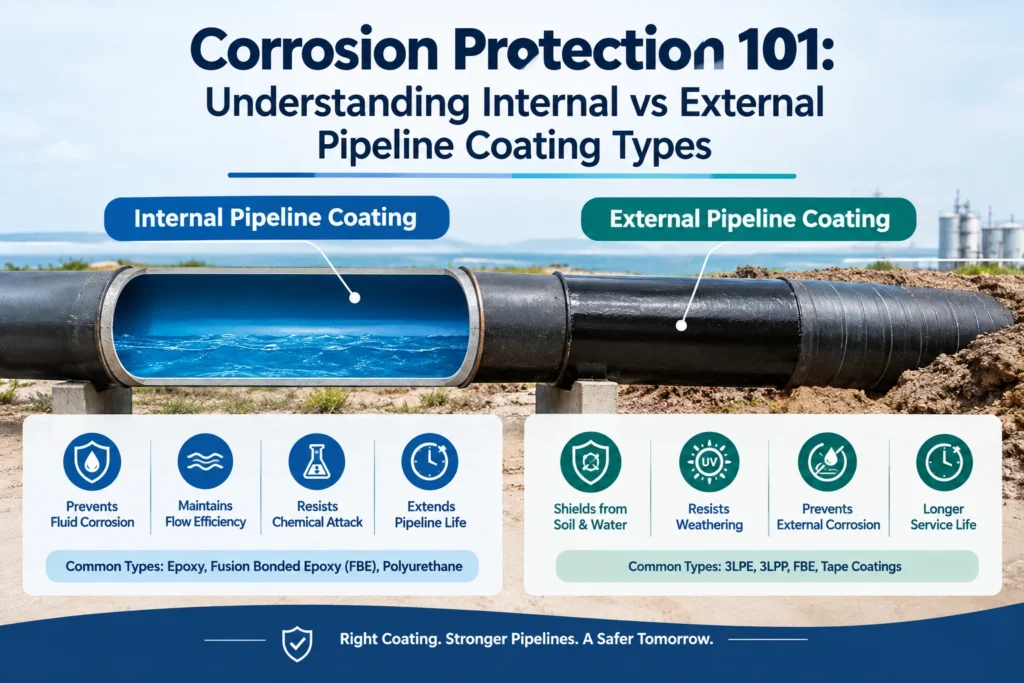
Corrosion in pipelines can shorten their lifespan, raise maintenance expenses, and cause major operational issues. Therefore, choosing the appropriate corrosion protection system is crucial to pipeline design for pipelines carrying chemicals, water, oil, gas, and other fluids.
Internal coatings, which shield the pipe’s inside surface, and external coatings, which shield the pipe’s outside from dirt, moisture, chemicals, seawater, and other environmental factors, are the two main types of pipeline coatings.
Engineers, EPC contractors, and purchasers can choose the best protection for their working conditions by being aware of the differences between different coating methods.
What Causes Pipeline Corrosion?
Corrosion occurs when a metal surface reacts with its surrounding environment.
Depending on the pipeline application, corrosion can be caused by:
Water and moisture
Oxygen
Chlorides and seawater
Carbon dioxide
Hydrogen sulfide
Acids and chemicals
Soil conditions
Microbiologically influenced corrosion
High temperatures
Abrasive particles
Electrical or galvanic effects
The corrosion mechanism can be different on the internal and external surfaces of a pipeline. This is why one coating system may not be suitable for both sides.
What Is Internal Pipeline Coating?
Internal coating is applied to the inside surface of a pipe or fitting to protect the metal from the transported fluid.
Internal coatings can also improve hydraulic performance by creating a smoother internal surface.
Common Internal Coating Types
Fusion Bonded Epoxy
Fusion bonded epoxy, commonly called FBE, is widely used for corrosion protection. It can provide a strong barrier between the steel surface and the surrounding environment.
FBE is commonly considered for:
Water pipelines
Oil and gas systems
Chemical pipelines
Process piping
Internal surfaces of fittings
The coating system must be selected according to the fluid, temperature, pressure and project requirements.
Liquid Epoxy Coatings
Liquid-applied epoxy systems can be applied to internal surfaces where site application, repair, or specific coating requirements make them suitable.
They can provide good chemical resistance and adhesion when the steel surface is properly prepared.
Cement Mortar Lining
Some water pipelines are frequently lined with cement mortar. It can assist in maintaining an appropriate interior surface and acts as a protective barrier between the steel and the conveyed water.
The chemistry of the water, the working environment, and the relevant specification all affect its applicability.
Polyurethane and Other Specialized Coatings
Polyurethane and other engineered coating systems may be selected for applications requiring specific combinations of chemical resistance, abrasion resistance or hydraulic performance.
What Is External Pipeline Coating?
External coating protects the outside surface of the pipeline from the surrounding environment.
Buried pipelines are exposed to:
Moisture
Soil
Salts
Chemicals
Groundwater
Microorganisms
Mechanical damage
Offshore pipelines face additional challenges such as:
Seawater
Chlorides
Marine organisms
Mechanical impact
Temperature variations
External coating is therefore a critical part of pipeline corrosion-control design.
Common External Pipeline Coating Types
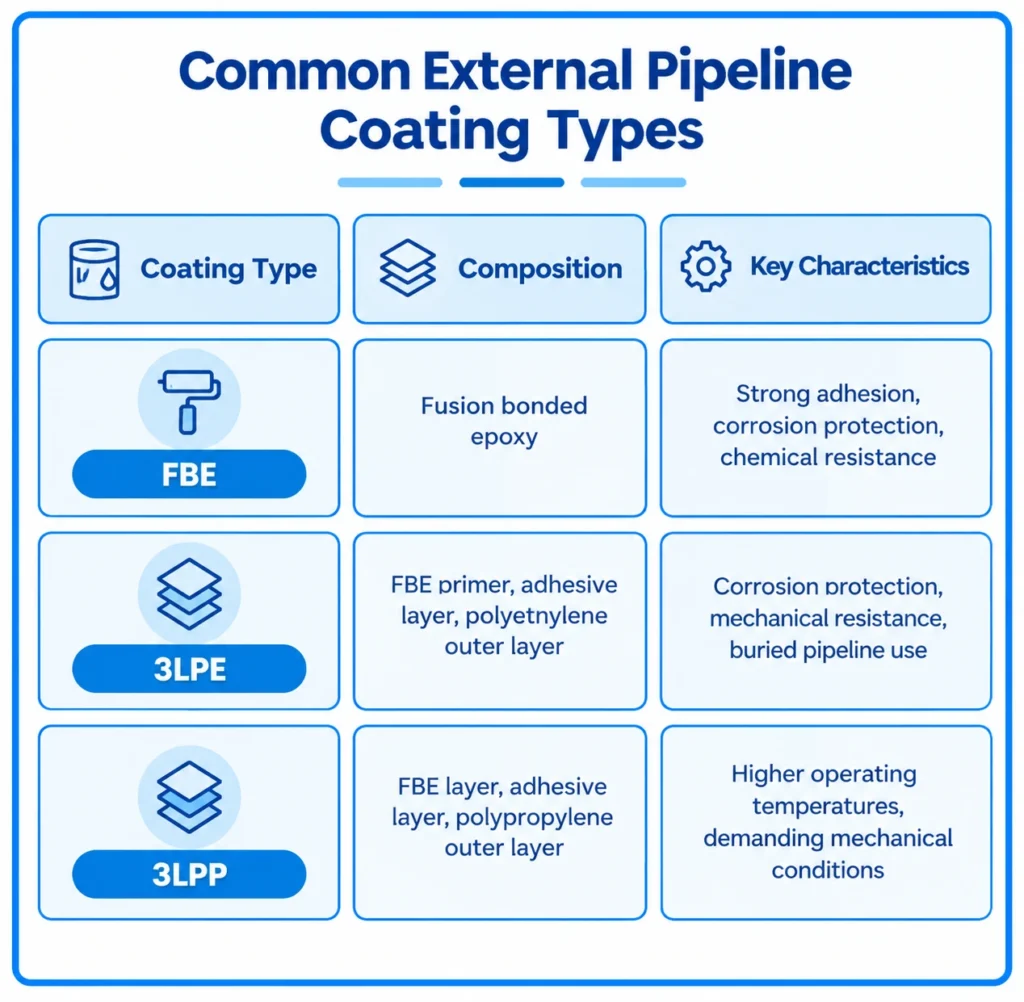
FBE Coating
FBE is one of the widely used external pipeline coating systems.
It provides a bonded protective layer over prepared steel and can be used for buried and other pipeline applications.
Advantages include:
Strong adhesion
Corrosion protection
Good chemical resistance
Relatively uniform coating
Suitable for many pipeline applications
However, application temperature, surface preparation, coating thickness and handling requirements must be controlled carefully.
3LPE Coating
Three-layer polyethylene, or 3LPE, combines multiple layers to provide corrosion protection and mechanical protection.
A typical system consists of:
Fusion bonded epoxy primer
Adhesive layer
Polyethylene outer layer
The epoxy provides corrosion protection, while the polyethylene layer offers additional mechanical resistance.
3LPE is widely considered for buried pipelines where resistance to soil and handling damage is important.
3LPP Coating
Three-layer polypropylene, or 3LPP, is similar in basic structure to 3LPE but uses polypropylene as the outer layer.
The system generally includes:
FBE layer
Adhesive layer
Polypropylene outer layer
3LPP can be selected for applications involving higher operating temperatures or demanding mechanical conditions.
Internal vs External Coating
Feature | Internal Coating | External Coating |
Protected surface | Inside pipe | Outside pipe |
Main threat | Transported fluid | Soil, water, seawater and environment |
Main objective | Internal corrosion control | External corrosion control |
Common systems | FBE, epoxy, cement mortar | FBE, 3LPE, 3LPP |
Hydraulic benefit | Can improve internal surface smoothness | Generally not applicable |
Mechanical protection | Usually less important | Often highly important |
Application considerations | Fluid compatibility and temperature | Soil, moisture, impact and temperature |
Why Surface Preparation Matters
Even the best coating can fail if the steel surface is not properly prepared.
Surface preparation typically involves:
Removing oil and grease
Removing rust and mill scale
Abrasive blasting
Achieving the required surface profile
Controlling surface cleanliness
Controlling steel temperature
Checking humidity and dew point
Poor surface preparation can lead to inadequate adhesion, blistering, premature coating failure and under-film corrosion.
Coating Thickness and Inspection
Coating thickness must comply with the applicable project specification.
Inspection may include:
Visual inspection
Dry film thickness measurement
Holiday detection
Adhesion testing
Surface profile measurement
Coating continuity testing
Spark testing where applicable
For multilayer systems, inspectors may also verify individual coating layers and application parameters.
Coating Selection for Different Applications
There is no single coating system suitable for every pipeline.
Oil and Gas Pipelines
FBE, 3LPE and 3LPP systems are commonly considered depending on temperature, environment, mechanical requirements and project specifications.
Water Pipelines
FBE and cement mortar lining may be considered for internal protection, while external FBE or multilayer systems can be used depending on installation conditions.
Offshore Pipelines
Coating systems must withstand seawater exposure, mechanical damage, temperature changes and other marine conditions. Additional corrosion-control systems, including cathodic protection, may also be required.
Chemical Pipelines
Internal coating selection should focus strongly on chemical compatibility, operating temperature and concentration. A coating suitable for one chemical may not be suitable for another.
Coating vs Cathodic Protection
Pipeline corrosion protection frequently employs multiple techniques.
An exterior coating can serve as the main barrier for steel pipelines that are buried or submerged, while cathodic protection offers extra defense at coating flaws or exposed places.
As a result, rather than being viewed as total replacements, the two systems cooperate.
How to Choose the Right Coating
Before selecting a coating system, consider:
Pipeline material
Internal fluid
Fluid chemistry
Operating temperature
Operating pressure
Soil conditions
Burial depth
Seawater exposure
Installation method
Mechanical handling requirements
Expected service life
Required coating thickness
Repair requirements
Applicable project standards
For critical projects, coating manufacturers, engineers and inspection agencies may need to review the complete operating conditions before final selection.
Related Reports
Inconel vs Hastelloy Fittings: Which High Nickel Alloy is Right for Your Project?
What Is Fusion Bonded Epoxy (FBE) Coating? Benefits for Oil & Gas Pipelines & Fittings
What Is Inconel Used For in Oil and Gas? Grades, Properties & Applications
Types of Stainless Steel Fittings: SS 310, 904L, 317L & When to Use Them
Conclusion
Although they have different functions, internal and external pipeline coatings are equally crucial for long-term corrosion prevention.
In addition to protecting the pipe from the fluid being conveyed, interior coatings can enhance the internal surface properties. Steel is shielded against soil, moisture, seawater, chemicals, and mechanical damage via external coatings.
There are particular uses and restrictions for common systems including FBE, 3LPE, 3LPP, liquid epoxy, and cement mortar lining. Temperature, chemical exposure, mechanical circumstances, installation environment, and project criteria all influence the right decision.
Effective corrosion protection for pipeline owners and EPC contractors begins with appropriate material selection, surface preparation, coating application, inspection, and long-term corrosion-control planning.
How We Support You
Selecting the right pipeline coating requires understanding whether protection is needed on the internal surface, external surface, or both. The correct coating system depends on the transported fluid, soil conditions, temperature, pressure, corrosion risks, installation environment, and project specifications. We help you identify suitable internal and external pipeline coating solutions for long-term protection and reliable service.
Our Support Includes:
Guidance on selecting suitable internal vs external pipeline coating systems based on operating and environmental conditions
Recommendations for protection against internal corrosion, external corrosion, moisture, chemicals, chlorides, and aggressive soil conditions
Support in selecting coating systems such as FBE, 3LPE, 3LPP, internal epoxy coatings, and other project-specific protective systems
Assistance with coating selection for oil & gas pipelines, water transmission, petrochemical, chemical, marine, and industrial applications
Technical guidance based on operating temperature, transported media, pressure, soil exposure, immersion conditions, and installation method
Support for FBE-coated pipe fittings, elbows, tees, reducers, flanges, bends, and other pipeline components
Assistance with coating requirements including surface preparation, coating thickness, application conditions, curing, inspection, and holiday testing
Guidance on relevant ASTM, ASME, API, ISO, NACE, and project-specific coating requirements
Support with coating inspection reports, test documentation, material certificates, traceability, and third-party inspection
Custom coating solutions for different pipe sizes, fitting configurations, coating thicknesses, service environments, and project requirements
Whether your project involves buried pipelines, offshore pipelines, water transmission systems, oil & gas facilities, refineries, chemical plants, or industrial process lines, we help you select appropriate internal and external corrosion protection systems based on the pipeline’s operating environment, material, service conditions, and required service life.