
In demanding industries like oil and gas, offshore engineering, desalination, chemical processing, maritime applications, and power generation, duplex and super duplex stainless steels are extensively utilized. These materials combine exceptional resistance to stress corrosion cracking, pitting, crevice corrosion, and corrosion caused by chloride with great mechanical strength.
Choosing the right material grade is just one step in the process of buying duplex or super duplex piping components. Because it outlines specifications for production, chemical composition, heat treatment, mechanical qualities, testing, and product form, the relevant ASTM product standard is equally significant.
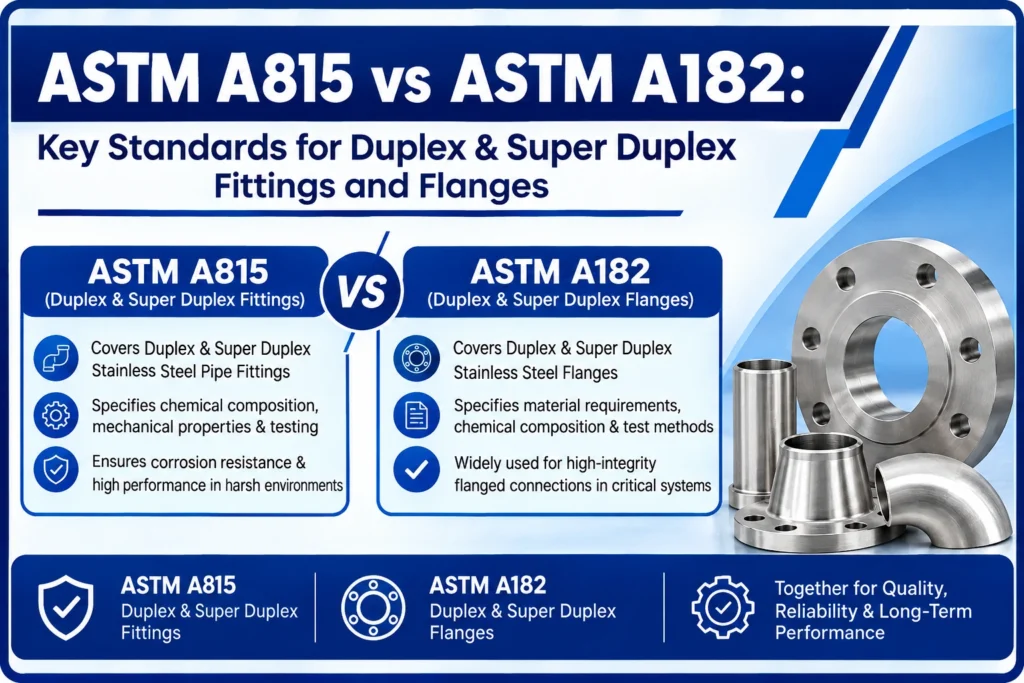
ASTM A815/A815M and ASTM A182/A182M are two significant standards utilized for these components. Both are applicable to duplex and super duplex stainless steel components, but they cannot be used interchangeably. While ASTM A182 covers forged or rolled pipe flanges, forged fittings, valves, and related pressure components, ASTM A815 mainly covers wrought stainless steel piping fittings.
What Is ASTM A815?
Wrought ferritic, ferritic/austenitic, and martensitic stainless steel piping fittings are covered by ASTM A815/A815M.
For duplex and super duplex applications, ASTM A815 is commonly associated with products such as:
90° elbows
45° elbows
Equal tees
Reducing tees
Concentric reducers
Eccentric reducers
Caps
Crosses
Other wrought piping fittings
The standard addresses requirements related to chemical composition, mechanical properties, heat treatment, manufacturing, and product analysis.
What Is ASTM A182?
Forged or rolled alloy and stainless steel pipe flanges, forged fittings, valves, and other parts meant for pressure systems and high-temperature use are covered by ASTM A182/A182M.
It is commonly used for:
Weld neck flanges
Blind flanges
Slip-on flanges
Socket weld flanges
Threaded flanges
Forged fittings
Valve components
Other forged pressure-containing parts
The specification establishes requirements for chemical composition, heat treatment, mechanical properties, hardness, and other applicable quality requirements.
ASTM A815 vs ASTM A182: The Main Difference
The simplest way to understand the difference is:
ASTM A815 = Wrought stainless steel piping fittings
ASTM A182 = Forged or rolled stainless steel flanges, forged fittings, valves, and related pressure components
This distinction is important because a project may require both standards for different components within the same piping system.
For example, a super duplex piping assembly could contain:
ASTM A815 UNS S32750 elbow
ASTM A815 UNS S32750 tee
ASTM A182 F53 flange
ASTM A182 F55 forged component
The material family may be similar, but the applicable ASTM specification depends on the type and manufacturing route of the component.
Comparison Table
Feature | ASTM A815/A815M | ASTM A182/A182M |
Primary Scope | Wrought stainless steel piping fittings | Forged/rolled flanges, fittings, valves and parts |
Typical Products | Elbows, tees, reducers, caps | Flanges, forged fittings, valve parts |
Duplex Materials | Yes | Yes |
Super Duplex Materials | Yes | Yes |
Manufacturing | Wrought, seamless or welded | Forged or rolled |
Typical Applications | Piping systems | Pressure-containing components |
Heat Treatment | Required according to grade/specification | Required according to grade/specification |
Mechanical Testing | Required | Required |
High-Pressure Applications | Yes, when properly specified | Yes |
Duplex and Super Duplex Grades
Both standards can be used with duplex and super duplex stainless steel grades, depending on the applicable product requirements.
Common duplex grades include:
UNS S31803
UNS S32205
Common super duplex grades include:
UNS S32750
UNS S32760
For example, Super Duplex 2507 components may be supplied as an ASTM A182 forged component or an ASTM A815 wrought fitting; the exact nomenclature will depend on the product form and applicable standard.
As a result, a purchase order must contain more details than merely “Super Duplex 2507”. The order should include the pertinent ASTM standard, UNS grade, dimensions, pressure requirements, testing, and documentation.
Manufacturing Differences
ASTM A815 Manufacturing
ASTM A815 covers wrought fittings manufactured through processes such as:
Bending
Forging
Extrusion
Rolling
Welding
Machining
Pressing
Other approved forming processes
Various fitting classifications are included in the standard based on the production process and relevant examination criteria.
Because of this, A815 is especially well suited for wrought piping fittings used in transmission and process systems.
ASTM A182 Manufacturing
ASTM A182 covers components that are rolled or forged. It consists of the pressure system’s flanges, fittings, valves, and other such components.
The production method and subsequent heat treatment are particularly important since forging affects the component’s mechanical characteristics and grain structure.
Why Heat Treatment Matters
Duplex and super duplex stainless steels require carefully controlled heat treatment to maintain their desired ferrite-austenite balance and corrosion resistance.
Improper processing can negatively affect:
Corrosion resistance
Toughness
Mechanical strength
Phase balance
Long-term service performance
ASTM A815 contains heat-treatment criteria for covered fitting materials, whereas ASTM A182 specifies heat-treatment requirements for forged components.
For significant projects, buyers should review the manufacturer’s heat-treatment records to ensure they adhere to the necessary grade and product standard.
Testing and Inspection Requirements
Quality control is especially important when duplex or super duplex components are used in offshore, subsea, chemical, or desalination applications.
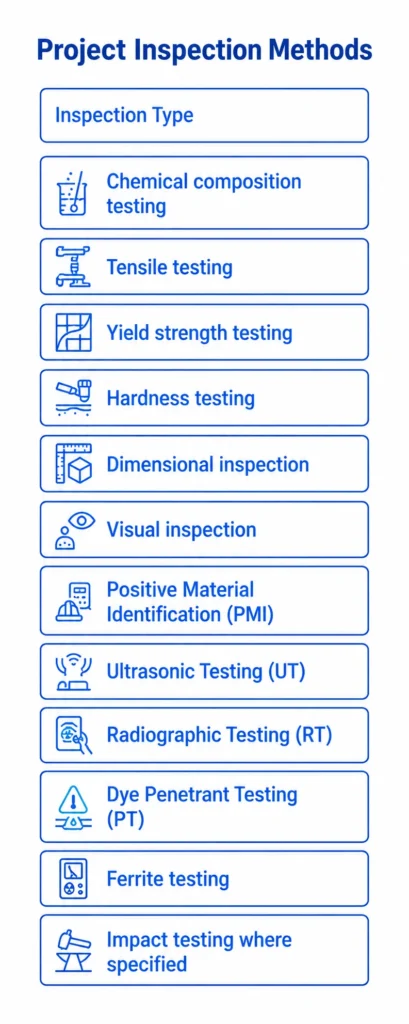
Depending on the project specification, inspection may include:
Chemical composition testing
Tensile testing
Yield strength testing
Hardness testing
Dimensional inspection
Visual inspection
Positive Material Identification (PMI)
Ultrasonic Testing (UT)
Radiographic Testing (RT)
Dye Penetrant Testing (PT)
Ferrite testing
Impact testing where specified
Additional testing may be required by the end user, EPC contractor, or project specification.
ASTM A815 Fittings vs ASTM A182 Flanges
A common procurement mistake is assuming that one ASTM specification can cover an entire piping package.
For example, a project requiring Super Duplex UNS S32750 piping may need:
Pipe: Applicable pipe material specification
Butt-weld fittings: ASTM A815
Forged/socket-weld fittings: Applicable forged fitting specification, often ASTM A182 where applicable
Flanges: ASTM A182
Dimensions: ASME B16.5, ASME B16.9, ASME B16.11, or another specified dimensional standard
This illustrates why the material grade and product specification must be treated as separate requirements.
Which Standard Should You Choose?
The answer depends primarily on the product type and manufacturing method.
Choose ASTM A815 When:
You are purchasing wrought piping fittings
The component is an elbow, tee, reducer, or cap
Seamless or welded wrought construction is required
The project specification calls for A815
Duplex or super duplex butt-weld fittings are required
Choose ASTM A182 When:
You are purchasing forged flanges
Forged fittings are required
Valve or pressure-containing components are involved
The component is manufactured through a forging or rolling process
The project specification calls for A182
The applicable project specification should always take precedence over a generic material-selection preference.
Common Applications
Duplex and super duplex fittings and flanges manufactured to these standards are used in:
Oil & Gas
Process piping
Offshore platforms
Gas processing
Water injection systems
Subsea equipment
Desalination
Seawater intake systems
Brine lines
Reverse osmosis systems
High-pressure piping
Chemical Processing
Acid handling
Chemical transfer lines
Corrosive process piping
Marine Applications
Seawater cooling
Ballast systems
Marine piping
Offshore utilities
Power Generation
Cooling water systems
Condensate systems
Chemical treatment systems
What Buyers Should Check Before Ordering
When sourcing duplex or super duplex fittings and flanges, buyers should clearly specify:
ASTM product specification
UNS material grade
Component type
Size
Wall thickness or schedule
Pressure class where applicable
Dimensional standard
Heat-treatment requirements
Testing requirements
Material Test Certificate requirements
Third-party inspection requirements
Surface finish requirements
For international projects, complete documentation and traceability are particularly important.
Related Reports
Inconel vs Hastelloy Fittings: Which High Nickel Alloy is Right for Your Project?
What Is Fusion Bonded Epoxy (FBE) Coating? Benefits for Oil & Gas Pipelines & Fittings
What Is Inconel Used For in Oil and Gas? Grades, Properties & Applications
Types of Stainless Steel Fittings: SS 310, 904L, 317L & When to Use Them
Conclusion
ASTM A815 and ASTM A182 are important standards for duplex and super duplex plumbing components, albeit covering different product groups. ASTM A815 focuses on wrought stainless steel piping fittings, including seamless and welded fittings, whereas ASTM A182 covers forged or rolled stainless steel flanges, forged fittings, valves, and other pressure components.
For a plumbing system to be successful, it is not enough to simply state UNS S32750, UNS S32760, or any duplex grade. The procurement specification should include the appropriate ASTM product standard, dimensional standard, production route, testing criteria, and documentation.
By understanding the distinctions between ASTM A815 and ASTM A182, engineers, procurement teams, EPC contractors, and end users can avoid specification errors and ensure that duplex and super duplex components offer the required strength, corrosion resistance, and long-term reliability in demanding industrial environments.
How We Support You
Selecting the correct ASTM material standard is essential for ensuring the quality, dimensional accuracy, mechanical performance, and long-term reliability of duplex and super duplex piping components. Our team helps you determine whether ASTM A815 or ASTM A182 is appropriate based on the component type, material grade, manufacturing process, pressure requirements, and project specifications.
Our Support Includes:
Expert guidance on understanding the differences between ASTM A815 and ASTM A182 for duplex and super duplex components
Recommendations based on fitting type, flange requirements, pressure class, temperature, and service conditions
Assistance with selecting suitable grades such as UNS S31803, S32205, S32750, and S32760
Guidance on sourcing duplex and super duplex elbows, tees, reducers, caps, bends, flanges, and other piping components
Technical support for applications requiring resistance to chlorides, seawater, pitting, crevice corrosion, and stress corrosion cracking
Assistance with compliance to ASTM, ASME, ANSI, API, NORSOK, NACE, and project-specific specifications
Support with Material Test Certificates (MTCs), PMI reports, heat treatment records, dimensional inspection, and third-party inspection documentation
Recommendations for oil & gas, offshore, subsea, desalination, chemical processing, marine, and petrochemical applications
Custom solutions for sizes, wall thicknesses, pressure classes, fitting configurations, and project-specific requirements
Fast quotations and dependable bulk supply support for projects across the GCC, Africa, Europe, and international markets
Whether your project requires duplex or super duplex fittings and flanges for offshore platforms, subsea pipelines, desalination plants, chemical facilities, or high-pressure process piping, we provide reliable solutions aligned with the applicable ASTM A815 and ASTM A182 requirements, project specifications, and demanding service conditions.