
The long-term dependability and performance of buried pipelines depend on the choice of external coating technology. Pipelines are constantly subjected to corrosive soil conditions, moisture, temperature changes, and mechanical strains in oil and gas, water transport, petrochemical processing, and industrial applications. These elements may result in corrosion, leaks, expensive repairs, and early pipeline failure in the absence of sufficient protection.
Three-Layer Polyethylene (3LPE) and Three-Layer Polypropylene (3LPP) coatings are two of the most used external coating technologies for buried pipelines. Both systems provide greater mechanical durability and corrosion resistance by combining numerous protective layers. However, each coating is appropriate for particular operating situations due to the substantial differences in their performance characteristics.
This article compares 3LPE and 3LPP coatings to help pipeline operators, engineers, and project managers determine the best solution for their applications.
What Are 3LPE and 3LPP Coatings?
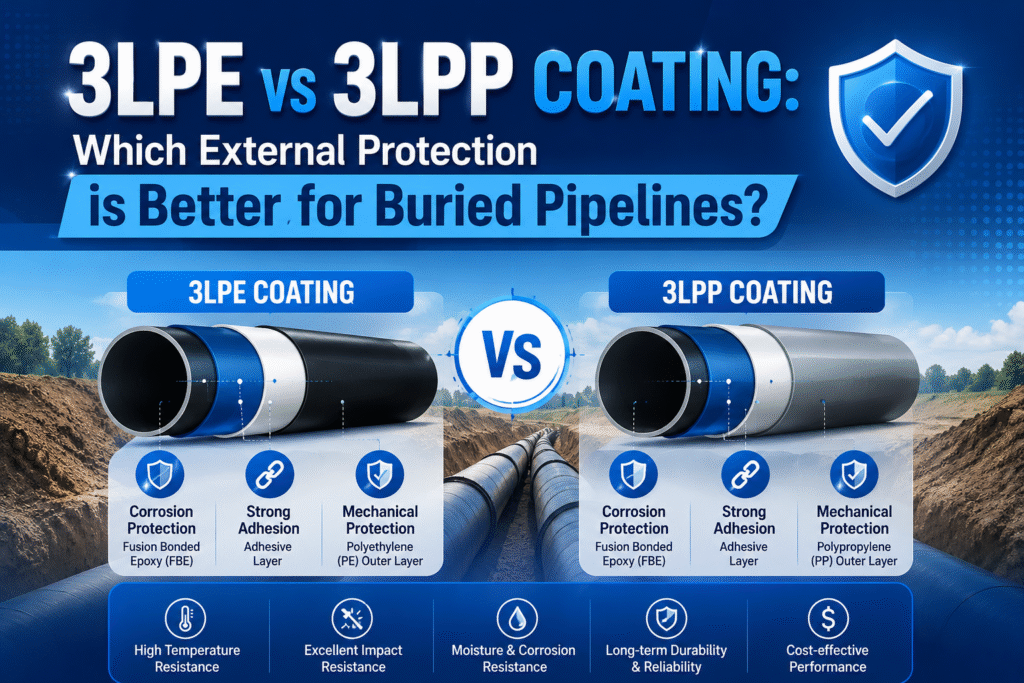
Multilayer coating systems like 3LPE and 3LPP are intended to shield steel pipelines from mechanical damage and external corrosion. Although their outer layers are made of different materials, they have a comparable structure.
A typical three-layer coating system consists of:
Fusion Bonded Epoxy (FBE) Primer: Provides excellent adhesion to the steel surface and serves as the primary corrosion protection layer.
Adhesive Copolymer Layer: Creates a strong bond between the FBE primer and the outer layer.
Polyolefin Outer Layer: Offers mechanical protection against impact, abrasion, moisture, and soil stress.
The key difference lies in the outer protective layer:
3LPE: Uses polyethylene as the outer layer.
3LPP: Uses polypropylene as the outer layer.
This distinction significantly affects the coating’s temperature resistance, flexibility, and overall performance.
How 3LPE Coating Works
3LPE coating combines the corrosion resistance of FBE with the flexibility and toughness of polyethylene.
The outer polyethylene layer provides:
Excellent impact resistance
High resistance to moisture penetration
Good flexibility during installation
Strong resistance to soil stress and abrasion
Because of its cost-effectiveness and reliable performance, 3LPE is widely used for onshore buried pipelines operating at moderate temperatures.
How 3LPP Coating Works
3LPP coating uses polypropylene as the outer protective layer, offering enhanced thermal and mechanical performance.
Compared with polyethylene, polypropylene provides:
Higher operating temperature resistance
Improved resistance to mechanical damage
Better performance under thermal cycling
Superior resistance to deformation at elevated temperatures
These characteristics make 3LPP suitable for demanding applications involving higher operating temperatures.
Key Differences Between 3LPE and 3LPP Coatings
Temperature Resistance
Temperature is often the most critical factor when selecting a pipeline coating system.
3LPE coatings typically perform effectively at operating temperatures up to approximately 80°C.
3LPP coatings can withstand temperatures ranging from 110°C to 140°C, depending on the coating specification and operating conditions.
For pipelines transporting hot fluids or operating in high-temperature environments, 3LPP is generally the preferred option.
Flexibility and Low-Temperature Performance
Polyethylene offers greater flexibility than polypropylene, especially at lower temperatures.
This allows 3LPE coatings to:
Accommodate ground movement more effectively
Resist cracking in cold environments
Simplify handling and installation
For pipelines installed in colder climates or regions with significant soil movement, 3LPE often provides better performance.
Mechanical Strength
Both coating systems offer excellent protection against mechanical damage, but 3LPP generally delivers higher hardness and improved resistance to:
Indentation
Abrasion
Compression
Elevated temperature stress
This makes 3LPP suitable for demanding installation conditions and environments where mechanical loads are significant.
Moisture and Corrosion Resistance
Excellent defense against moisture intrusion and exterior corrosion is offered by both 3LPE and 3LPP.
While the adhesive and outer layers stop water penetration and shield the coating from harm, the FBE primer serves as the main anti-corrosion barrier.
Both technologies provide long-term corrosion protection for subterranean pipelines when used and maintained correctly.
Cost Considerations
Cost is another important factor in coating selection.
3LPE coatings are generally more economical.
3LPP coatings involve higher material and application costs due to the performance characteristics of polypropylene.
For standard operating conditions, 3LPE often provides the best balance between cost and performance.
Typical Applications of 3LPE Coatings
3LPE coatings are commonly used in:
Crude oil pipelines
Natural gas transmission pipelines
Water distribution networks
Cross-country pipelines
Municipal infrastructure projects
Low- to medium-temperature industrial pipelines
Typical Applications of 3LPP Coatings
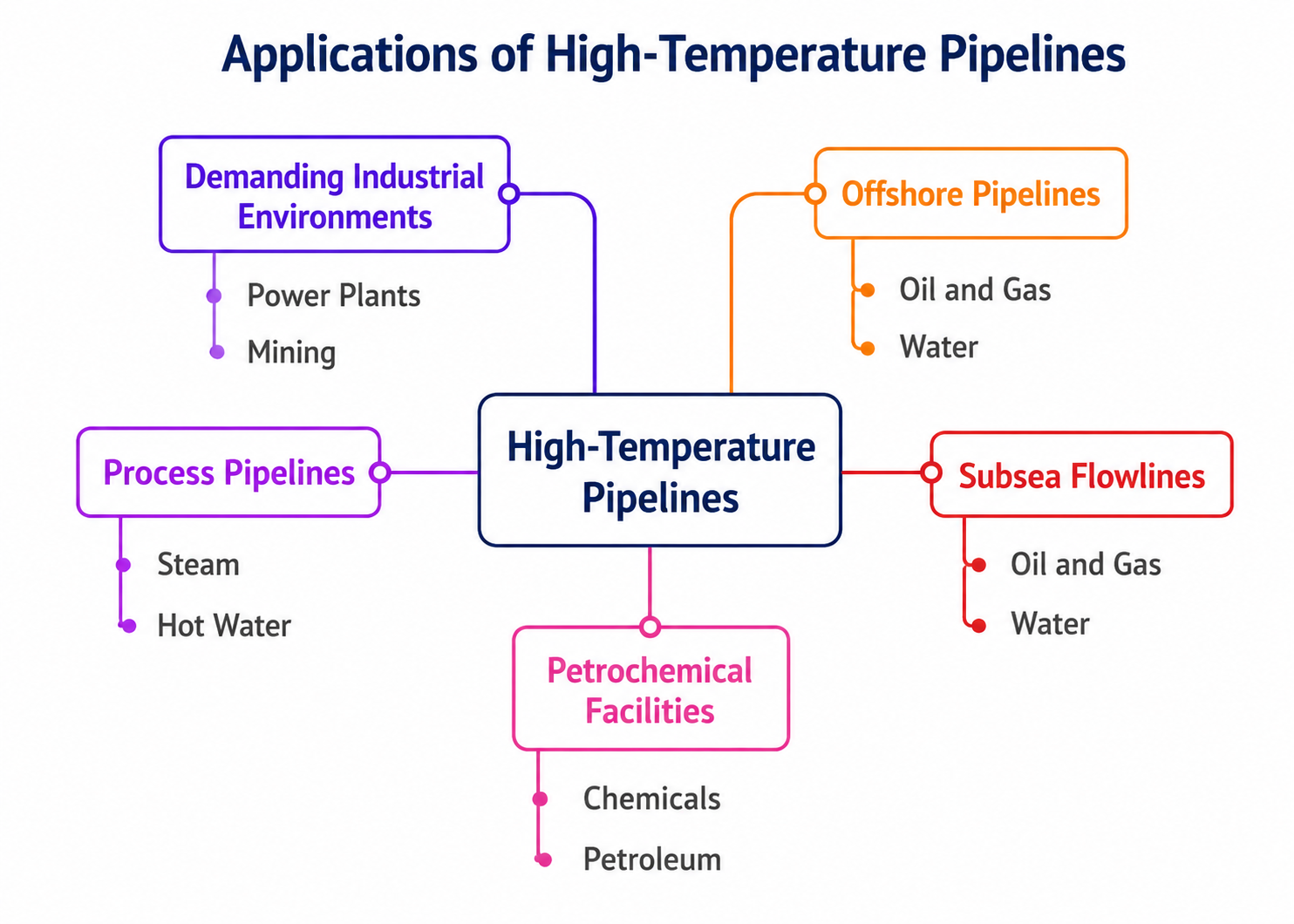
3LPP coatings are widely used in:
High-temperature oil pipelines
Offshore pipelines
Subsea flowlines
Petrochemical facilities
Process pipelines carrying heated fluids
Pipelines in demanding industrial environments
3LPE vs 3LPP: Comparison Table
Parameter | 3LPE | 3LPP |
Outer Layer Material | Polyethylene | Polypropylene |
Maximum Operating Temperature | Up to approximately 80°C | Up to approximately 140°C |
Low-Temperature Flexibility | Excellent | Good |
Impact Resistance | Excellent | Excellent |
Abrasion Resistance | Very Good | Excellent |
High-Temperature Performance | Moderate | Superior |
Mechanical Strength | Very Good | Excellent |
Installation in Cold Climates | Excellent | Good |
Relative Cost | Lower | Higher |
Typical Applications | Buried onshore pipelines | High-temperature and offshore pipelines |
Which External Protection Is Better for Buried Pipelines?
There is no single coating system that is universally better for every application. The ideal choice depends on operating conditions, environmental factors, project requirements, and budget.
Choose 3LPE coating when:
Operating temperatures are moderate
Cost efficiency is a priority
Pipelines are installed in colder environments
Greater flexibility is required
Choose 3LPP coating when:
Pipelines operate at elevated temperatures
Enhanced mechanical strength is needed
Thermal cycling is significant
Long-term performance in demanding environments is critical
In many standard buried pipeline applications, 3LPE provides an effective and economical solution. However, for high-temperature pipelines and more challenging operating conditions, 3LPP delivers superior performance and durability.
Related Reports
Inconel vs Hastelloy Fittings: Which High Nickel Alloy is Right for Your Project?
What Is Fusion Bonded Epoxy (FBE) Coating? Benefits for Oil & Gas Pipelines & Fittings
What Is Inconel Used For in Oil and Gas? Grades, Properties & Applications
Types of Stainless Steel Fittings: SS 310, 904L, 317L & When to Use Them
Conclusion
By combining the advantages of Fusion Bonded Epoxy with strong polyolefin outer layers, 3LPE and 3LPP coatings provide superior external corrosion protection for buried pipes.
While 3LPP excels in high-temperature and mechanically demanding situations, 3LPE is generally selected for its versatility, affordability, and robust performance in moderate-temperature applications.
The best coating system for long-term pipeline integrity and dependability will be chosen with careful consideration of variables such operating temperature, soil conditions, installation environment, mechanical stress, and project budget.
How We Support You
Selecting the right external pipeline coating is essential for ensuring long-term corrosion protection, mechanical durability, and reliable performance in buried pipeline applications. Our team helps you determine whether 3LPE (Three-Layer Polyethylene) or 3LPP (Three-Layer Polypropylene) coating is the best fit based on operating temperature, soil conditions, installation methods, and project requirements.
Our Support Includes:
Expert guidance in selecting the most suitable 3LPE or 3LPP coating system for your pipeline application
Recommendations based on operating temperature, soil characteristics, environmental conditions, and installation requirements
Technical support for protection against corrosion, moisture ingress, impact damage, abrasion, and cathodic disbondment
Assistance with compliance to ISO, DIN, ASTM, ASME, API, CSA, and project-specific standards
Guidance on coating selection for buried pipelines, cross-country transmission lines, offshore pipelines, and subsea applications
Support in choosing the right coating for oil and gas, water transmission, petrochemical, and industrial pipeline systems
Recommendations for pipelines operating in high-temperature, corrosive, rocky, and challenging terrain conditions
Assistance with coating specifications, quality documentation, inspection reports, and material test certificates (MTCs)
Custom solutions for coating thicknesses, pipe diameters, operating pressures, and project-specific requirements
Fast quotations and dependable bulk supply support for projects across the GCC, Africa, and global markets
Whether your project involves long-distance transmission pipelines, refinery infrastructure, offshore developments, desalination facilities, or industrial processing plants, we provide reliable pipeline coating solutions designed to maximize service life, reduce maintenance costs, and ensure long-term asset integrity in demanding environments.