
Petrochemical, electricity, water, mining, oil and gas, and industrial piping systems all make extensive use of long radius bends. They aid with a pipeline’s direction change while lowering mechanical stress, erosion, turbulence, and pressure loss.
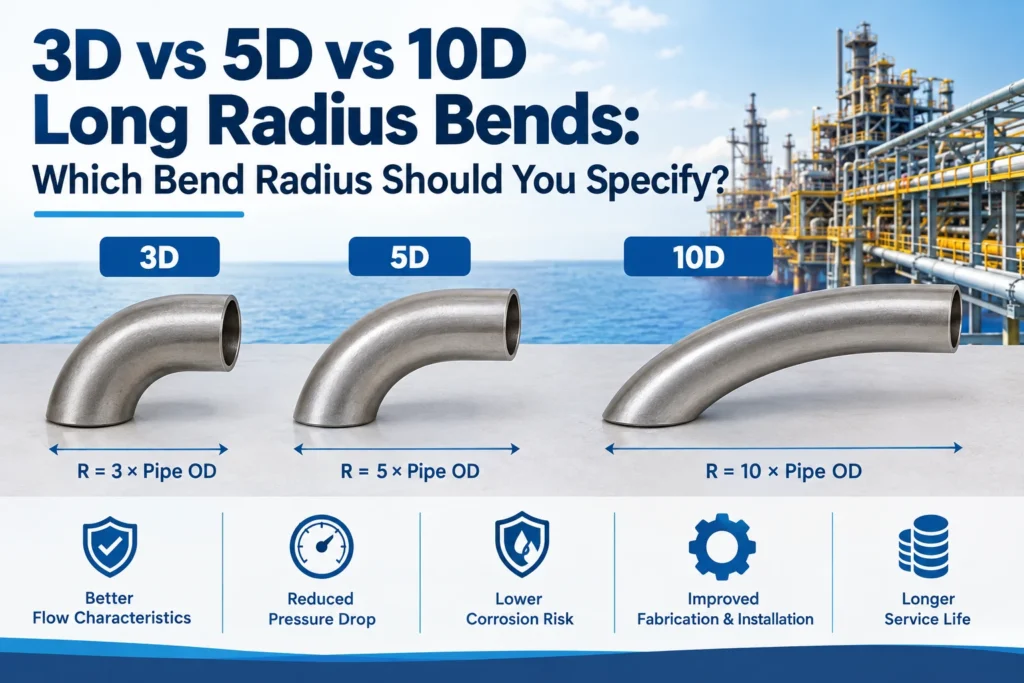
The bend radius is one of the most crucial choices when defining a bend. 3D, 5D, and 10D bends are popular choices, where “D” stands for the nominal pipe diameter.
Which radius, though, should you specify? Flow conditions, space availability, pressure drop requirements, pigging needs, erosion risk, and project specifications all influence the response.
What Does 3D, 5D and 10D Mean?
The “D” in a bend radius refers to the pipe’s nominal diameter.
For example, if a pipe has a nominal diameter of 10 inches:
3D bend = approximately 30-inch centerline radius
5D bend = approximately 50-inch centerline radius
10D bend = approximately 100-inch centerline radius
The actual dimensional requirements can vary according to the applicable manufacturing standard and project specification, so the required radius should always be clearly defined on the engineering drawing or purchase specification.
3D Long Radius Bends
A 3D bend provides a relatively compact change in direction while offering smoother flow than a short-radius bend.
Key advantages
Requires less installation space
Lower pressure loss than tighter bends
Suitable for many general industrial piping systems
Easier to accommodate in compact layouts
Available in carbon steel, stainless steel, duplex, super duplex and nickel alloys
Typical applications
3D bends can be used in:
Oil and gas piping
Refineries
Chemical plants
Water transmission
General process piping
Industrial utility systems
They are often selected when the piping layout has limited space but still requires a relatively smooth flow path.
5D Long Radius Bends
A 5D bend has a larger radius and provides a smoother transition than a 3D bend.
The additional radius can help reduce flow disturbance and local turbulence, making 5D bends useful in systems where hydraulic performance is more important.
Key advantages
Lower pressure loss compared with tighter-radius bends
Reduced turbulence
Better flow distribution
Lower risk of localized erosion
Useful for high-flow pipeline systems
Can be advantageous for pigging applications
Typical applications
5D bends are commonly considered for:
Long-distance oil and gas pipelines
Offshore pipelines
Water transmission systems
Slurry pipelines
High-flow process systems
Pipeline systems requiring smoother directional changes
For many pipeline applications, 5D provides a practical balance between hydraulic performance and installation space.
10D Long Radius Bends
A 10D bend provides a substantially larger radius than 3D or 5D.
Because the directional change occurs gradually, the flow path can be smoother and pressure losses can be reduced. However, the bend requires considerably more space.
Key advantages
Very smooth directional transition
Lower turbulence
Reduced pressure loss in suitable applications
Lower localized erosion potential
Useful where flow efficiency is critical
Can support demanding pigging and pipeline configurations
Typical applications
10D bends may be specified for:
Large-diameter pipelines
High-flow transmission systems
Offshore and subsea pipelines
Slurry transportation
Critical process piping
Systems where pressure loss needs to be minimized
The larger radius is particularly useful when pipeline performance is more important than compact installation.
3D vs 5D vs 10D: Key Differences
Feature | 3D Bend | 5D Bend | 10D Bend |
Bend radius | 3 × D | 5 × D | 10 × D |
Space requirement | Lower | Moderate | High |
Flow transition | Smooth | Smoother | Very smooth |
Pressure loss | Relatively higher | Lower | Generally lowest |
Turbulence | Moderate | Lower | Very low |
Installation flexibility | High | Moderate | Lower |
Typical use | General piping | Pipeline/high-flow systems | Critical/high-flow applications |
Cost/complexity | Generally lower | Moderate | Generally higher |
These comparisons are general engineering considerations. Actual pressure drop, erosion and flow behavior depend on pipe diameter, fluid properties, velocity, bend geometry, surface roughness and the overall piping configuration.
How Bend Radius Affects Flow
When fluid changes direction, the flow experiences additional disturbances. A tighter bend generally creates stronger changes in flow direction and can increase pressure losses.
Increasing the bend radius allows the fluid to change direction more gradually.
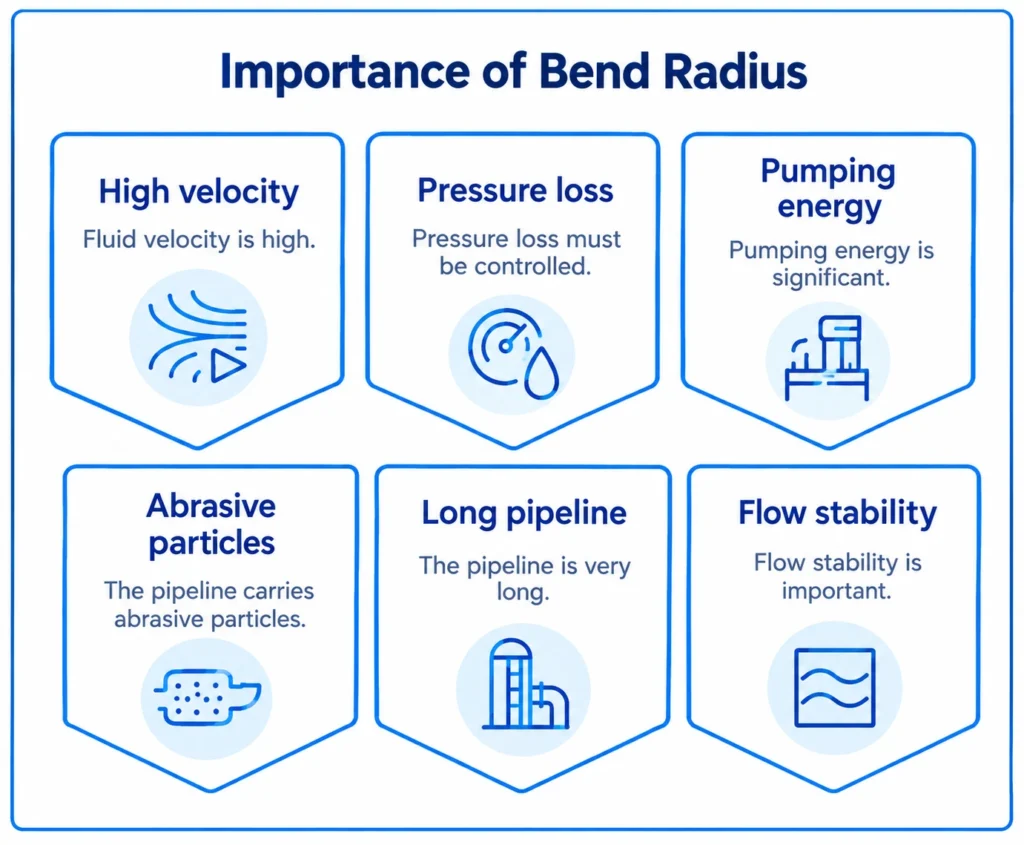
This can be particularly important when:
Fluid velocity is high
The pipeline carries abrasive particles
Pressure loss must be controlled
The pipeline is very long
Pumping energy is significant
Flow stability is important
For slurry pipelines, for example, bend geometry should be evaluated carefully because solid particles can increase erosion at directional changes.
Bend Radius and Pigging
Pigging is another important consideration for pipeline projects.
Pipelines carrying oil, gas, water or other fluids may use pigs for:
Cleaning
Inspection
Wax removal
Debris removal
Internal measurement
Maintenance
The bend radius, bend angle, diameter, ovality and internal geometry all influence pig passage.
A larger-radius bend can provide a smoother path for certain pigging operations. However, the suitability of a bend must be checked against the specific pig design and pipeline configuration rather than assuming that a larger radius automatically guarantees pig compatibility.
Which Bend Should You Specify?
There is no universal answer.
Specify 3D when:
Installation space is limited
The system is not highly sensitive to pressure loss
Standard industrial piping is involved
A compact layout is required
Consider 5D when:
The pipeline carries significant flow
Pressure loss needs to be reduced
Pigging is required
The system involves long-distance transportation
A balance between space and hydraulic performance is needed
Consider 10D when:
Flow efficiency is a major priority
Pipeline diameter is large
High velocities or erosion are concerns
Space is available
The project specification requires a large-radius transition
Material Selection Is Also Important
The bend radius is only one part of bend selection. Material must also match the operating environment.
Common materials include:
Carbon steel
Stainless steel 304/304L
Stainless steel 316/316L
Duplex 2205
Super Duplex S32750/S32760
Inconel 600/625
Hastelloy alloys
Other nickel alloys
For offshore and subsea applications, chloride exposure and seawater can make corrosion resistance particularly important. Duplex, super duplex and nickel alloys may be selected depending on the design conditions and project requirements.
Important Specifications to Check
Before ordering a 3D, 5D or 10D bend, confirm:
Pipe outside diameter
Wall thickness
Bend radius
Bend angle
Material grade
Manufacturing method
Applicable ASTM/ASME or project specification
Pressure and temperature
End preparation
Dimensional tolerances
Heat treatment
PMI requirements
NDT requirements
MTC and traceability requirements
For critical oil and gas projects, additional requirements may apply for sour service, corrosion testing, impact testing, hardness, ferrite content or third-party inspection.
Related Reports
Inconel vs Hastelloy Fittings: Which High Nickel Alloy is Right for Your Project?
What Is Fusion Bonded Epoxy (FBE) Coating? Benefits for Oil & Gas Pipelines & Fittings
What Is Inconel Used For in Oil and Gas? Grades, Properties & Applications
Types of Stainless Steel Fittings: SS 310, 904L, 317L & When to Use Them
Conclusion
The balance between installation space, flow performance, pressure loss, erosion, pigging, and project requirements determines whether to use 3D, 5D, or 10D large radius bends.
When compact installation and space are crucial, 3D bends might be helpful. For many pipeline and high-flow applications, 5D bends offer a workable balance. When space is available and hydraulic performance is important, 10D bends provide a significantly smoother directional transition.
Therefore, rather than choosing a bend radius based just on the diameter, the proper specification should be based on the entire piping design. Before deciding on the bend radius for essential applications, engineers should consider flow conditions, mechanical loads, pigging needs, material compatibility, and relevant project standards.
How We Support You
Selecting the right bend radius is important for maintaining smooth flow, reducing pressure losses, controlling stress, and ensuring reliable performance in demanding piping systems. Our team helps you select between 3D, 5D, and 10D long radius bends based on pipe diameter, flow requirements, operating pressure, temperature, space availability, material, and project specifications.
Our Support Includes:
Expert guidance on selecting 3D, 5D, and 10D long radius bends for different piping applications
Recommendations based on pipe diameter, bend radius, flow velocity, pressure, temperature, and installation conditions
Technical support for reducing turbulence, pressure drop, erosion, vibration, and flow-related stress
Assistance in selecting suitable bend radii for oil & gas pipelines, petrochemical plants, refineries, power plants, water transmission, and process piping
Support for different materials including carbon steel, stainless steel, duplex steel, super duplex, alloy steel, and high nickel alloys
Guidance on selecting 3D bends for space-conscious installations, 5D bends for balanced flow performance, and 10D bends where smoother flow and lower stress are required
Assistance with dimensional requirements, wall thickness, pipe schedule, bend angle, end preparation, and project-specific configurations
Support with compliance to relevant ASTM, ASME, ANSI, API, and project-specific piping standards
Assistance with Material Test Certificates (MTCs), dimensional inspection, PMI, heat treatment records, traceability, and third-party inspection requirements
Reliable support for custom sizes, large-diameter bends, bulk requirements, and project-specific long radius bend specifications
Whether your project involves long-distance pipelines, offshore facilities, refineries, petrochemical plants, power generation, water transmission systems, or industrial process piping, we help you select the appropriate 3D, 5D, or 10D bend radius according to your flow requirements, installation limitations, operating conditions, and required piping performance.