
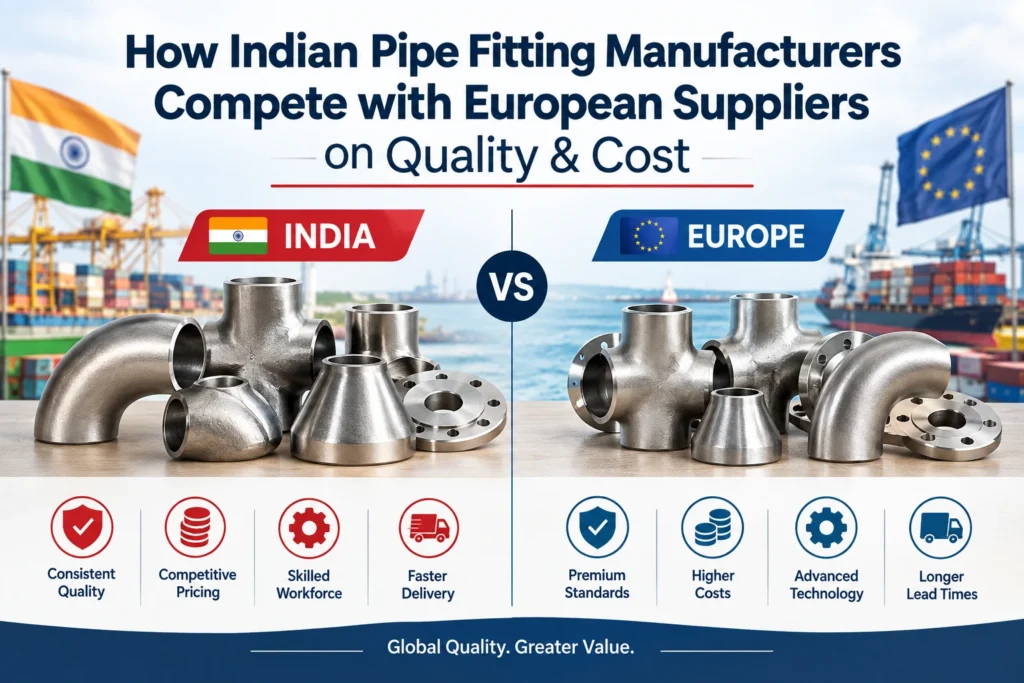
Oil and gas, petrochemical, electricity, chemical, water, maritime, and infrastructure projects all over the world now rely heavily on Indian pipe fitting makers. While Indian manufacturers are increasingly competing through international standards, manufacturing capabilities, quality control, customisation, and cost effectiveness, European manufacturers maintain their strong positions in highly regulated applications and specialised engineering.
For consumers, the contrast goes beyond just deciding between Europe and India. Whether the manufacturer can reliably achieve the necessary material specifications, dimensional standards, inspection requirements, paperwork, and delivery schedule is the more crucial concern.
International Standards Support Global Quality
A major factor helping Indian manufacturers compete internationally is their ability to manufacture fittings according to widely used standards.
Depending on the product and application, Indian manufacturers supply fittings and flanges according to standards such as:
ASTM
ASME
ANSI
MSS
EN
DIN
API
NACE requirements where applicable
Project-specific specifications
ASME B16.9 for factory-made butt-welding fittings and ASME B16.11 for threaded and forged socket-welding fittings are common pipe fitting standards. ASTM A234, ASTM A403, ASTM A815, ASTM A182, and other pertinent standards may be included in material specifications.
This makes it possible for competent Indian producers to create parts for projects that employ both domestic and international engineering guidelines.
Quality Control Is More Than the Final Inspection
European buyers generally expect detailed quality documentation and traceability, and established Indian manufacturers have developed their systems around these requirements.
Quality control can include:
Chemical composition testing
PMI testing
Tensile and yield testing
Hardness testing
Impact testing
Dimensional inspection
Ultrasonic testing
Radiographic testing
Magnetic particle testing
Dye penetrant testing
Hydrostatic testing
Ferrite testing for applicable stainless and duplex grades
Manufacturers may also provide EN 10204 3.1 or 3.2 documentation, depending on project requirements.
The important point is that quality should be evaluated manufacturer by manufacturer. A country of origin alone does not guarantee product quality.
Material Traceability Gives Buyers Greater Confidence
Traceability is particularly important for critical piping systems.
A properly documented fitting should allow the buyer or inspector to connect the finished component with its material heat and manufacturing records.
Typical documentation can include:
Material Test Certificate
Heat number
Chemical analysis
Mechanical test results
Heat-treatment records
PMI report
Dimensional inspection report
NDT reports
Hydrostatic test certificate where applicable
Certificate of conformity
For EPC projects, this documentation can be just as important as the physical fitting because it supports inspection, commissioning, and future maintenance records.
Why Indian Manufacturers Can Offer Competitive Pricing
Cost competitiveness is one of India’s important advantages.
Indian manufacturers benefit from several factors, including:
Large engineering and fabrication workforce
Established steel and forging industries
Extensive manufacturing clusters
Competitive labor costs
Domestic availability of raw materials
Large production capacity
Established export infrastructure
Experience producing standardized fittings in volume
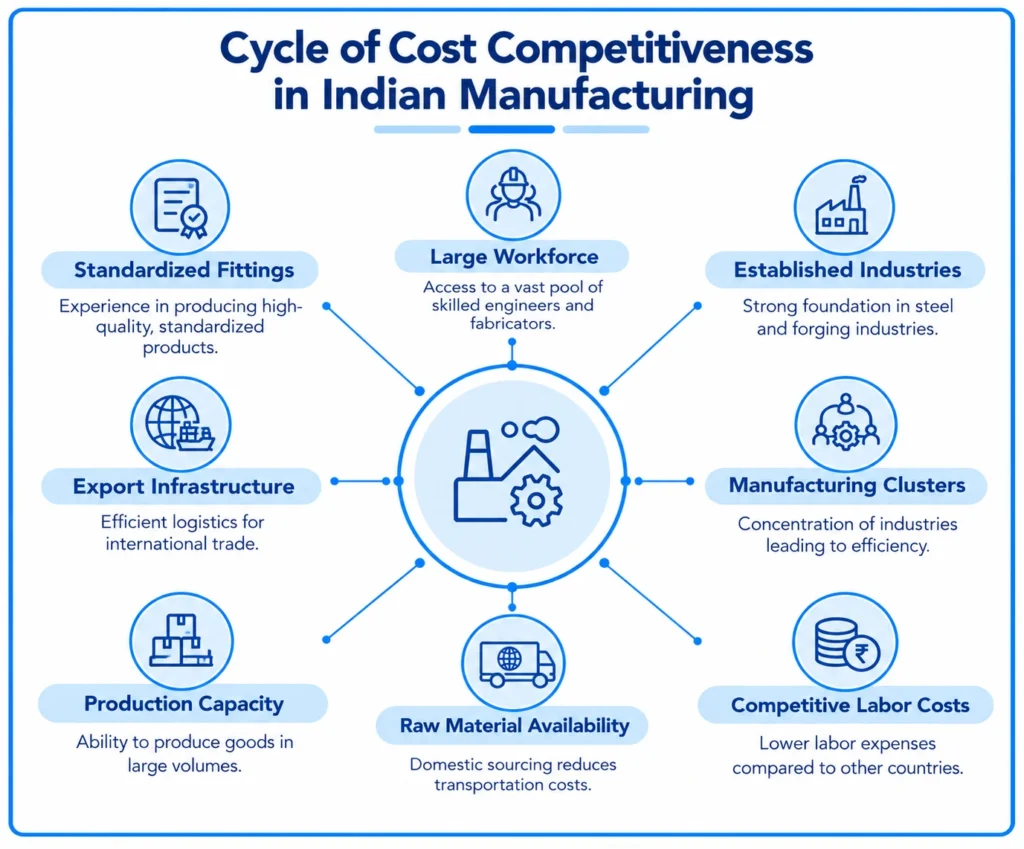
These factors can reduce manufacturing costs while allowing manufacturers to supply products to international specifications.
However, buyers should compare total landed cost, not just the factory quotation.
The final cost may also include:
Freight
Insurance
Inspection
Testing
Customs duties
Packaging
Certification
Documentation
Delivery time
Rejection or replacement risk
A lower initial price is useful only when the product meets the required technical and quality conditions.
Custom Manufacturing Is Another Advantage
Many projects require more than standard elbows, tees and reducers.
Indian manufacturers can produce customized components according to:
Engineering drawings
Special wall thickness
Non-standard dimensions
Special bend radius
Specific pressure classes
Special material grades
Machined ends
Customized tolerances
Project-specific inspection plans
This flexibility can be valuable for EPC contractors handling replacement components, brownfield projects and specialized piping systems.
Wide Range of Materials
Indian manufacturers also compete by offering a broad material portfolio.
Carbon Steel
Used extensively for general industrial, oil and gas, water and structural piping applications.
Stainless Steel
Grades such as 304, 304L, 316 and 316L are widely used in chemical, food, pharmaceutical and process applications.
Duplex Stainless Steel
Duplex 2205 provides a combination of strength and corrosion resistance and is frequently considered for oil and gas, marine and chemical applications.
Super Duplex
Grades such as UNS S32750 and S32760 are used where higher resistance to chloride-related corrosion is required.
Nickel Alloys
Inconel, Hastelloy and Monel can be selected for high-temperature or highly corrosive applications where conventional stainless steels may not be sufficient.
The availability of these materials allows qualified Indian suppliers to serve a wide range of international industries.
Indian vs European Suppliers: What Buyers Should Compare
Factor | Indian Manufacturers | European Manufacturers |
International standards | Widely available from qualified manufacturers | Widely established |
Manufacturing cost | Often competitive | Generally higher |
Customization | Available from experienced manufacturers | Available |
Material range | Broad | Broad |
Documentation | Can include EN 10204 and project-specific records | Strong documentation systems |
Lead time | Depends on production and export logistics | Depends on location and capacity |
Quality consistency | Manufacturer-dependent | Manufacturer-dependent |
Inspection | In-house and third-party options | Extensive inspection capabilities |
Export experience | Strong among established exporters | Strong |
Specialized applications | Available from qualified suppliers | Strong presence in specialized sectors |
This table is a general market comparison. Individual manufacturers can differ significantly in capabilities, quality systems, pricing, and delivery performance.
Certifications and Third-Party Inspection
For major projects, buyers can request independent inspection through organizations such as TÜV, SGS, Bureau Veritas, Intertek or other client-approved agencies.
Third-party inspection can verify:
Raw material
Dimensions
Heat treatment
Mechanical properties
PMI
NDT
Surface condition
Marking
Documentation
This provides an additional quality-control layer for international buyers.
What Should European Buyers Check?
Instead of selecting a supplier based only on price or country, buyers should evaluate:
Manufacturing capability – Can the supplier manufacture the required product?
Material compliance – Does the material meet the specified ASTM, EN or other standard?
Quality system – Is the quality management system appropriate for the project?
Testing facilities – Are required mechanical, chemical and NDT tests available?
Traceability – Can every component be linked to its material heat and documentation?
Inspection acceptance – Can the supplier work with client-appointed inspectors?
Previous export experience – Has the manufacturer supplied comparable international projects?
Packaging and logistics – Can the fittings reach the destination without damage or corrosion?
Documentation – Are MTCs, inspection reports and certificates supplied correctly?
Total landed cost – Does the quotation remain competitive after freight, inspection and other costs?
Related Reports
Inconel vs Hastelloy Fittings: Which High Nickel Alloy is Right for Your Project?
What Is Fusion Bonded Epoxy (FBE) Coating? Benefits for Oil & Gas Pipelines & Fittings
What Is Inconel Used For in Oil and Gas? Grades, Properties & Applications
Types of Stainless Steel Fittings: SS 310, 904L, 317L & When to Use Them
Conclusion
Indian pipe fitting producers use a combination of international standards, expert production, wide material availability, customisation, high-quality documentation, and cost effectiveness to compete with European suppliers.
The most powerful Indian suppliers don’t just compete on pricing. They are developing export capabilities based on project-specific documentation, traceability, inspection, and ASTM, ASME, and EN criteria.
Evaluating each manufacturer in relation to the project’s technical specifications, quality criteria, inspection plan, documentation needs, and total delivered cost is the most dependable method for European EPC contractors and industrial purchasers.
Compared to merely comparing Indian and European vendors by country of origin, this produces a more meaningful comparison.
How We Support You
Choosing the right pipe fitting supplier involves more than comparing prices. Quality, material traceability, manufacturing standards, inspection, delivery reliability, and technical support all influence the overall value of a piping component. We help buyers evaluate Indian pipe fitting manufacturers based on both quality requirements and project costs, while ensuring the selected fittings meet applicable international standards and specifications.
Our Support Includes:
Guidance on selecting Indian-manufactured pipe fittings for oil & gas, petrochemical, power, water, and industrial projects
Support in comparing quality, manufacturing capabilities, lead times, and overall cost against international sourcing options
Supply of fittings manufactured according to applicable ASTM, ASME, ANSI, API, and project-specific standards
Assistance with material selection including carbon steel, stainless steel, duplex, super duplex, alloy steel, and high nickel alloys
Support for elbows, tees, reducers, caps, crosses, bends, stub ends, flanges, and custom pipe fittings
Assistance with Material Test Certificates (MTCs), PMI reports, dimensional inspection, heat treatment records, and material traceability
Guidance on meeting European and international project specifications when sourcing fittings from Indian manufacturers
Support with third-party inspection, testing, quality documentation, and inspection plans where required
Custom solutions for sizes, schedules, wall thicknesses, pressure classes, fitting configurations, and special material requirements
Competitive support for bulk orders, EPC projects, export requirements, packaging, documentation, and international delivery
Whether your project involves European EPC contractors, GCC oil & gas projects, African infrastructure, refineries, petrochemical plants, power plants, or industrial pipelines, we provide Indian pipe fitting solutions focused on international quality standards, documented traceability, competitive sourcing, and dependable project supply.