
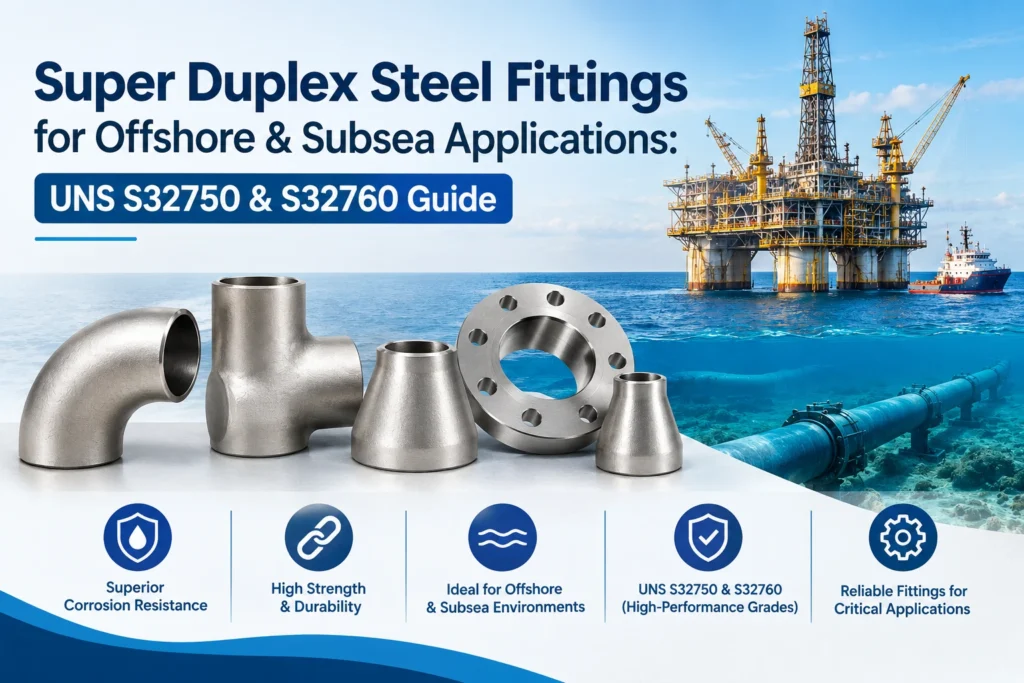
In the oil and gas sector, offshore and subsea piping systems work in some of the harshest conditions. For typical piping materials, constant exposure to seawater, chlorides, high pressure, temperature fluctuations, corrosive process fluids, and mechanical strains can pose major problems.
Super duplex stainless steel fittings, especially UNS S32750 and UNS S32760, are frequently utilized in these applications when high strength and resistance to localized corrosion are needed. Pipes, fittings, flanges, valves, and other essential pipeline parts come in these grades.
What Is Super Duplex Stainless Steel?
Super duplex stainless steel is a family of ferritic-austenitic stainless steels containing high levels of chromium, molybdenum, and nitrogen.
The combination of ferritic and austenitic phases gives these alloys a useful balance of:
High mechanical strength
Excellent chloride corrosion resistance
Strong resistance to pitting
Strong resistance to crevice corrosion
Good resistance to chloride stress corrosion cracking
Good performance in seawater
Good resistance to erosion-corrosion
These characteristics make super duplex fittings suitable for demanding offshore and subsea applications where both mechanical loading and corrosion resistance are important.
Common super duplex fittings include:
45° elbows
90° elbows
Long-radius elbows
Equal tees
Reducing tees
Concentric reducers
Eccentric reducers
Caps
Stub ends
Cross fittings
Forged fittings
Why Super Duplex Is Used Offshore
Marine conditions are a constant threat to offshore infrastructure. Pitting and crevice corrosion may be exacerbated by the high amounts of chloride ions found in seawater.
Because they are installed at directional changes, branches, connections, and transitions where stresses and flow conditions can alter, pipeline fittings are very crucial.
Super duplex alloys offer a combination of corrosion resistance and high strength that makes them attractive for:
Offshore production platforms
FPSO units
Subsea pipelines
Flowlines
Manifolds
Chemical injection systems
Seawater systems
Produced-water systems
Firewater systems
Desalination-related equipment
UNS S32750: Super Duplex 2507
UNS S32750, commonly known as Super Duplex 2507, is one of the most widely used super duplex grades.
Its nominal alloy composition includes approximately:
24–26% chromium
6–8% nickel
3–5% molybdenum
0.24–0.32% nitrogen
These alloying elements offer robust mechanical qualities and a good resistance to localized corrosion caused by chloride.
UNS S32750 is frequently offered in the form of pipes, fittings, flanges, valves, and forgings for demanding piping applications.
ASTM A182 F53 is utilized for appropriate forgings and flanges, and ASTM A815 is a frequently used specification for fittings.
UNS S32760: Super Duplex F55
UNS S32760 is another high-alloy super duplex grade. It is commonly associated with the commercial designation Zeron 100.
Its composition includes approximately:
24–26% chromium
6–8% nickel
3–4% molybdenum
0.20–0.30% nitrogen
0.5–1.0% tungsten
0.5–1.0% copper
The addition of tungsten and copper differentiates S32760 from S32750 and can provide useful corrosion performance in certain aggressive environments.
S32760 is supplied for applications where high corrosion resistance and mechanical strength are required.
S32750 vs S32760
Although both grades are super duplex stainless steels, they should not simply be treated as interchangeable materials.
Property | UNS S32750 | UNS S32760 |
Common designation | Super Duplex 2507 | Zeron 100 / F55 |
Chromium | 24–26% | 24–26% |
Nickel | 6–8% | 6–8% |
Molybdenum | 3–5% | 3–4% |
Nitrogen | 0.24–0.32% | 0.20–0.30% |
Tungsten | Not normally specified | 0.5–1.0% |
Copper | Up to about 0.5% | 0.5–1.0% |
Typical PREN | Above 40 | Above 40 |
Typical application | Offshore/subsea, seawater | Offshore/subsea, aggressive service |
The exact requirements should always be checked against the applicable material specification and project datasheet.
Pitting and Crevice Corrosion Resistance
Super Duplex’s resistance to localized corrosion is one of the main factors in its selection for offshore systems.
When stainless steel’s passive surface deteriorates locally in a chloride environment, pitting may result. In confined spaces where stagnant fluid conditions arise, crevice corrosion may occur.
Super duplex alloys are resistant to these mechanisms in part because of their high chromium, molybdenum, and nitrogen content.
A commonly used indicator is the Pitting Resistance Equivalent Number (PREN):
PREN = %Cr + 3.3 × %Mo + 16 × %N
Both S32750 and S32760 generally achieve PREN values above 40, although the actual value should be calculated from the material’s certified chemistry rather than assumed from the grade name.
Strength Advantages
Super duplex stainless steel offers significantly higher strength than many conventional austenitic stainless steels.
This can provide design opportunities such as:
Reduced wall thickness
Lower component weight
Higher pressure capability
Improved structural strength
Reduced material consumption
For offshore projects, weight reduction can be particularly valuable because topside equipment and offshore structures have strict weight constraints.
However, pressure ratings must always be determined according to the applicable design code and component specification.
Subsea Applications
Subsea piping components face a combination of external seawater exposure and demanding internal service conditions.
Typical applications include:
Subsea flowlines
Manifolds
Jumpers
Injection systems
Control systems
Subsea production equipment
Water injection systems
Chemical injection lines
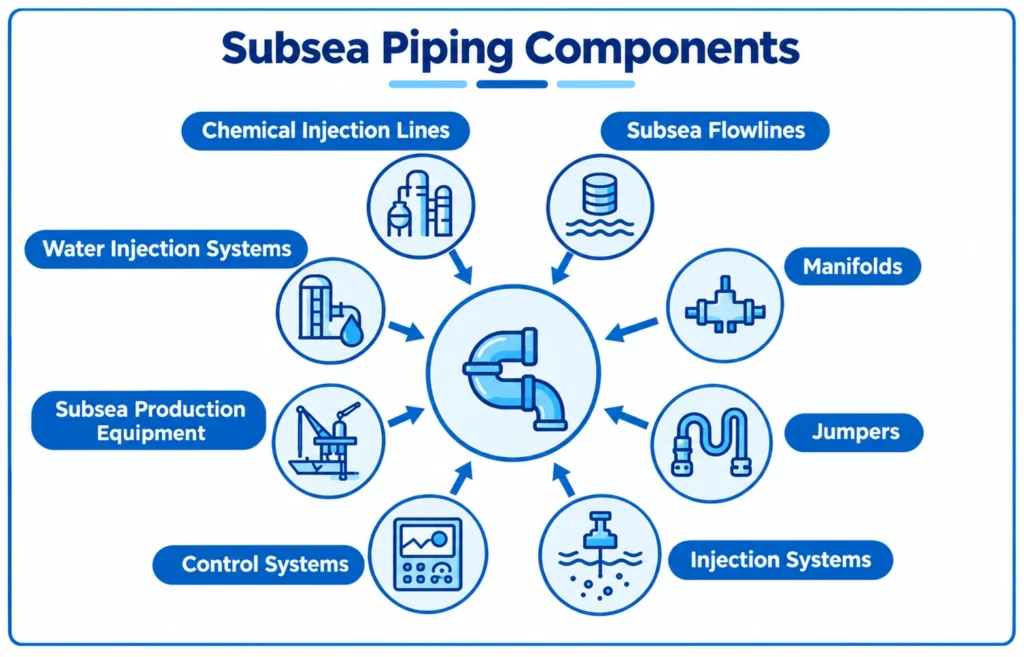
Super duplex fittings can provide corrosion resistance while maintaining the mechanical strength required for high-pressure systems.
Seawater Applications
Seawater is highly corrosive because of its chloride content and electrical conductivity.
Super duplex fittings can be used in systems such as:
Seawater cooling
Firewater systems
Seawater injection
Desalination systems
Offshore utility systems
Marine process piping
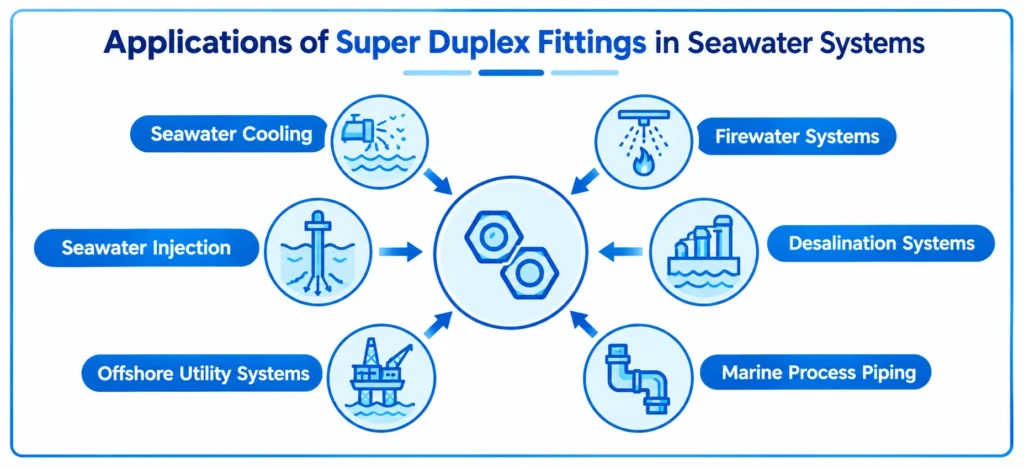
However, actual suitability depends on temperature, flow velocity, oxygen content, biological activity, and other water chemistry parameters.
Sour-Service Applications
Oil and gas systems may contain hydrogen sulfide, creating sour-service conditions.
Material selection for sour service requires careful consideration of:
H₂S partial pressure
Temperature
Chloride concentration
pH
Material hardness
Heat treatment
Welding procedures
Applicable sour-service requirements
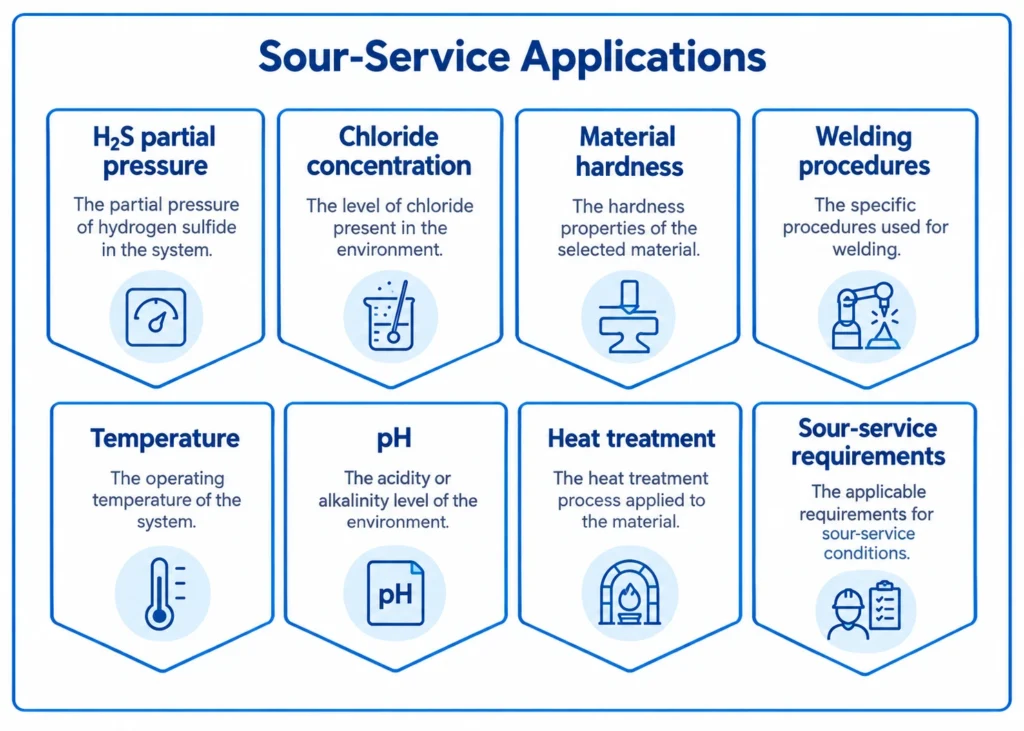
Super duplex materials may be used in suitable sour-service applications when the specific grade, manufacturing condition, and project requirements comply with the applicable requirements.
A material should never be assumed to be sour-service compliant solely because it carries an S32750 or S32760 designation.
Standards for Super Duplex Fittings
For offshore and subsea projects, specifications are particularly important.
Common standards include:
ASTM A815 – Wrought ferritic, ferritic/austenitic, and martensitic stainless steel pipe fittings
ASTM A182 – Forged or rolled alloy and stainless steel flanges, forged fittings, and valves
ASME B16.9 – Factory-made wrought butt-welding fittings
ASME B16.5 – Pipe flanges and flanged fittings
ASME B16.47 – Large-diameter steel flanges
NORSOK M-630 – Material data requirements for piping materials used in relevant petroleum applications
Project specifications may impose additional requirements beyond these base standards.
NORSOK and Offshore Quality Requirements
Material certification and manufacturing controls might be far more difficult for offshore projects with NORSOK standards than just fulfilling a basic ASTM specification.
Controlled steelmaking, solution annealing, corrosion testing, mechanical testing, microstructure analysis, traceability, and certification are a few examples of requirements.
For this reason, all project-specific criteria should be explicitly stated in the purchase order by offshore buyers.
Heat Treatment and Microstructure
Super duplex stainless steel requires controlled heat treatment.
The desired duplex microstructure must be maintained during manufacturing because unsuitable thermal conditions can result in unwanted phases that negatively affect toughness and corrosion resistance.
Important manufacturing controls include:
Solution annealing
Controlled cooling
Appropriate forming temperatures
Ferrite/austenite balance
Microstructure examination
Corrosion testing where specified
For critical offshore fittings, heat-treatment records should be reviewed as part of the quality documentation.
Inspection and Testing
Quality inspection is particularly important for subsea and offshore components.
Depending on the project specification, testing may include:
Chemical analysis
PMI
Tensile testing
Yield-strength testing
Impact testing
Hardness testing
Ferrite measurement
Corrosion testing
Ultrasonic testing
Radiographic testing
Dye penetrant testing
Dimensional inspection
Visual examination
Additional testing may be required for critical subsea applications.
Material Traceability
Every critical fitting should be traceable back to its material heat and manufacturing records.
Important documentation can include:
Material Test Certificate
Heat number
Chemical composition
Mechanical properties
Heat-treatment records
PMI report
NDT reports
Corrosion-test results
Dimensional inspection report
Certificate of conformity
For offshore projects, complete documentation helps EPC contractors and operators verify that the supplied fittings match the approved material specification.
Choosing a Super Duplex Fitting Supplier
Selecting the correct supplier is as important as selecting the correct grade.
Before placing an order, buyers should evaluate:
Manufacturing Experience
Check whether the manufacturer has experience producing S32750 and S32760 fittings rather than simply trading generic stainless steel products.
Standards Compliance
Verify compliance with the exact ASTM, ASME, NORSOK, API, or project specification required.
Testing Capability
The supplier should have access to appropriate chemical, mechanical, corrosion, and NDT testing.
Traceability
Heat numbers should remain traceable from raw material through the final product.
Inspection
For critical offshore orders, third-party inspection can be included in the quality plan.
Documentation
The supplier should provide complete and accurate MTCs and inspection documentation.
Why Super Duplex Is Suitable for Offshore & Subsea Systems
Super duplex fittings combine several characteristics that are valuable in offshore applications:
High strength: Supports demanding pressure and structural requirements.
Chloride resistance: Helps resist localized corrosion in seawater environments.
SCC resistance: Provides strong resistance to chloride stress corrosion cracking compared with many conventional austenitic stainless steels.
Weight efficiency: High strength can allow efficient component design.
Long service life: Strong corrosion resistance can reduce premature replacement and maintenance.
International availability: S32750 and S32760 are established grades with recognized international specifications.
Related Reports
Inconel vs Hastelloy Fittings: Which High Nickel Alloy is Right for Your Project?
What Is Fusion Bonded Epoxy (FBE) Coating? Benefits for Oil & Gas Pipelines & Fittings
What Is Inconel Used For in Oil and Gas? Grades, Properties & Applications
Types of Stainless Steel Fittings: SS 310, 904L, 317L & When to Use Them
Conclusion
Super duplex stainless steel fittings constructed from UNS S32750 and UNS S32760 combine exceptional resistance to corrosion caused by chloride with great mechanical strength, making them ideal for a variety of offshore and subsea applications.
While UNS S32760 offers a nearly related but chemically different option incorporating tungsten and copper, UNS S32750 is a commonly used super duplex grade for offshore pipelines, seawater systems, and subsea equipment. For suitable piping components, both grades are offered in accordance with pertinent international material criteria.
However, selecting the grade is just the first stage for important offshore projects. It is necessary to regulate manufacturing quality, heat treatment, phase balancing, corrosion testing, NDT, material traceability, and project-specific requirements.
Before manufacturing starts, it is best for EPC contractors and procurement teams to identify the precise UNS grade, applicable ASTM/ASME specifications, project standards, inspection requirements, and documentation needs.
For difficult offshore, subsea, marine, and oil and gas piping systems, S32750 and S32760 super duplex fittings can offer the strength, corrosion resistance, and dependability needed when properly specified and built.
How We Support You
Selecting the right super duplex steel fittings is essential for achieving excellent corrosion resistance, high mechanical strength, and long-term reliability in demanding offshore and subsea applications. Our team helps you select between UNS S32750 and UNS S32760 based on seawater exposure, operating pressure, temperature, corrosion conditions, and project specifications.
Our Support Includes:
Expert guidance on selecting UNS S32750 and UNS S32760 super duplex steel fittings
Recommendations based on seawater exposure, chloride levels, operating temperature, pressure, and corrosion risks
Technical support for resistance against pitting, crevice corrosion, erosion-corrosion, and stress corrosion cracking
Assistance with material selection for offshore platforms, subsea pipelines, FPSO systems, manifolds, risers, and marine infrastructure
Guidance on selecting elbows, tees, reducers, caps, flanges, bends, valves, and high-pressure piping components
Support with compliance to ASTM, ASME, ANSI, API, NORSOK, NACE, and project-specific standards
Assistance with Material Test Certificates (MTCs), PMI reports, heat treatment records, dimensional inspection, traceability, and third-party inspection
Recommendations for sour service, high-pressure systems, subsea equipment, and highly corrosive marine environments
Custom solutions for sizes, wall thicknesses, pressure ratings, fitting configurations, and project-specific requirements
Fast quotations and dependable bulk supply support for projects across the GCC, Africa, offshore, subsea, oil & gas, and marine sectors
Whether your project involves deepwater pipelines, offshore drilling platforms, FPSO facilities, subsea production systems, marine pipelines, or seawater processing infrastructure, we provide reliable UNS S32750 and UNS S32760 super duplex fitting solutions tailored to your operating conditions, corrosion challenges, and required mechanical performance.