
Piping and equipment are subjected to some of the harshest industrial environments during mining operations. Rapid corrosion and wear can be caused by slurries that comprise chemicals, dissolved minerals, chlorides, acidic process water, and abrasive particles. However, material durability is crucial since mining systems frequently work under high pressure and continuous production circumstances.
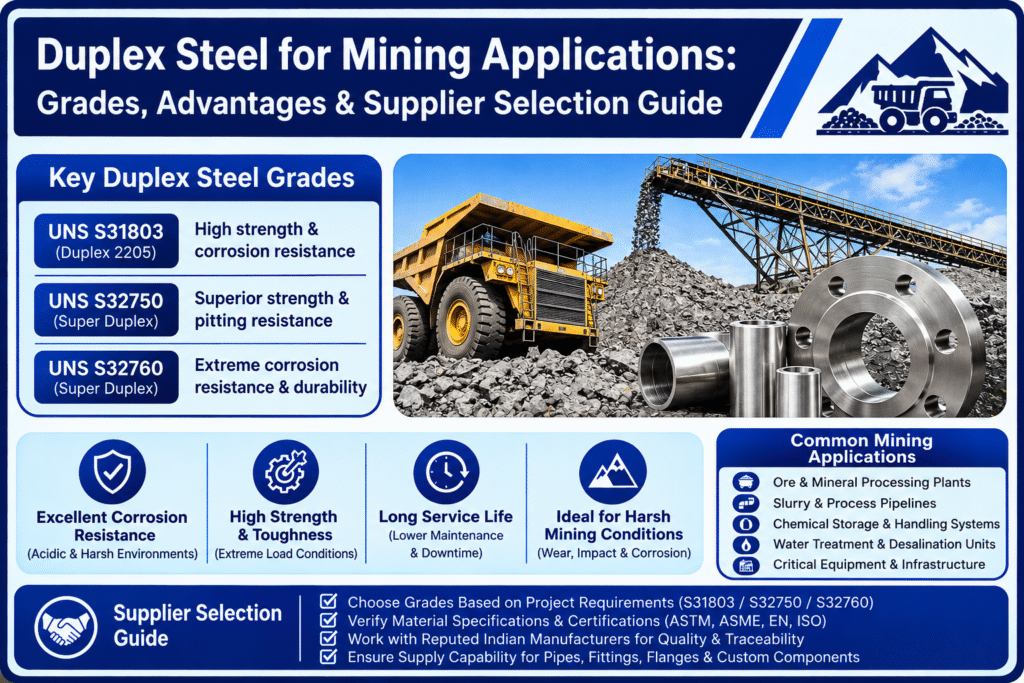
Due to its superior corrosion resistance and high mechanical strength, duplex stainless steel has gained popularity as a material for mining applications. Super duplex grades like 2507 and UNS S32760, as well as duplex grades like 2205, can offer a helpful balance between lifecycle cost, durability, and corrosion performance.
What Is Duplex Stainless Steel?
Austenite and ferrite make up the majority of the two-phase microstructure of duplex stainless steel. Duplex alloys provide a combination of qualities thanks to this structure that can be challenging to get with traditional stainless steel grades.
Key characteristics include:
High yield strength
Good toughness
Excellent resistance to chloride stress corrosion cracking
Good resistance to pitting and crevice corrosion
Good general corrosion resistance
Good resistance to erosion-corrosion
Lower thermal expansion than conventional austenitic stainless steels
The duplex family includes several grades with different levels of corrosion resistance. The appropriate grade depends on the mining environment and process conditions.
Why Duplex Steel Is Used in Mining
Abrasive and corrosive elements are often encountered by mining equipment. For instance, water, acids, sulfates, chlorides, and suspended particles can all be found in mineral slurries.
Both regular stainless steel and common carbon steel can be harmed by these circumstances.
Duplex stainless steel can offer advantages in areas such as:
Slurry pipelines
Process piping
Pump components
Valves
Tanks
Heat exchangers
Pressure vessels
Agitator shafts
Mining process equipment
Its combination of strength and corrosion resistance makes it particularly useful where both mechanical loading and corrosive exposure are significant.
Major Duplex Grades for Mining Applications
1. Duplex 2205
UNS S31803/S32205 is the most widely recognized standard duplex grade.
It provides a strong balance between:
Strength
Corrosion resistance
Fabrication
Availability
Cost
Typical applications include:
Process piping
Slurry systems
Tanks
Heat exchangers
Pump components
Chemical processing equipment
Mining process systems
2205 has a typical PREN of around 35, providing significantly higher pitting resistance than 316 stainless steel.
For moderate chloride and corrosive mining environments, 2205 is often a practical starting point for material evaluation.
2. Super Duplex 2507
UNS S32750 is a super duplex stainless steel with higher chromium, molybdenum, and nitrogen levels than 2205.
Its typical PREN is around 43, providing a greater margin against localized corrosion than standard duplex 2205.
Super duplex 2507 can be considered for:
High-chloride process streams
Acidic mining solutions
Aggressive slurry environments
Seawater-related mining systems
High-pressure process equipment
Severe corrosion conditions
The higher alloy content generally comes with a higher material cost, so 2507 should be selected based on actual service requirements rather than simply choosing the highest-alloy grade.
3. Super Duplex UNS S32760
UNS S32760 is another high-alloy super duplex grade used where high strength and corrosion resistance are required.
Applications can include:
Aggressive process piping
Chemical processing systems
High-chloride environments
Mining equipment exposed to severe corrosion
Pump and valve components
The final selection should always be based on the specific chemical composition and operating conditions of the process fluid.
Duplex Steel vs Conventional Stainless Steel
The greater mechanical strength of duplex stainless steel is one of the primary factors that mining operators take into account.
Duplex grades can provide significantly higher yield strength when compared to ordinary austenitic stainless steels like 304 and 316. When the relevant design code allows it, this may present chances to decrease component weight or wall thickness.
Property | 316 Stainless Steel | Duplex 2205 | Super Duplex 2507 |
Microstructure | Austenitic | Austenitic + Ferritic | Austenitic + Ferritic |
Strength | Moderate | High | Very High |
Chloride Resistance | Good | Excellent | Excellent/Very High |
Pitting Resistance | Moderate | High | Very High |
SCC Resistance | Lower | Excellent | Excellent |
Typical Mining Use | General service | Corrosive process systems | Severe environments |
Relative Cost | Lower | Medium | Higher |
Corrosion Resistance in Mining Environments
Mining environments can contain several aggressive substances simultaneously.
Examples include:
Chlorides
Sulfates
Acids
Alkaline solutions
Dissolved metals
Process chemicals
High-moisture conditions
Duplex stainless steels resist many forms of corrosion because of their chromium, molybdenum, and nitrogen content.
A commonly used indicator is the Pitting Resistance Equivalent Number (PREN):
PREN = %Cr + 3.3 × %Mo + 16 × %N
Higher PREN generally indicates greater resistance to localized pitting corrosion, although PREN should not be treated as a complete material-selection method. Actual performance depends on temperature, chemistry, surface condition, fabrication, and service conditions.
Abrasion and Slurry Applications
Mining slurries can contain hard particles that continuously impact pipe walls and equipment surfaces.
Examples include:
Sand
Ore particles
Silica
Mineral concentrates
Tailings
Rock fragments
Duplex stainless steel can provide good resistance to erosion-corrosion, but duplex should not automatically be considered an abrasion-resistant replacement for specialized wear materials.
For highly abrasive slurry service, engineers should evaluate:
Particle size
Particle hardness
Slurry concentration
Flow velocity
Impact angle
Temperature
Chemical composition
Required service life
Depending on the application, duplex may be combined with liners, coatings, or specialized wear-resistant materials.
Applications of Duplex Steel in Mining
Slurry Pipelines
Slurry pipelines transport mixtures of water and mineral solids. Duplex stainless steel can be considered where corrosion and mechanical strength are both important.
Pump Components
Mining pumps experience continuous exposure to abrasive and corrosive fluids. Duplex materials can be used for selected:
Pump casings
Impellers
Shafts
Wear components
The actual grade should be selected according to the slurry chemistry and wear conditions.
Process Piping
Duplex 2205 is suitable for many corrosive process piping systems where conventional stainless steel may not provide sufficient performance.
Chemical Processing
Mining operations frequently use chemicals for mineral extraction and processing. Depending on the chemical environment, duplex or super duplex can provide improved corrosion resistance.
Tanks and Pressure Equipment
High strength can make duplex stainless steel attractive for selected tanks, pressure vessels, and process equipment where weight and corrosion resistance are important.
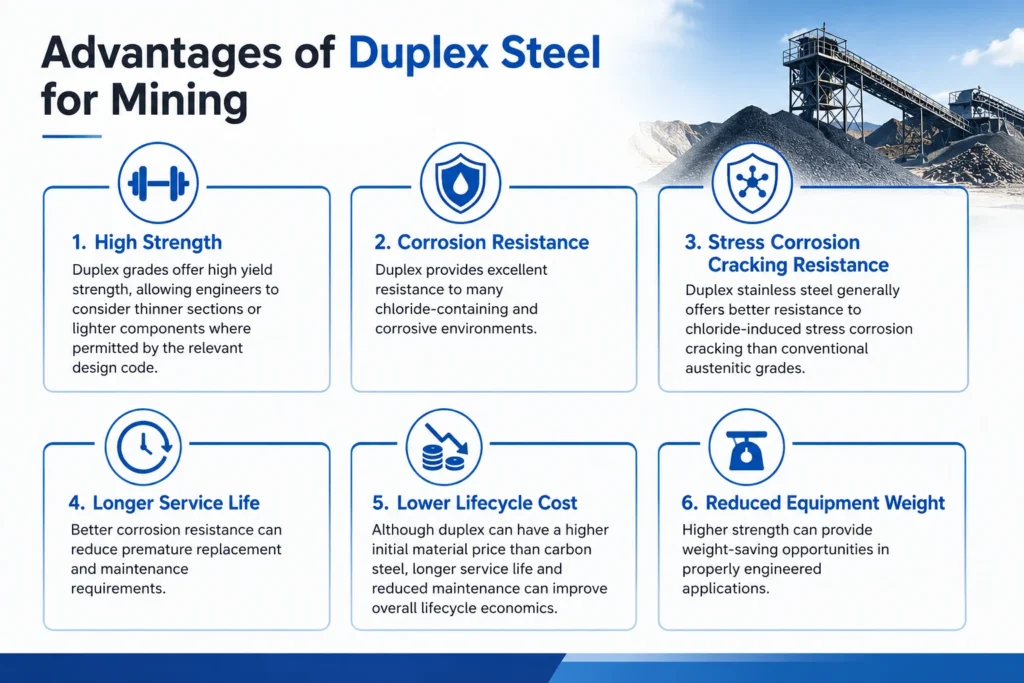
Advantages of Duplex Steel for Mining
1. High Strength
Duplex grades offer high yield strength, allowing engineers to consider thinner sections or lighter components where permitted by the relevant design code.
2. Corrosion Resistance
Duplex provides excellent resistance to many chloride-containing and corrosive environments.
3. Stress Corrosion Cracking Resistance
Duplex stainless steel generally offers better resistance to chloride-induced stress corrosion cracking than conventional austenitic grades.
4. Longer Service Life
Better corrosion resistance can reduce premature replacement and maintenance requirements.
5. Lower Lifecycle Cost
Although duplex can have a higher initial material price than carbon steel, longer service life and reduced maintenance can improve overall lifecycle economics.
6. Reduced Equipment Weight
Higher strength can provide weight-saving opportunities in properly engineered applications.
Choosing Between 2205 and 2507
The choice between standard duplex and super duplex should be based on the service environment.
Choose 2205 When:
Corrosion conditions are moderate to severe
Chloride exposure is significant but manageable
High mechanical strength is required
Cost optimization is important
Standard duplex corrosion resistance is sufficient
Choose 2507 When:
Chloride concentration is very high
The process is highly corrosive
Seawater exposure is involved
Higher pitting resistance is required
Temperature and corrosion conditions exceed the practical range of 2205
The higher alloy content of 2507 provides greater corrosion resistance, but unnecessary upgrading can increase procurement and fabrication costs.
What to Look for in a Duplex Steel Supplier
Choosing the correct supplier is as important as choosing the correct grade.
Mining companies and EPC contractors should evaluate suppliers based on:
Material Certifications
Request complete Material Test Certificates (MTCs) showing:
Chemical composition
Mechanical properties
Heat number
Heat treatment
Product specification
Material grade
Traceability
The supplier should maintain traceability from the original raw material through manufacturing and final inspection.
Manufacturing Capability
Evaluate whether the supplier has appropriate:
Forging equipment
Forming equipment
Heat-treatment facilities
CNC machining
Welding capabilities
NDT facilities
Testing laboratories
Quality Management
Check relevant quality certifications and project-specific quality requirements.
Inspection Capability
Depending on project criticality, inspection may include:
PMI
Tensile testing
Hardness testing
Impact testing
Ferrite testing
Ultrasonic testing
Radiographic testing
Dye penetrant testing
Dimensional inspection
Welding and Fabrication Considerations
Duplex stainless steel requires controlled fabrication.
Incorrect welding procedures can disturb the desired ferrite-austenite balance and reduce corrosion resistance or toughness.
Important controls include:
Qualified welding procedures
Appropriate filler metals
Controlled heat input
Interpass temperature control
Proper heat treatment where specified
Ferrite evaluation
NDT after fabrication
This is particularly important for mining pipelines and equipment where failure can cause significant production losses.
Related Reports
Inconel vs Hastelloy Fittings: Which High Nickel Alloy is Right for Your Project?
What Is Fusion Bonded Epoxy (FBE) Coating? Benefits for Oil & Gas Pipelines & Fittings
What Is Inconel Used For in Oil and Gas? Grades, Properties & Applications
Types of Stainless Steel Fittings: SS 310, 904L, 317L & When to Use Them
Conclusion
For mining applications where corrosion, pressure, strength, and service life are crucial factors, duplex stainless steel is a robust material choice.
Duplex 2205 is appropriate for numerous process pipe and equipment applications because it offers a balanced mix of strength, corrosion resistance, availability, and cost. Higher levels of corrosion resistance are offered by Super Duplex 2507 and UNS S32760 for harsher chemical, acidic, and chloride conditions.
Nevertheless, no single duplex grade is perfect for all mining applications. Slurry chemistry, particle concentration, abrasion, temperature, pressure, flow velocity, and anticipated service life should all be taken into account when choosing a material.
Choosing a qualified supplier is equally crucial for procurement teams. Before buying duplex steel products, it is important to consider verified certificates, material traceability, manufacturing capacity, testing facilities, inspection protocols, and shown project experience.
Duplex stainless steel can assist mining operators in striking a beneficial balance between corrosion resistance, mechanical strength, durability, low maintenance, and long-term lifecycle performance when properly specified and produced.
How We Support You
Selecting the right duplex stainless steel grade is essential for ensuring high strength, corrosion resistance, wear performance, and long-term reliability in demanding mining applications. Our team helps you choose the most suitable duplex steel grades based on slurry conditions, chemical exposure, operating temperature, pressure, abrasion, and project specifications.
Our Support Includes:
Expert guidance on selecting suitable duplex and super duplex grades, including UNS S31803, S32205, S32750, and S32760
Recommendations based on mineral slurry composition, chloride exposure, pH levels, temperature, pressure, and abrasion conditions
Technical support for resistance against pitting, crevice corrosion, erosion-corrosion, and stress corrosion cracking
Assistance with material selection for slurry pipelines, mineral processing plants, pumps, valves, tailings systems, dewatering systems, and process piping
Guidance on selecting duplex steel elbows, tees, reducers, flanges, bends, valves, and other piping components
Support with compliance to ASTM, ASME, ANSI, API, NACE, ISO, and project-specific standards
Assistance with Material Test Certificates (MTCs), PMI reports, heat treatment records, dimensional inspection, and third-party inspection documentation
Recommendations for applications involving abrasive slurries, corrosive process water, seawater, and chemically aggressive mining environments
Custom solutions for sizes, wall thicknesses, pressure ratings, fitting configurations, and project-specific requirements
Fast quotations and dependable bulk supply support for mining projects across Africa, GCC, Australia, and international markets
Whether your project involves mineral processing plants, slurry transportation systems, copper and gold mines, tailings infrastructure, desalination units, or heavy-duty mining pipelines, we provide reliable duplex steel piping solutions designed to deliver high mechanical strength, corrosion resistance, and dependable performance in challenging mining environments.