
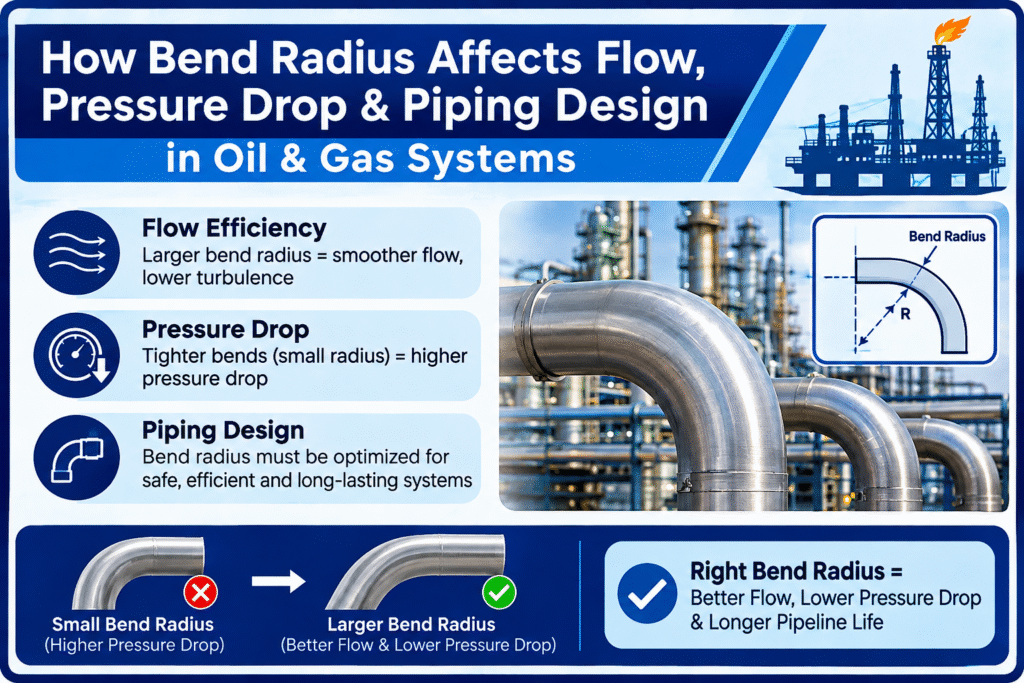
Bends are crucial for managing intricate plant layouts, connecting equipment, routing process lines, and altering pipeline direction in oil and gas piping systems. However, fluid flow, pressure drop, turbulence, erosion, and overall piping performance are all directly impacted by a bend’s geometry.
The bend radius is among the most crucial design elements. While a tight-radius curve might enhance turbulence and local pressure losses, a bend with a broader radius often offers a smoother transition for the flowing fluid.
Engineers can choose appropriate elbows and bends for pipelines used in upstream, middle, and downstream oil and gas applications by knowing how bend radius impacts flow and pressure drop.
What Is Bend Radius?
Bend radius is the distance from the centerline of a curved pipe to the center of the pipe itself. It is commonly expressed as a multiple of the pipe’s outside diameter.
For example:
1D bend: Radius is approximately equal to the pipe diameter
1.5D bend: Radius is approximately 1.5 times the pipe diameter
3D bend: Radius is approximately three times the pipe diameter
5D bend: Radius is approximately five times the pipe diameter
The larger the bend radius, the more gradual the change in flow direction.
Common piping components include:
Short-radius elbows
Long-radius elbows
1.5D bends
3D bends
5D bends
Hot induction bends
Fabricated bends
The appropriate choice depends on the fluid, flow rate, pressure, pipe size, material, and project requirements.
How Bend Radius Influences Fluid Flow
When fluid flows through a straight pipe, the velocity profile is relatively predictable. At a bend, the fluid must change direction, creating additional flow effects.
These can include:
Turbulence
Secondary flow
Pressure redistribution
Velocity variation
Local energy losses
A tight bend forces the fluid to change direction more rapidly. This can produce stronger secondary flow and higher local turbulence.
A larger-radius bend provides a smoother directional transition and generally reduces these effects.
Bend Radius and Pressure Drop
Pressure drop is one of the most important considerations in pipeline design.
Every bend introduces an additional local pressure loss. This loss is commonly represented using a loss coefficient (K):
ΔP = K × ρV² / 2
Where:
ΔP = pressure loss
K = bend loss coefficient
ρ = fluid density
V = fluid velocity
Bend radius, bend angle, pipe diameter, surface roughness, Reynolds number, and bend geometry are some of the variables that affect the precise K-value.
The loss coefficient of a short-radius bend is often larger than that of a long-radius bend.
Thus, in many piping arrangements, increasing bend radius can minimize pressure loss.
Short-Radius vs Long-Radius Bends
Short-Radius Bends
Short-radius bends change flow direction over a relatively small distance.
Advantages include:
Compact installation
Lower space requirements
Easier routing in congested areas
Lower material requirements in some layouts
However, they can produce:
Higher turbulence
Greater pressure loss
Stronger secondary flow
Increased erosion potential
Greater flow disturbance
They may therefore be less desirable in high-velocity or erosion-sensitive systems.
Long-Radius Bends
Long-radius bends provide a smoother change in direction.
Advantages include:
Lower pressure loss
Reduced turbulence
Smoother fluid flow
Lower erosion potential
Better flow distribution
They require more installation space and may increase material and fabrication costs.
Effect on Turbulence
Centrifugal forces cause the fluid to redistribute over the pipe cross-section when it changes direction quickly.
Increased turbulence and secondary flow patterns may result from this.
The fluid can shift direction more gradually with a bigger bend radius, which lessens the severity of these effects.
This is particularly important for:
High-flow-rate pipelines
Gas transmission systems
Slurry pipelines
Multiphase flow
Erosion-sensitive systems
Effect on Erosion
Erosion can be a major concern in oil and gas pipelines carrying:
Sand
Solid particles
Water droplets
Gas-liquid mixtures
Slurries
Particles can strike the bend’s outer wall at greater angles and speeds at a tight bend.
This could lead to more localized wear.
By offering a more progressive flow pattern, long-radius bends can lessen the intensity of particle impacts.
For systems with significant solids content, bend radius should therefore be considered alongside:
Flow velocity
Particle concentration
Particle size
Fluid density
Pipe material
Operating pressure
Multiphase Flow Considerations
Oil and gas pipelines frequently transport mixtures of:
Oil
Gas
Water
Condensate
Sand
Single-phase liquid or gas flow behaves differently from multiphase flow.
Changes in local velocity profiles, flow separation, and phase redistribution can all result from bends.
Bends may have an impact on downstream equipment in some systems.
Engineers may require sophisticated flow modeling or computational fluid dynamics (CFD) analysis for crucial multiphase systems in order to comprehend the impact of bend geometry.
Bend Radius and Pumping Requirements
Pressure losses throughout a pipeline contribute to the total system head requirement.
If a piping system contains many tight-radius bends, the cumulative pressure loss can become significant.
Higher pressure losses may require:
Higher pump power
Larger compressors
Increased operating costs
Higher pressure ratings
Additional energy consumption
Using larger-radius bends where practical can reduce the number and magnitude of local losses.
However, the economic benefit must be evaluated against the additional cost and space required for larger bends.
Bend Radius in Gas Pipelines
Because gas density and velocity can vary dramatically with temperature and pressure, gas systems are especially vulnerable to pressure loss.
Smoother flow can be maintained and local pressure losses can be minimized with large-radius bends.
They are commonly considered in:
Natural gas transmission pipelines
Gas processing plants
Compressor stations
LNG facilities
Gas gathering systems
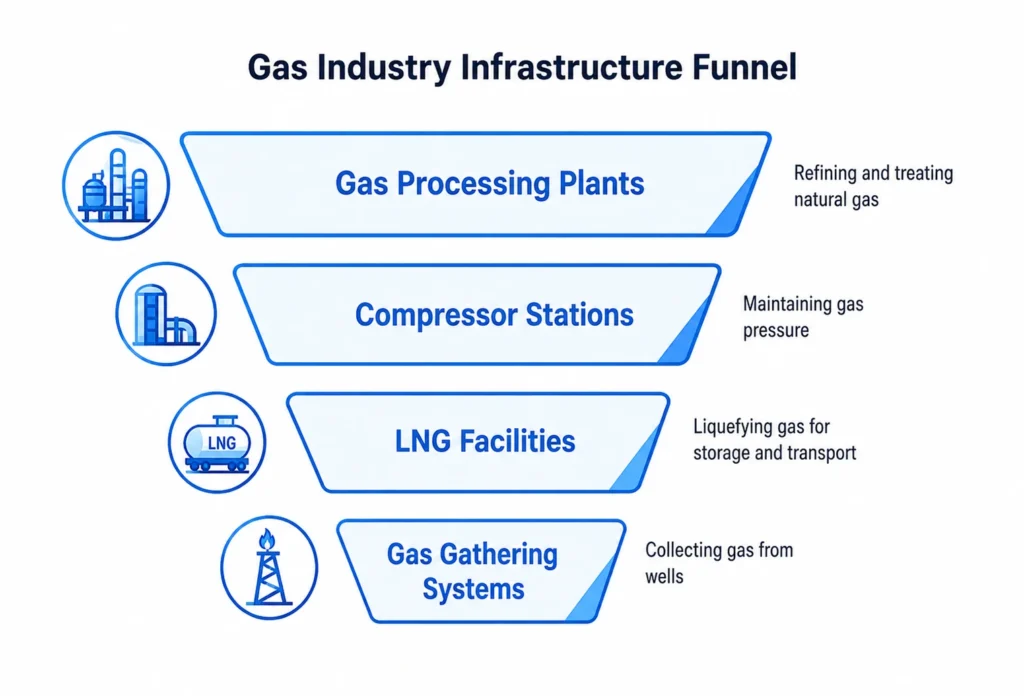
For high-velocity gas systems, bend geometry should be carefully evaluated to minimize unnecessary turbulence and vibration.
Bend Radius in Liquid Pipelines
Liquid pipelines are also affected by bend geometry.
Applications include:
Crude oil pipelines
Refined product pipelines
Produced water systems
Cooling water systems
Firewater systems
Seawater pipelines
In long-distance liquid pipelines, even relatively small pressure losses can become important when accumulated across hundreds of fittings.
Bend Radius and Piping Layout
Bend radius also affects the physical design of the piping system.
A larger bend requires:
More installation space
Larger support spacing considerations
More material
Potentially more complex routing
A short-radius elbow may be preferred where space is limited.
Therefore, piping designers must balance hydraulic performance with:
Equipment layout
Accessibility
Maintenance
Structural support
Construction requirements
Cost
Bend Radius and Stress Analysis
Bends are also important from a mechanical design perspective.
Piping systems experience stresses caused by:
Internal pressure
Thermal expansion
Weight
Vibration
Seismic loads
Equipment loads
Bend geometry influences flexibility and stress distribution.
A properly designed bend can provide flexibility within the piping system and help accommodate thermal expansion.
This is particularly important in high-temperature oil and gas facilities.
Common Bend Radius Selection
There is no single bend radius that is suitable for every oil and gas application.
Typical choices include:
Bend Type | Typical Use |
1D | Compact piping layouts |
1.5D | General process piping |
3D | Lower-loss process and pipeline applications |
5D | Specialized flow-sensitive applications |
Long-radius induction bend | Large-diameter transmission pipelines |
The actual selection should be based on the applicable piping code, project specification, hydraulic analysis, and operating conditions.
Hot Induction Bends for Large-Diameter Pipelines
Hot induction bending is frequently used to create long-radius bends for large-diameter oil and gas pipelines.
The pipe is gradually shaped into the necessary radius during the operation, which makes use of controlled targeted heating.
Benefits include:
Consistent geometry
Good dimensional accuracy
Controlled wall thickness
Reduced number of welded joints
Suitability for large-diameter pipes
Ability to produce custom bend radii
Induction bends can be particularly useful for pipeline systems where smooth flow and reliable mechanical performance are important.
How Engineers Choose the Right Bend Radius
Engineers typically consider:
Pipe diameter
Fluid type
Flow rate
Operating pressure
Operating temperature
Fluid velocity
Solids content
Multiphase flow behavior
Required pressure drop
Available installation space
Stress and flexibility requirements
Project standards
Choosing the biggest bend radius is not the only goal. Rather, engineers look for a suitable balance between cost, fabrication requirements, space, mechanical integrity, and hydraulic performance.
Related Reports
Inconel vs Hastelloy Fittings: Which High Nickel Alloy is Right for Your Project?
What Is Fusion Bonded Epoxy (FBE) Coating? Benefits for Oil & Gas Pipelines & Fittings
What Is Inconel Used For in Oil and Gas? Grades, Properties & Applications
Types of Stainless Steel Fittings: SS 310, 904L, 317L & When to Use Them
Conclusion
In oil and gas systems, bend radius greatly affects flow behavior, pressure drop, erosion, turbulence, and overall piping design. In situations when space is restricted, smaller-radius bends might be helpful, but they typically result in more flow disruption and local pressure losses. In addition to offering a smoother flow channel, larger-radius bends can lower the hazards of erosion, turbulence, and energy losses.
Bend geometry should be taken into account during both hydraulic and mechanical design for crucial oil and gas pipelines, especially those transporting high-velocity, multiphase, or particle-laden fluids.
In the end, the particular application determines the optimal bend radius. Designers can choose bends that effectively balance flow efficiency, dependability, safety, and total project cost by assessing flow circumstances, pressure requirements, material selection, piping arrangement, and relevant engineering standards.
How We Support You
Selecting the right pipe bend radius is essential for maintaining efficient flow, controlling pressure drop, reducing turbulence, and ensuring the long-term reliability of oil & gas piping systems. Our team helps you select the most suitable bend radius and piping configuration based on pipe diameter, flow rate, operating pressure, fluid characteristics, and project specifications.
Our Support Includes:
Expert guidance on selecting suitable bend radii for oil & gas piping applications
Recommendations for long radius, short radius, 3D, 5D, and custom bends based on system requirements
Technical support for optimizing flow efficiency, pressure drop, turbulence, and energy losses
Assistance with bend selection based on pipe diameter, wall thickness, flow velocity, pressure, temperature, and fluid properties
Guidance on selecting elbows, long radius bends, induction bends, tees, reducers, and other piping components
Support for applications involving crude oil, natural gas, refined products, water, steam, and process fluids
Assistance with compliance to ASME, ASTM, API, ANSI, MSS, ISO, and project-specific piping standards
Support with dimensional inspection, material test certificates (MTCs), bend qualification reports, and third-party inspection documentation
Custom solutions for bend angle, radius, diameter, wall thickness, pressure rating, and project-specific design requirements
Fast quotations and dependable bulk supply support for projects across the oil & gas, petrochemical, power generation, water transmission, and industrial sectors
Whether your project involves cross-country pipelines, refinery piping, offshore platforms, gas transmission systems, pumping stations, or process plants, we provide reliable pipe bends and piping components engineered to support efficient flow, minimize unnecessary pressure losses, and deliver dependable long-term performance in demanding operating environments.