
Super Duplex stainless steels are now necessary components for demanding applications that call for both remarkable corrosion resistance and excellent mechanical strength. Super duplex grades are widely used for pipes, fittings, flanges, valves, and pressure-containing components in industries like oil and gas, offshore engineering, subsea pipelines, desalination, chemical processing, maritime engineering, and power generation.
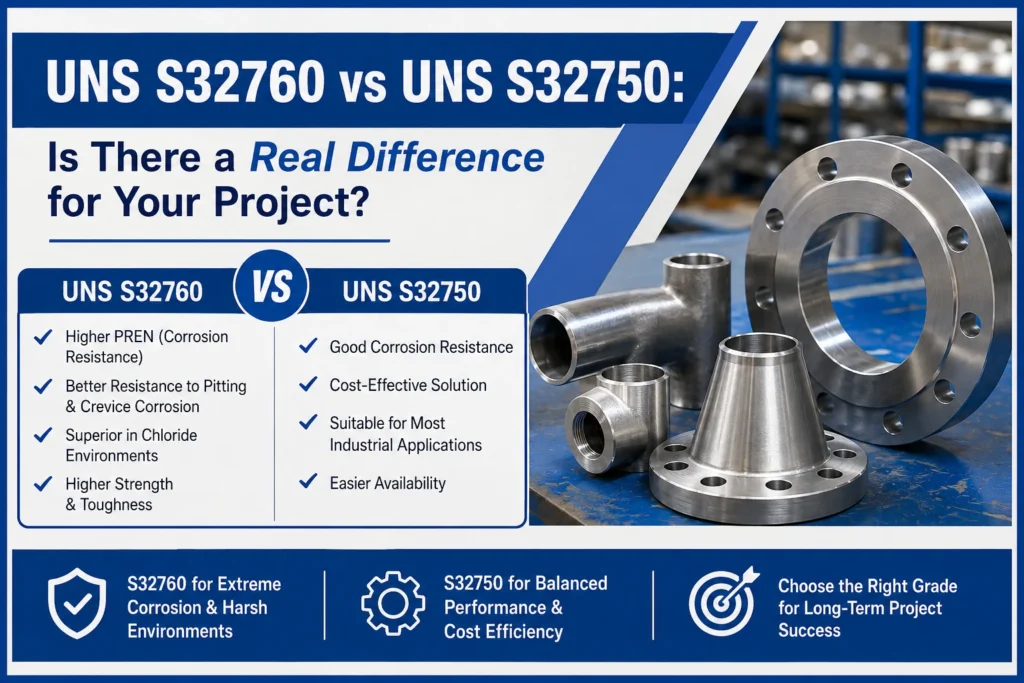
UNS S32750 and UNS S32760 are two of the most often specified super duplex grades. Both offer outstanding resistance to stress corrosion cracking, pitting, crevice corrosion, and environments high in chloride. They seem extremely similar at first glance, which frequently prompts the crucial question, “Is there a real difference between UNS S32760 and UNS S32750, and does it matter for your project?”
Yes, is the response. Material selection may be impacted by variations in chemical composition, strength, corrosion resistance, and specification requirements, even though the two classes have identical metallurgical structures and many performance traits.
What Is UNS S32750?
Super Duplex 2507 is another name for UNS S32750. It is a high-alloy duplex stainless steel with almost equal amounts of austenitic and ferritic phases.
Its alloying elements typically include:
Chromium: 24–26%
Nickel: 6–8%
Molybdenum: 3–5%
Nitrogen: 0.24–0.32%
Carbon: Low
Iron: Balance
While nitrogen adds strength and aids in maintaining the intended duplex microstructure, the high chromium and molybdenum concentration offers exceptional resistance to localized corrosion.
In offshore and marine applications where resistance to seawater and chloride exposure is essential, UNS S32750 is frequently utilized.
What Is UNS S32760?
Another super duplex stainless steel that is frequently connected to the Zeron 100-type alloy family is UNS S32760. Although it contains controlled additions of elements like copper and tungsten, its composition is generally identical to S32750.
Typical composition ranges include:
Chromium: 24–26%
Nickel: 6–8%
Molybdenum: 3–4%
Nitrogen: 0.2–0.3%
Tungsten: approximately 0.5–1.0%
Copper: controlled addition
Iron: Balance
The additional alloying elements are designed to enhance corrosion resistance and provide excellent performance in demanding chloride-containing environments.
UNS S32760 vs UNS S32750: Chemical Composition
The alloying balance is the most obvious change.
High levels of nitrogen, nickel, molybdenum, and chromium are present in both grades. But S32760 usually contains additions of copper and tungsten, which are not typical of S32750 chemistry.
These additions can improve performance in certain aggressive environments.
Element | UNS S32750 | UNS S32760 |
Chromium | 24–26% | 24–26% |
Nickel | 6–8% | 6–8% |
Molybdenum | 3–5% | 3–4% |
Nitrogen | 0.24–0.32% | Approximately 0.2–0.3% |
Tungsten | Not typically specified | Typically added |
Copper | Low/controlled | Typically added |
Microstructure | Duplex | Duplex |
Exact limits depend on the applicable product standard and specification, so project documents should always take precedence over generic grade comparisons.
Corrosion Resistance
Both S32750 and S32760 provide outstanding corrosion resistance.
They are particularly resistant to:
Pitting corrosion
Crevice corrosion
Chloride stress corrosion cracking
General corrosion
Seawater corrosion
Erosion-corrosion
Their high chromium, molybdenum, and nitrogen contents give them a high Pitting Resistance Equivalent Number (PREN), generally above 40.
Which Has Better Corrosion Resistance?
Both grades can function exceptionally well in harsh chloride conditions in real-world engineering applications.
The regulated tungsten and copper additions in S32760 can be beneficial in some harsh chemical and saltwater environments. The real performance, however, is contingent upon the particular environment, temperature, heat treatment, fabrication quality, and appropriate material specification.
Therefore, claiming that S32760 is always better than S32750 would be untrue.
Mechanical Strength
Both grades offer significantly higher strength than conventional austenitic stainless steels such as 304L and 316L.
This high strength provides several benefits:
Reduced wall thickness
Lower component weight
Higher pressure capability
Improved resistance to mechanical loads
Better fatigue performance
When manufactured in accordance with the applicable specifications, S32760 also provides exceptional strength and toughness, while S32750 is already equipped to handle rigorous pressure applications.
Instead of presuming that one grade is always stronger, the necessary minimum yield and tensile strength for a given project should be compared to the relevant product standard.
Resistance to Seawater
Seawater contains high concentrations of chloride ions and can cause severe localized corrosion.
Both S32750 and S32760 are widely used in:
Seawater cooling systems
Desalination plants
Offshore platforms
Subsea equipment
Marine pipelines
Water injection systems
Their excellent pitting and crevice corrosion resistance makes them suitable for long-term exposure to marine environments.
Weldability
Compared to traditional austenitic stainless steels, super duplex stainless steels require more precise welding techniques.
The ferrite-austenite balance can be upset by improper welding, which also lowers toughness or corrosion resistance.
For both S32750 and S32760, manufacturers and fabricators must carefully control:
Heat input
Interpass temperature
Welding consumables
Cooling rate
Post-weld inspection
Proper welding procedures are essential for maintaining the required properties of the finished component.
Applications of UNS S32750
UNS S32750 is widely used for:
Oil and gas pipelines
Offshore platforms
Subsea pipelines
Seawater piping
Desalination plants
Chemical processing
Heat exchangers
Pressure vessels
Valves
Flanges and pipe fittings
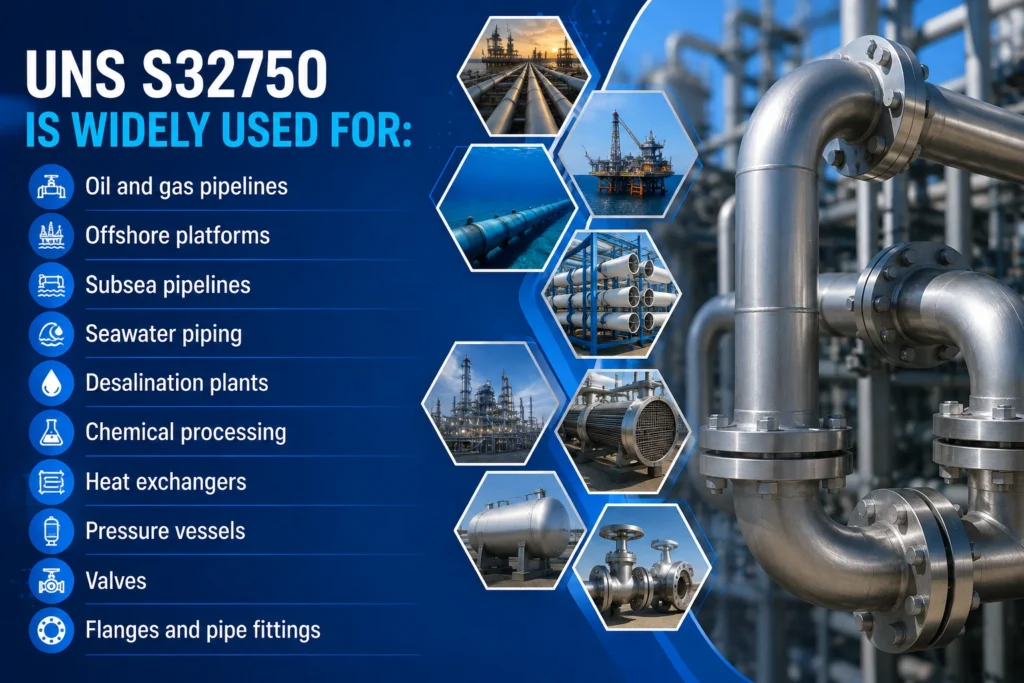
It is particularly popular because it provides a strong combination of corrosion resistance, mechanical strength, availability, and established industry acceptance.
Applications of UNS S32760
UNS S32760 is commonly selected for similarly demanding applications, including:
Offshore oil and gas equipment
Subsea systems
Seawater cooling systems
Desalination plants
Chemical processing equipment
Firewater systems
Heat exchangers
Pumps and valves
High-pressure piping
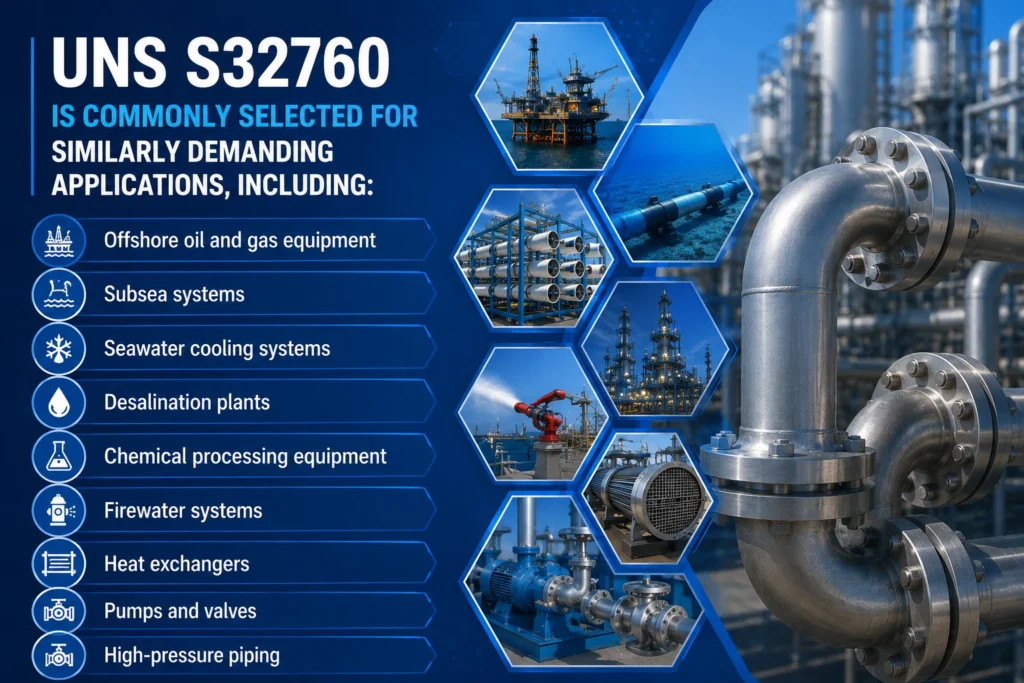
Its enhanced alloy chemistry makes it attractive for particularly demanding environments where additional corrosion resistance may justify the material selection.
UNS S32760 vs UNS S32750: Application Comparison
Property | UNS S32750 | UNS S32760 |
Material Family | Super Duplex | Super Duplex |
Corrosion Resistance | Excellent | Excellent |
Seawater Resistance | Outstanding | Outstanding |
Pitting Resistance | Excellent | Excellent |
Chloride SCC Resistance | Excellent | Excellent |
Mechanical Strength | Very High | Very High |
Weldability | Good with controlled procedures | Good with controlled procedures |
Typical Applications | Oil & gas, marine, desalination | Offshore, marine, chemical, subsea |
Availability | Widely available | Widely available |
Relative Cost | Competitive | May be higher depending on specification |
Which Grade Should You Choose?
The correct choice depends on the specific project requirements rather than simply selecting the grade with the highest perceived corrosion resistance.
Choose UNS S32750 When:
The project specification specifically calls for S32750
Excellent seawater resistance is required
High mechanical strength is needed
The application involves offshore or subsea service
A widely established super duplex grade is preferred
Cost and material availability are important considerations
Choose UNS S32760 When:
The project specification requires S32760
Additional alloying characteristics are beneficial
The equipment operates in particularly aggressive chloride environments
The application requires a specific S32760 product certification
The engineering specification has been designed around S32760 properties
Standards and Certifications Matter
When purchasing super duplex pipe fittings, flanges, and related components, the UNS designation alone is not enough.
Buyers should verify:
Applicable ASTM or ASME standard
Chemical composition
Mechanical properties
Heat treatment requirements
PREN requirements where specified
Impact testing requirements
Corrosion testing
PMI results
Material Test Certificate
Third-party inspection requirements
For critical oil and gas and offshore projects, additional client-specific requirements may apply.
Cost and Availability
S32750 is generally one of the most commonly specified super duplex grades, which can make sourcing relatively straightforward.
S32760 is also commercially available from specialist manufacturers, but the final cost depends on:
Product form
Size
Wall thickness
Quantity
Manufacturing process
Testing requirements
Certification
Project specifications
The cheapest material is not necessarily the most economical choice. Lifecycle performance, corrosion resistance, maintenance requirements, and expected service life should all be considered.
Related Reports
Inconel vs Hastelloy Fittings: Which High Nickel Alloy is Right for Your Project?
What Is Fusion Bonded Epoxy (FBE) Coating? Benefits for Oil & Gas Pipelines & Fittings
What Is Inconel Used For in Oil and Gas? Grades, Properties & Applications
Types of Stainless Steel Fittings: SS 310, 904L, 317L & When to Use Them
Conclusion
So, do UNS S32760 and UNS S32750 actually differ from one another?
Indeed. Alloy chemistry and specification requirements vary amongst the grades, especially when it comes to additives like copper and tungsten in S32760. These variations may have an impact on corrosion performance and environmental compatibility.
Nonetheless, UNS S32750 and UNS S32760 are both high-performance super duplex stainless steels that can provide exceptional strength and resistance to corrosion in demanding applications.
The choice for the majority of projects shouldn’t be made solely on the basis of which grade is “better.” Rather, engineers should assess the actual working environment, temperature, pressure, concentration of chloride, welding requirements, relevant standards, and project specifications.
When appropriately designed, fabricated, welded, and inspected, either grade can offer outstanding long-term performance for offshore, subsea, desalination, and marine applications. The grade that satisfies the technical requirements of the project and offers the necessary mechanical performance and corrosion resistance at the lowest feasible lifecycle cost is ultimately the best option.
How We Support You
Selecting the right super duplex stainless steel grade is essential for achieving excellent corrosion resistance, high mechanical strength, and long-term reliability in demanding industrial and offshore applications. Our team helps you determine whether UNS S32760 or UNS S32750 is the better choice based on corrosion conditions, pressure, temperature, mechanical requirements, and project specifications.
Our Support Includes:
Expert guidance in selecting between UNS S32760 and UNS S32750 super duplex grades
Recommendations based on chloride exposure, seawater conditions, operating temperature, pressure, and corrosion risks
Technical support for resistance against pitting, crevice corrosion, erosion-corrosion, and stress corrosion cracking
Assistance with material selection for offshore platforms, subsea pipelines, desalination plants, marine systems, and chemical processing facilities
Guidance on selecting elbows, tees, reducers, flanges, valves, pipes, bends, and high-pressure piping components
Support with compliance to ASTM, ASME, ANSI, API, NORSOK, NACE, and project-specific standards
Assistance with Material Test Certificates (MTCs), PMI reports, inspection documentation, traceability, and third-party inspection
Recommendations for sour service, high-pressure systems, seawater applications, and highly corrosive environments
Custom solutions for sizes, wall thicknesses, pressure ratings, fitting configurations, and project-specific requirements
Fast quotations and dependable bulk supply support for projects across the GCC, Africa, offshore, marine, oil & gas, and petrochemical sectors
Whether your project involves subsea pipelines, offshore production systems, desalination facilities, marine infrastructure, chemical plants, or oil & gas processing units, we provide reliable UNS S32760 and UNS S32750 super duplex solutions tailored to your operating conditions, corrosion challenges, and required mechanical performance.