
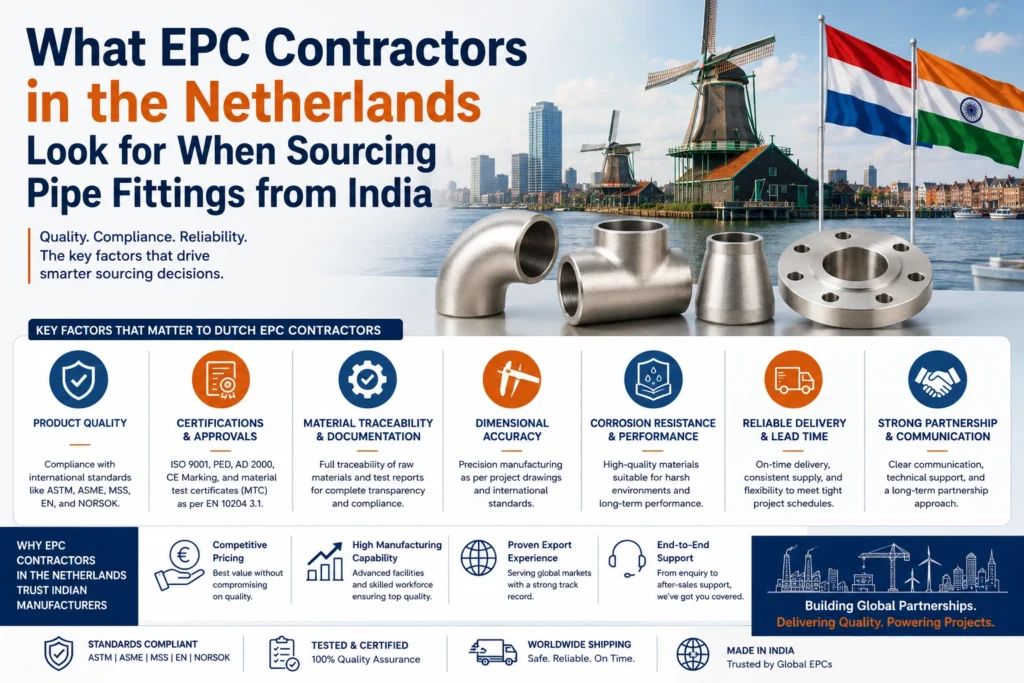
With significant investments in oil and gas, petrochemicals, offshore energy, LNG terminals, water treatment, renewable energy, and infrastructure projects, the Netherlands is one of Europe’s top industrial and logistics hubs. In the Netherlands, engineering, procurement, and construction (EPC) contractors oversee intricate projects that call for premium plumbing components that can withstand difficult working conditions and stringent European requirements.
Because it offers a combination of affordable price, modern manufacturing capabilities, and compliance with international quality standards, India has become a favorite sourcing destination for pipe fittings and flanges. But when choosing suppliers, Dutch EPC contractors consider a lot more factors than only price. Quality, certifications, traceability, delivery performance, and long-term dependability are their main concerns.
This article explores the key factors EPC contractors in the Netherlands consider when sourcing pipe fittings from Indian manufacturers.
Why Dutch EPC Contractors Source Pipe Fittings from India
Indian manufacturers have earned a strong reputation in the global piping industry by supplying products to major industrial projects across Europe, the Middle East, Asia, and North America.
Some of the primary reasons Dutch EPC contractors source from India include:
Competitive manufacturing costs
Wide range of material grades
Compliance with international standards
Advanced production facilities
Strong export capabilities
Ability to manufacture customized products
Reliable global logistics support
These advantages help contractors optimize project costs without compromising quality.
Product Quality Is the Highest Priority
Quality remains the most important factor during supplier evaluation.
Dutch EPC contractors expect manufacturers to maintain strict quality control throughout every stage of production.
This includes:
Raw material inspection
Dimensional accuracy
Precision machining
Heat treatment
Surface finishing
Final inspection
Complete product traceability
Manufacturers that consistently deliver defect-free products are more likely to become long-term suppliers.
Compliance with International Standards
European industrial projects require products that conform to globally recognized manufacturing standards.
Common standards include:
Pipe Fittings
ASME B16.9
ASME B16.11
MSS SP-43
MSS SP-75
Pipe Flanges
ASME B16.5
ASME B16.47
EN 1092-1
Material Standards
ASTM A234
ASTM A403
ASTM A420
ASTM A815
ASTM A182
ASTM B366
ASTM B564
Compliance with these standards ensures compatibility, safety, and long-term performance.
Material Traceability
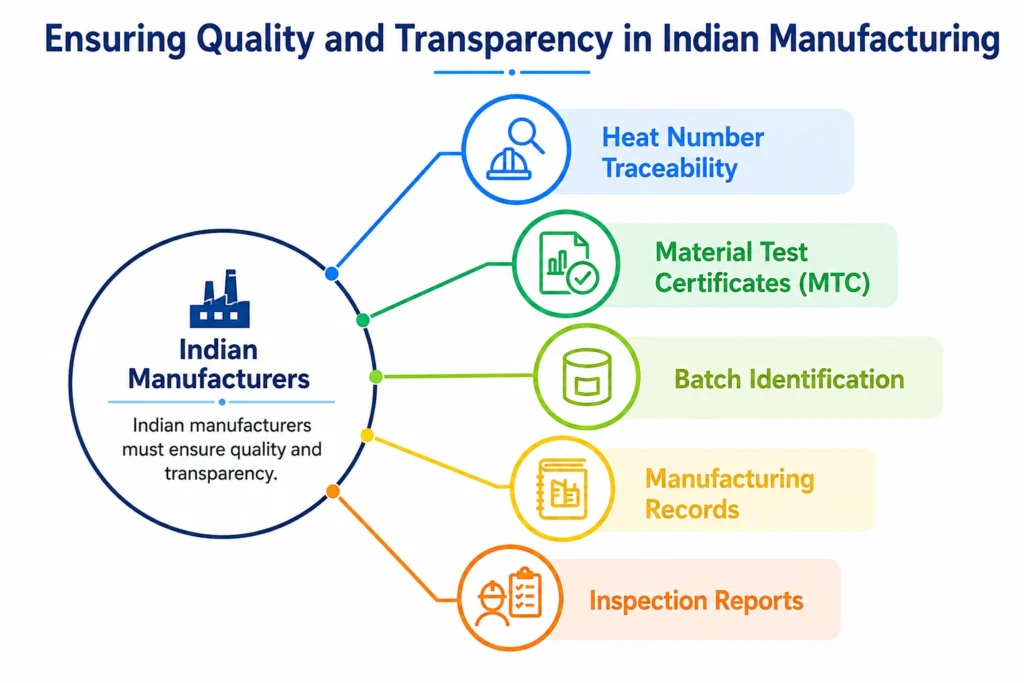
European EPC companies place significant emphasis on full material traceability.
Indian manufacturers should provide:
Heat number traceability
Material Test Certificates (MTC)
Batch identification
Manufacturing records
Inspection reports
Most projects require EN 10204 Type 3.1 certification, while highly critical applications may require third-party certification according to project specifications.
Availability of Multiple Material Grades
Dutch industrial projects involve a wide range of operating conditions.
Manufacturers capable of supplying multiple material grades have a competitive advantage.
Commonly requested materials include:
Carbon Steel
ASTM A234 WPB
ASTM A420 WPL6
Stainless Steel
304
304L
316
316L
321
347
Duplex Stainless Steel
UNS S31803
UNS S32205
Super Duplex Stainless Steel
UNS S32750
UNS S32760
Nickel Alloys
Inconel 625
Inconel 718
Incoloy 825
Monel 400
Monel K-500
Hastelloy C22
Hastelloy C276
A broad product portfolio enables EPC contractors to source multiple components from a single supplier.
Manufacturing Capabilities
Leading EPC contractors evaluate the technical capabilities of manufacturing facilities before approving suppliers.
They look for equipment such as:
CNC machining centers
Forging presses
Hot induction bending machines
Heat treatment furnaces
Automated welding systems
Pickling and passivation facilities
Advanced manufacturing technology ensures consistent quality and faster production.
Inspection and Testing Facilities
Inspection plays a critical role in project acceptance.
Reliable manufacturers should be able to perform:
Positive Material Identification (PMI)
Radiographic Testing (RT)
Ultrasonic Testing (UT)
Dye Penetrant Testing (PT)
Magnetic Particle Testing (MT)
Hydrostatic testing
Hardness testing
Visual inspection
Dimensional inspection
Many Dutch EPC contractors also require third-party inspections before shipment.
Delivery Performance
Large industrial projects operate under strict construction schedules.
Late deliveries can delay installation and increase project costs.
Contractors therefore assess suppliers based on:
Manufacturing lead time
Production planning
Inventory management
Export experience
On-time delivery record
Packaging quality
Reliable delivery performance often becomes a deciding factor during supplier selection.
Documentation Requirements
European projects require comprehensive documentation.
Typical documentation includes:
Material Test Certificates
Inspection reports
Quality certificates
Dimensional reports
Packing lists
Commercial invoices
Certificates of Origin
Heat treatment records
Third-party inspection reports
Accurate documentation simplifies customs clearance and project approval.
Sustainability and Environmental Compliance
Sustainability is becoming increasingly important across Europe.
Many EPC contractors prefer suppliers that follow environmentally responsible manufacturing practices.
These may include:
Efficient energy use
Waste reduction
Responsible raw material sourcing
Recycling initiatives
Compliance with environmental regulations
Manufacturers that demonstrate sustainable practices often gain a competitive advantage in European markets.
Competitive Pricing with Long-Term Value
Although competitive pricing is important, Dutch EPC contractors rarely select suppliers based solely on the lowest quotation.
They evaluate overall value by considering:
Product quality
Compliance with specifications
Manufacturing capability
Inspection standards
Delivery reliability
Technical support
Warranty
Lifecycle performance
A slightly higher initial cost often proves more economical if it reduces maintenance and replacement expenses.
Export Experience to Europe
Manufacturers with previous export experience to European countries generally understand the documentation, packaging, and logistics requirements better.
Experienced exporters can efficiently manage:
Sea freight packaging
Container optimization
Customs documentation
International shipping procedures
Project marking requirements
Export compliance
This minimizes delays and ensures smooth delivery.
Industries Served
Dutch EPC contractors procure Indian pipe fittings for a wide range of industries, including:
Oil and gas
Petrochemical plants
Offshore platforms
LNG terminals
Chemical processing
Hydrogen projects
Water treatment plants
Desalination facilities
Power generation
Renewable energy infrastructure
Each sector requires products that meet specific technical and quality requirements.
Tips for Indian Manufacturers
Indian manufacturers seeking to supply Dutch EPC contractors should focus on:
Maintaining international quality standards
Providing complete technical documentation
Offering fast quotation responses
Ensuring full material traceability
Investing in advanced inspection facilities
Delivering consistent product quality
Meeting agreed delivery schedules
Building long-term customer relationships
These factors significantly improve the chances of becoming an approved supplier for European projects.
Related Reports
Inconel vs Hastelloy Fittings: Which High Nickel Alloy is Right for Your Project?
What Is Fusion Bonded Epoxy (FBE) Coating? Benefits for Oil & Gas Pipelines & Fittings
What Is Inconel Used For in Oil and Gas? Grades, Properties & Applications
Types of Stainless Steel Fittings: SS 310, 904L, 317L & When to Use Them
Conclusion
Due to significant expenditures in energy, petrochemicals, offshore infrastructure, and sustainable technologies, the Netherlands continues to be one of Europe’s most significant markets for industrial piping components. Dutch EPC contractors place a higher priority on quality, traceability, certifications, prompt delivery, and adherence to international standards than do Indian manufacturers, who profit from competitive prices and robust production capabilities.
Manufacturers are in a good position to build enduring relationships with EPC contractors in the Netherlands if they regularly provide high-quality pipe fittings with comprehensive documentation, cutting-edge testing, and dependable export support. Indian vendors may increase their market share in Europe and help complicated industrial projects be completed successfully by fulfilling these demands.
How We Support You
Sourcing pipe fittings from Indian manufacturers for EPC projects in the Netherlands requires more than competitive pricing—it demands consistent quality, international certifications, complete documentation, and reliable project execution. Our team helps EPC contractors and industrial buyers source piping components that meet stringent European and project-specific requirements.
Our Support Includes:
Expert guidance in selecting the right pipe fittings, flanges, and piping components based on EPC project specifications
Recommendations on suitable materials, including carbon steel, stainless steel, duplex, super duplex, nickel alloys, and alloy steel
Assistance with compliance to ASTM, ASME, ANSI, API, EN, PED, ISO, NACE, and client-specific specifications
Support in sourcing elbows, tees, reducers, caps, stub ends, flanges, long radius bends, and custom-fabricated piping components
Complete documentation support, including EN 10204 3.1/3.2 certificates, Material Test Certificates (MTCs), PMI reports, inspection reports, and third-party inspection documentation
Guidance on quality assurance, traceability, dimensional inspections, hydrostatic testing, and non-destructive testing (NDT) requirements
Assistance with custom sizes, wall thicknesses, pressure classes, coatings, and project-specific manufacturing requirements
Reliable export support, including international packing, marking, customs documentation, and timely shipping to the Netherlands and other European destinations
Fast quotations, competitive pricing, and dependable bulk supply for EPC contractors, engineering companies, and industrial procurement teams
Dedicated technical support throughout the procurement, manufacturing, inspection, logistics, and delivery process
Whether your project involves oil & gas, offshore, petrochemical, hydrogen, power generation, water treatment, or industrial processing facilities, we provide dependable pipe fitting and flange solutions manufactured in India to meet European quality standards, support EPC procurement requirements, and ensure reliable performance throughout the project lifecycle.