
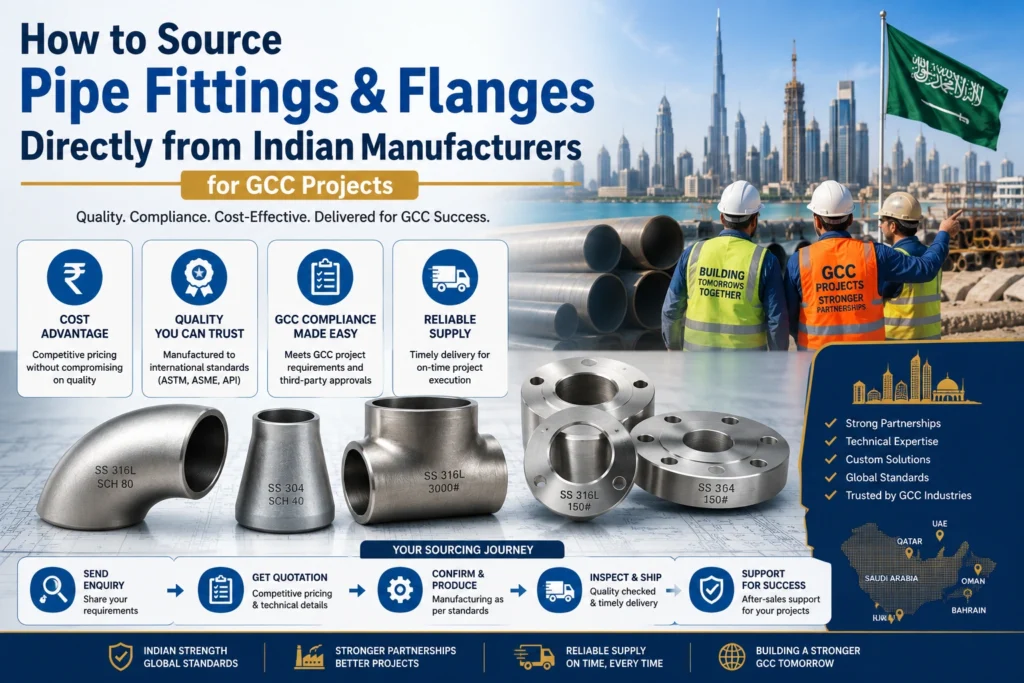
Oil and gas, petrochemicals, desalination plants, power production, water infrastructure, and renewable energy projects continue to receive significant investments from the Gulf Cooperation Council (GCC) region, which includes Saudi Arabia, the United Arab Emirates (UAE), Qatar, Kuwait, Oman, and Bahrain. These sectors need premium plumbing parts that are affordable, easily accessible, and adhere to strict international requirements.
India is now one of the world’s top producers of pipe fittings and flanges, supplying major EPC contractors, oil firms, and industrial projects throughout the Gulf Cooperation Council. Indian producers are known for their strong export experience, competitive pricing, adherence to global quality standards, and sophisticated production skills.
This guide explains how buyers, contractors, and procurement teams can successfully source pipe fittings and flanges directly from Indian manufacturers for GCC projects.
Why Choose Indian Manufacturers?
By providing premium goods at affordable costs, Indian producers have made a significant impact on the worldwide piping market. While adhering to global standards and project-specific specifications, numerous manufacturers frequently ship to Saudi Arabia, the United Arab Emirates, Qatar, Oman, Kuwait, and Bahrain.
Key advantages include:
Competitive pricing compared to European and North American suppliers
Wide range of stainless steel, carbon steel, alloy steel, duplex, super duplex, nickel alloy, and special alloy products
Compliance with international standards such as ASTM, ASME, ANSI, EN, and ISO
Modern manufacturing facilities with advanced machining and testing equipment
Strong export logistics and documentation support
Ability to manufacture customized products for EPC and industrial projects
These advantages make India an attractive sourcing destination for GCC buyers.
Understand Your Project Requirements
Before approaching manufacturers, prepare a detailed technical requirement sheet. This helps suppliers provide accurate quotations and ensures that the supplied products meet project specifications.
Typical information should include:
Product type (elbows, tees, reducers, caps, flanges, stub ends, etc.)
Material grade
Pipe size
Wall thickness or schedule
Pressure rating
Quantity
Applicable standards
Surface finish requirements
Testing requirements
Delivery schedule
Destination port
Providing complete specifications reduces procurement delays and avoids costly revisions.
Select the Right Material Grade
Different GCC industries require different materials depending on operating conditions.
Common materials include:
Carbon Steel
Suitable for:
Oil transmission
Water pipelines
Structural applications
Utility systems
Popular grades include ASTM A234 WPB fittings and ASTM A105 flanges.
Stainless Steel
Common grades include:
SS 304
SS 304L
SS 316
SS 316L
SS 321
SS 347
These grades are widely used in food processing, chemical plants, desalination, and water treatment facilities.
Duplex Stainless Steel
Popular grades:
UNS S31803
UNS S32205
Applications include:
Offshore platforms
Seawater systems
Petrochemical plants
Super Duplex Stainless Steel
Common grades:
UNS S32750
UNS S32760
These materials provide outstanding corrosion resistance for marine and offshore environments.
Nickel Alloys
Indian manufacturers also produce fittings and flanges in:
Inconel 625
Inconel 718
Incoloy 825
Monel 400
Monel K-500
Hastelloy C22
Hastelloy C276
These alloys are commonly specified for aggressive chemical and high-temperature applications.
Verify Compliance with International Standards
GCC projects often require strict compliance with internationally recognized manufacturing standards.
Common standards include:
Product Standards
ASME B16.9 – Butt Weld Fittings
ASME B16.11 – Forged Fittings
ASME B16.5 – Pipe Flanges
ASME B16.47 – Large Diameter Flanges
MSS SP-43
MSS SP-75
Material Standards
ASTM A234
ASTM A403
ASTM A420
ASTM A815
ASTM A182
ASTM B366
ASTM B564
Always verify that the manufacturer can supply products according to the required specifications.
Check Manufacturing and Quality Control Capabilities
Reliable manufacturers maintain strict quality control throughout the production process.
Look for facilities offering:
CNC machining
Hot induction bending
Forging
Heat treatment
Precision welding
Pickling and passivation
Surface finishing
Quality inspection should include:
Dimensional inspection
Visual inspection
Positive Material Identification (PMI)
Radiographic Testing (RT)
Ultrasonic Testing (UT)
Dye Penetrant Testing (PT)
Magnetic Particle Testing (MT)
Hydrostatic testing
Hardness testing
Manufacturers should also provide Material Test Certificates (MTC) in accordance with EN 10204 3.1 or project requirements.
Ensure GCC Project Compliance
Many projects in the GCC require compliance with client-specific standards and approvals.
Depending on the project, manufacturers may need to meet requirements from:
Saudi Aramco
ADNOC
QatarEnergy
SABIC
Kuwait Oil Company (KOC)
PDO Oman
BAPCO Bahrain
Before placing an order, confirm that the supplier has experience meeting the technical specifications and documentation required by your project.
Evaluate Export Experience
Exporting industrial piping products requires knowledge of international shipping procedures and documentation.
Choose manufacturers experienced in exporting to GCC countries and capable of handling:
Commercial invoices
Packing lists
Certificates of Origin
Material Test Certificates
Inspection reports
Third-party inspection documentation
Shipping marks
Export packaging suitable for sea freight
Experienced exporters help ensure smooth customs clearance and timely delivery.
Compare Multiple Suppliers
Request quotations from several manufacturers and compare them based on:
Product quality
Technical compliance
Manufacturing capability
Delivery time
Pricing
Quality certifications
Export experience
Customer support
Warranty and after-sales service
Selecting the lowest price without considering quality and delivery performance may lead to higher lifecycle costs.
Conduct Supplier Audits
For large GCC projects, conducting a supplier audit is highly recommended.
An audit should evaluate:
Manufacturing infrastructure
Production capacity
Quality management systems
Testing facilities
Traceability procedures
Export capabilities
Health and safety practices
Many EPC contractors also require third-party inspections before shipment.
Logistics and Delivery Considerations
Timely delivery is critical for construction schedules.
Discuss the following with your supplier:
Production lead time
Shipping schedule
Port of loading
Packaging methods
Container optimization
Freight options
Incoterms (FOB, CIF, CFR, EXW)
Proper logistics planning minimizes delays and reduces transportation costs.
Benefits of Sourcing Directly from Indian Manufacturers
Buying directly from manufacturers offers several advantages over trading companies.
These include:
Better pricing
Faster communication
Direct technical support
Greater customization options
Improved quality control
Reduced procurement costs
Better project coordination
Reliable after-sales assistance
Working directly with manufacturers also provides greater transparency throughout the procurement process.
Common Applications in GCC Projects
Indian-manufactured pipe fittings and flanges are widely used in:
Oil and gas processing plants
Refineries
Petrochemical facilities
LNG terminals
Offshore platforms
Desalination plants
Power generation stations
Water transmission projects
Fire protection systems
Chemical processing industries
Their ability to meet international quality standards makes them suitable for a wide range of industrial applications.
Related Reports
Inconel vs Hastelloy Fittings: Which High Nickel Alloy is Right for Your Project?
What Is Fusion Bonded Epoxy (FBE) Coating? Benefits for Oil & Gas Pipelines & Fittings
What Is Inconel Used For in Oil and Gas? Grades, Properties & Applications
Types of Stainless Steel Fittings: SS 310, 904L, 317L & When to Use Them
Conclusion
For GCC infrastructure and energy projects, India has emerged as a reliable worldwide supplier of premium pipe fittings and flanges. Indian manufacturers are well-positioned to satisfy the exacting demands of industries in Saudi Arabia, the United Arab Emirates, Qatar, Oman, Kuwait, and Bahrain thanks to their sophisticated manufacturing capabilities, adherence to international standards, low pricing, and vast export expertise.
Buyers can expedite procurement, cut costs, and guarantee the successful delivery of dependable piping components by precisely specifying project specifications, confirming certificates, evaluating manufacturing capabilities, and choosing seasoned export partners. In addition to improving supply chain efficiency, sourcing directly from Indian manufacturers gives GCC projects access to specialized solutions that contribute to their long-term success.
How We Support You
Sourcing pipe fittings and flanges directly from Indian manufacturers can help reduce procurement costs, improve product quality, and ensure timely delivery for GCC projects. Our team supports EPC contractors, distributors, and industrial buyers by providing reliable manufacturing solutions that meet international standards and project-specific requirements.
Our Support Includes:
Expert guidance in selecting the right pipe fittings, flanges, and piping components based on your project specifications
Recommendations on suitable materials, including carbon steel, stainless steel, duplex, super duplex, nickel alloys, and alloy steel
Assistance with compliance to ASTM, ASME, ANSI, API, EN, NACE, ISO, ARAMCO, SABIC, ADNOC, and project-specific standards
Support in sourcing elbows, tees, reducers, caps, stub ends, flanges, long radius bends, and custom-fabricated piping components
Complete documentation support, including Material Test Certificates (MTCs), inspection reports, PMI reports, EN 10204 3.1/3.2 certification, and third-party inspection
Assistance with custom sizes, wall thicknesses, pressure classes, coatings, and project-specific manufacturing requirements
Reliable export support, including packing, marking, documentation, and international shipping for GCC countries
Fast quotations, competitive pricing, and dependable bulk supply for EPC contractors, stockists, and industrial projects
Dedicated technical support throughout the procurement, manufacturing, inspection, and delivery process
Whether your project involves oil & gas, petrochemical, desalination, power generation, water treatment, marine, or infrastructure developments, we provide dependable pipe fitting and flange solutions manufactured in India to meet international quality standards, ensure timely project execution, and deliver long-term performance across GCC markets.