
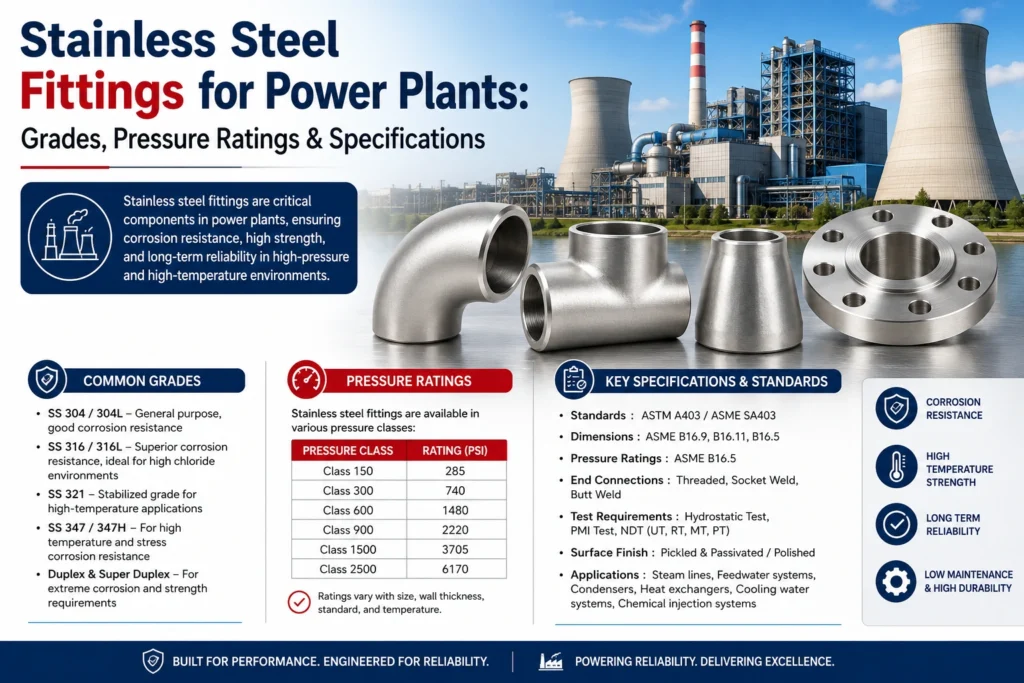
Piping systems are subjected to high pressures, high temperatures, steam, corrosive chemicals, and constant operating cycles in power plants. The dependability of piping components has a direct impact on plant safety, efficiency, and operational longevity in thermal, nuclear, hydroelectric, biomass, and combined-cycle power plants.
Because of their superior corrosion resistance, high-temperature strength, durability, and extended service life, stainless steel fittings are frequently chosen among the several materials used in power generation. To guarantee safe and effective plant operation, the right stainless steel grade, pressure rating, and relevant specification must be chosen.
The frequently used stainless steel fitting grades, pressure ratings, industry standards, and their uses in contemporary power plants are examined in this article.
Why Stainless Steel Fittings Are Used in Power Plants
Power generation facilities transport steam, condensate, cooling water, chemicals, fuel gases, and high-temperature process fluids through extensive piping networks. These systems require fittings that can withstand severe operating conditions without compromising structural integrity.
Stainless steel fittings offer several advantages:
Excellent corrosion resistance
High mechanical strength
Outstanding heat resistance
Long service life
Low maintenance requirements
Good weldability
Excellent pressure-handling capability
Resistance to oxidation and scaling
These properties make stainless steel fittings suitable for both high-pressure and high-temperature service.
Common Types of Stainless Steel Fittings
Power plants use various pipe fittings to connect, redirect, and control fluid flow.
The most common types include:
90° and 45° Elbows
Equal and Reducing Tees
Concentric Reducers
Eccentric Reducers
Pipe Caps
Stub Ends
Crosses
Couplings
Socket Weld Fittings
Threaded Fittings
These fittings are manufactured according to recognized international standards to ensure compatibility and reliability.
Common Stainless Steel Grades Used in Power Plants
The choice of stainless steel grade depends on operating temperature, pressure, fluid composition, and corrosion requirements.
Stainless Steel 304 / 304L
Grade 304 is one of the most widely used austenitic stainless steels.
Key Features:
Good corrosion resistance
Excellent weldability
Good formability
Cost-effective solution
Suitable for moderate temperatures
Typical Applications:
Water treatment systems
Utility piping
Cooling water lines
Low-pressure process piping
Stainless Steel 316 / 316L
Grade 316 contains molybdenum, providing improved resistance to chlorides and chemical corrosion.
Key Features:
Better corrosion resistance than 304
Excellent resistance to chlorides
Good high-temperature performance
Superior pitting resistance
Typical Applications:
Chemical dosing systems
Cooling water circuits
Demineralized water systems
Coastal and marine power plants
Stainless Steel 321
Grade 321 is stabilized with titanium to improve resistance to carbide precipitation during welding.
Key Features:
Excellent high-temperature strength
Good oxidation resistance
Improved weldability
Resistant to intergranular corrosion
Typical Applications:
Superheated steam lines
High-temperature exhaust systems
Boiler components
Stainless Steel 347
Grade 347 is stabilized with niobium, making it ideal for elevated temperature service.
Key Features:
Excellent creep resistance
High-temperature oxidation resistance
Superior weldability
Enhanced thermal stability
Typical Applications:
Steam pipelines
Heat exchangers
Boiler piping
Turbine systems
Duplex Stainless Steel
Duplex stainless steels combine high strength with excellent corrosion resistance.
Popular grades include:
UNS S31803
UNS S32205
Applications:
Seawater cooling systems
Desalination units
Offshore power plants
Chemical handling systems
Super Duplex Stainless Steel
Super Duplex grades such as UNS S32750 and UNS S32760 are used where extreme corrosion resistance is required.
Typical applications include:
Seawater intake systems
Offshore power facilities
High-chloride environments
Cooling water pipelines
Pressure Ratings for Stainless Steel Fittings
Power plant piping systems operate under varying pressure conditions, requiring fittings with appropriate pressure ratings.
Butt Weld Fittings
Butt weld fittings are generally manufactured with wall thicknesses corresponding to pipe schedules such as:
SCH 10
SCH 20
SCH 40
SCH 80
SCH 120
SCH 160
XXS (Double Extra Strong)
The pressure capacity depends on:
Pipe schedule
Material grade
Operating temperature
Pipe diameter
These fittings are commonly used in high-pressure steam and process pipelines.
Socket Weld and Threaded Fittings
Forged fittings are manufactured in pressure classes such as:
Class 2000
Class 3000
Class 6000
Class 9000
Socket weld fittings are preferred for high-pressure, small-diameter piping because they provide strong, leak-resistant joints.
Threaded fittings are typically used in lower-pressure utility services where easy installation and maintenance are required.
Important Specifications and Standards
Power plant projects require compliance with internationally recognized standards to ensure quality, safety, and interchangeability.
Manufacturing Standards
Common standards include:
ASME B16.9 – Factory-made butt weld fittings
ASME B16.11 – Forged socket weld and threaded fittings
MSS SP-43 – Lightweight corrosion-resistant fittings
MSS SP-75 – High-strength butt weld fittings
Material Specifications
Typical material standards include:
ASTM A403 – Austenitic stainless steel fittings
ASTM A182 – Forged stainless steel flanges and forged fittings
ASTM A815 – Duplex stainless steel fittings
ASTM A182 F51, F53, and F55 for duplex and super duplex forged components
Pressure Testing Standards
Manufacturers typically perform:
Hydrostatic testing
Pneumatic testing (when specified)
Visual inspection
Dimensional inspection
Non-destructive testing (NDT)
Positive Material Identification (PMI)
Additional inspections such as radiographic testing (RT), ultrasonic testing (UT), dye penetrant testing (PT), and magnetic particle testing (MT) may be required depending on project specifications.
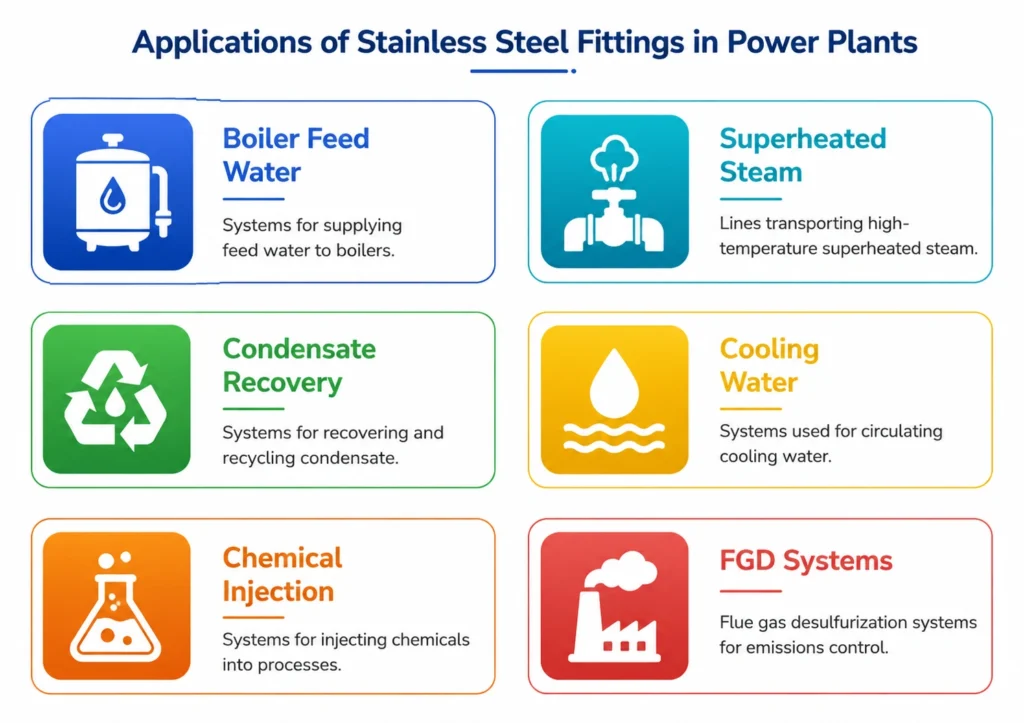
Applications of Stainless Steel Fittings in Power Plants
Stainless steel fittings are used across various systems within power generation facilities.
Boiler Feed Water Systems
These systems transport high-pressure feed water to boilers and require fittings with excellent strength and corrosion resistance.
Superheated Steam Lines
Steam pipelines operate under high temperatures and pressures, making grades such as 321 and 347 ideal choices.
Condensate Recovery Systems
Condensate systems require corrosion-resistant fittings capable of handling temperature fluctuations and continuous operation.
Cooling Water Systems
Cooling circuits often contain treated or untreated water that may cause corrosion. Stainless steel fittings help improve reliability and reduce maintenance.
Chemical Injection Systems
Power plants use chemicals for water treatment, corrosion inhibition, and pH control. Stainless steel fittings resist chemical attack and ensure long service life.
Flue Gas Desulfurization (FGD) Systems
FGD units handle aggressive chemicals and acidic condensates. Higher-alloy stainless steels or duplex grades are commonly selected for these applications.
Factors to Consider When Selecting Stainless Steel Fittings
Choosing the right fitting involves evaluating several operating conditions, including:
Operating pressure
Service temperature
Fluid composition
Corrosion potential
Pipe size and schedule
Welding requirements
Applicable industry standards
Maintenance and lifecycle costs
Selecting the correct grade helps improve plant reliability while minimizing operational expenses.
Benefits of Stainless Steel Fittings in Power Plants
Using high-quality stainless steel fittings offers several long-term advantages:
Excellent corrosion resistance
Superior strength at elevated temperatures
Longer service life
Reduced maintenance costs
Improved plant safety
Leak-free performance
Compatibility with high-pressure systems
Reliable performance under cyclic loading
These benefits contribute to increased plant efficiency and lower total lifecycle costs.
Related Reports
Inconel vs Hastelloy Fittings: Which High Nickel Alloy is Right for Your Project?
What Is Fusion Bonded Epoxy (FBE) Coating? Benefits for Oil & Gas Pipelines & Fittings
What Is Inconel Used For in Oil and Gas? Grades, Properties & Applications
Types of Stainless Steel Fittings: SS 310, 904L, 317L & When to Use Them
Conclusion
Modern power plants depend on stainless steel fittings to run safely and effectively. The proper fitting grade and pressure rating are crucial for long-term performance in everything from boiler feed systems and superheated steam lines to cooling water networks and chemical processing units.
While 321 and 347 offer improved performance in high-temperature steam service, grades like 304/304L and 316/316L are frequently utilized for general-purpose applications. For extremely corrosive settings, such as offshore power plants and seawater cooling systems, Duplex and Super Duplex stainless steels are perfect.
Plant operators can achieve dependable, leak-free operation, enhanced safety, and longer service life by choosing fittings that adhere to international standards including ASME B16.9, ASME B16.11, ASTM A403, ASTM A182, and ASTM A815. The optimal option for each power generation application is ensured by a thorough assessment of operating circumstances, pressure requirements, and material specifications.
How We Support You
Selecting the right stainless steel fittings is essential for ensuring safe, efficient, and long-lasting performance in power generation systems operating under high temperatures and pressures.
Our team helps you choose the most suitable stainless steel grades, pressure ratings, and fitting specifications based on operating conditions, process media, corrosion exposure, and project requirements.
Our Support Includes:
Expert guidance on selecting the appropriate stainless steel grades, including SS 304, SS 304L, SS 316, SS 316L, SS 321, SS 347, SS 310, Duplex, and Super Duplex for power plant applications
Recommendations based on operating temperature, pressure, steam service, and corrosion resistance requirements
Technical support for applications involving boilers, steam lines, condensate systems, cooling water circuits, heat exchangers, and turbine piping
Assistance with selecting the correct pressure classes, schedules, wall thicknesses, and fitting configurations
Guidance on choosing elbows, tees, reducers, flanges, caps, stub ends, and high-pressure piping components
Support with compliance to ASTM, ASME, ANSI, API, MSS SP, EN, and project-specific standards
Assistance with material test certificates (MTCs), PMI reports, quality documentation, and third-party inspection requirements
Recommendations for thermal power plants, nuclear facilities, combined-cycle plants, renewable energy projects, and industrial power generation systems
Custom solutions for sizes, pressure ratings, material grades, and project-specific fabrication requirements
Fast quotations and reliable bulk supply support for projects across the power generation, oil & gas, petrochemical, and heavy industrial sectors
Whether your project involves high-pressure steam pipelines, boiler systems, cooling water networks, heat recovery units, or power plant process piping, we provide dependable stainless steel fitting solutions engineered to deliver exceptional strength, corrosion resistance, and long-term operational reliability.