
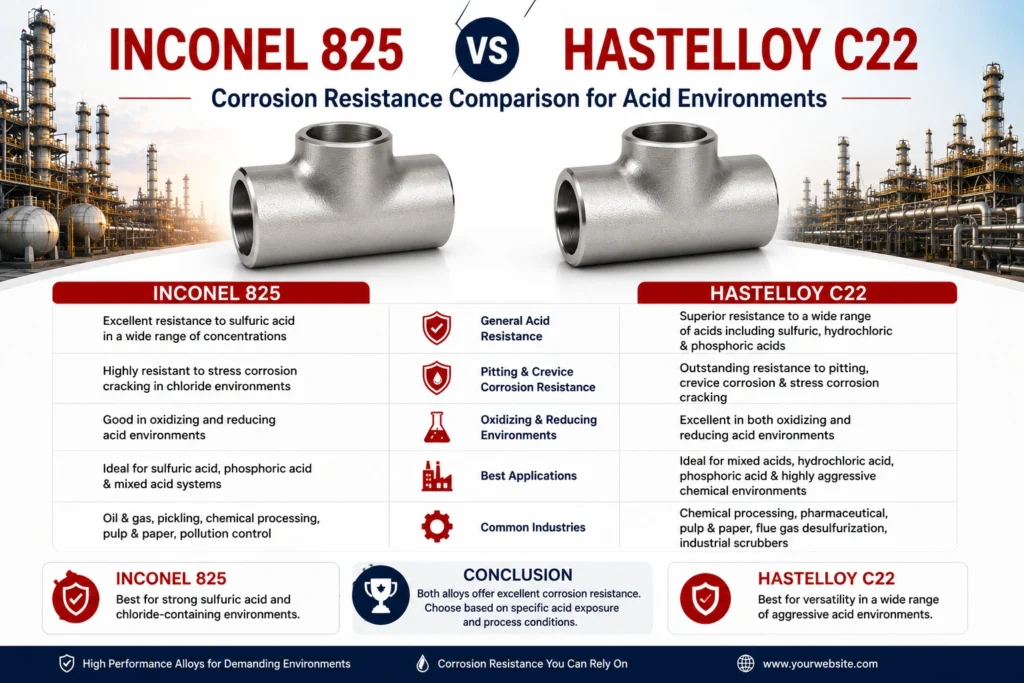
One of the main issues facing the chemical processing, oil and gas, power generating, pharmaceutical, and environmental control sectors is corrosion. Materials that can preserve structural integrity while decreasing maintenance and downtime are necessary for equipment subjected to strong acids, chlorides, oxidizing agents, and reducing chemicals.
Inconel 825 and Hastelloy C22 are two of the most used nickel-based alloys for corrosive applications. Although they are made for distinct working conditions and chemical exposures, both alloys have outstanding corrosion resistance. A number of variables, including acid concentration, operating temperature, chloride content, and project budget, influence the choice of alloy.
The characteristics, corrosion resistance, uses, and appropriateness for acidic conditions of Inconel 825 and Hastelloy C22 are compared in this article.
What Is Inconel 825?
Inconel 825, also known as Alloy 825, is a nickel-iron-chromium alloy with additions of molybdenum, copper, and titanium. It is specifically developed to provide excellent resistance to both oxidizing and reducing acids while maintaining good mechanical properties.
Its typical chemical composition includes:
Nickel: 38–46%
Chromium: 19.5–23.5%
Iron: Balance
Molybdenum: 2.5–3.5%
Copper: 1.5–3%
Titanium: 0.6–1.2%
The combination of nickel, chromium, molybdenum, and copper gives Inconel 825 excellent resistance to sulfuric acid, phosphoric acid, and stress corrosion cracking in chloride-containing environments.
What Is Hastelloy C22?
Hastelloy C22 is a nickel-chromium-molybdenum-tungsten alloy designed for superior corrosion resistance in highly aggressive chemical environments. It offers exceptional protection against oxidizing and reducing chemicals, making it one of the most versatile corrosion-resistant alloys available.
Its typical chemical composition includes:
Nickel: Balance
Chromium: 20–22.5%
Molybdenum: 12.5–14.5%
Tungsten: 2.5–3.5%
Iron: 2–6%
Compared to Inconel 825, Hastelloy C22 contains significantly higher levels of molybdenum, which greatly improves resistance to localized corrosion such as pitting and crevice attack.
Corrosion Resistance Comparison
Resistance to Sulfuric Acid
Sulfuric acid is commonly used in chemical manufacturing, fertilizer production, and mineral processing.
Inconel 825 performs exceptionally well in sulfuric acid, particularly in moderate concentrations and temperatures. The addition of copper significantly improves its resistance to sulfuric acid corrosion.
Hastelloy C22 also performs well in sulfuric acid, especially in mixed acid environments where oxidizing contaminants are present.
Best Choice: Inconel 825 for moderate sulfuric acid service; Hastelloy C22 for more aggressive or mixed acid conditions.
Resistance to Hydrochloric Acid
One of the most aggressive chemicals utilized in industrial processing is hydrochloric acid.
Under extreme circumstances, Inconel 825 may corrode more quickly and has less resistance to strong hydrochloric acid.
Hastelloy C22 is the material of choice for hydrochloric acid processing because it offers superior resistance to hydrochloric acid across a larger range of concentrations and temperatures.
Best Choice: Hastelloy C22
Resistance to Nitric Acid
Nitric acid is a strong oxidizing acid commonly used in fertilizer production and chemical synthesis.
The high chromium content of both alloys provides good oxidation resistance, but Hastelloy C22 generally offers better performance in mixed acid environments where oxidizing and reducing agents are present simultaneously.
Best Choice: Hastelloy C22
Resistance to Phosphoric Acid
Food processing and fertilizer manufacturing both make extensive use of phosphoric acid.
Inconel 825 has been extensively utilized in phosphoric acid manufacturing facilities due to its exceptional performance in phosphoric acid applications.
Although Hastelloy C22 offers superior resistance as well, ordinary phosphoric acid service may not always justify its greater cost.
Best Choice: Inconel 825
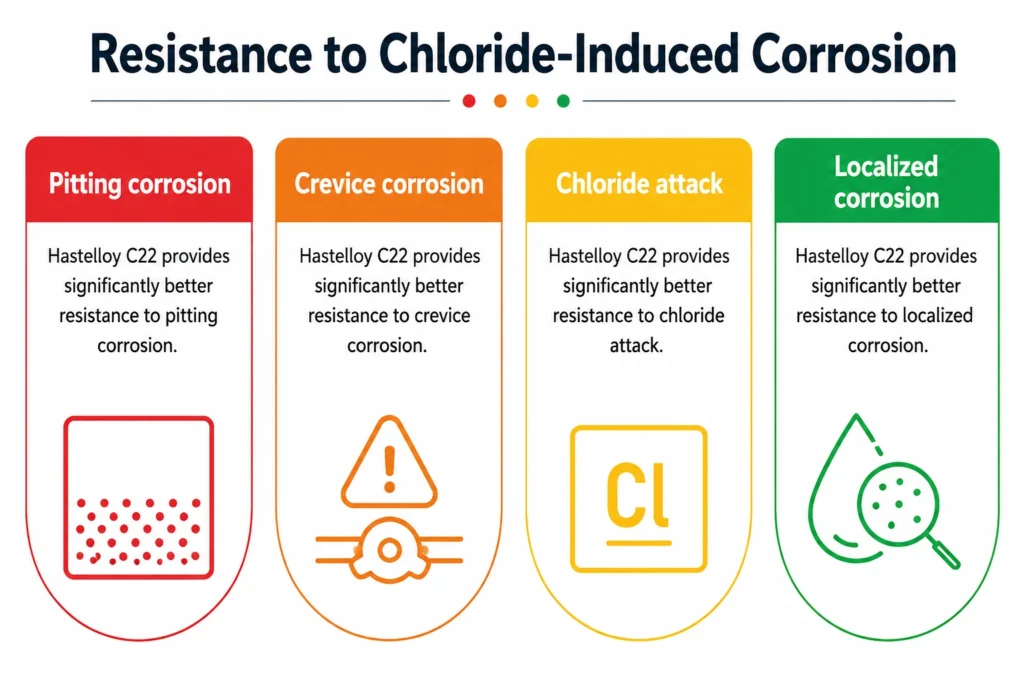
Resistance to Chloride-Induced Corrosion
Chloride-containing environments are particularly challenging because they promote pitting, crevice corrosion, and stress corrosion cracking.
While Inconel 825 offers good resistance to chloride stress corrosion cracking, Hastelloy C22 provides significantly better resistance to:
Pitting corrosion
Crevice corrosion
Chloride attack
Localized corrosion
Its higher molybdenum content makes it one of the best materials for chloride-rich environments.
Best Choice: Hastelloy C22
Mechanical Properties
Both alloys provide excellent mechanical strength, but they are optimized for different applications.
Inconel 825
Good tensile strength
Excellent ductility
Good weldability
Suitable for moderate-temperature applications
Hastelloy C22
Higher strength at elevated temperatures
Excellent fatigue resistance
Superior thermal stability
Outstanding weldability
For applications involving both corrosive chemicals and elevated temperatures, Hastelloy C22 generally offers better overall performance.
Weldability and Fabrication
Both alloys can be fabricated using conventional welding techniques.
Inconel 825 is relatively easy to weld and machine, making it a practical choice for many industrial piping systems.
Hastelloy C22 also offers excellent weldability and is less susceptible to weld decay because of its low carbon content.
Both alloys can be fabricated into:
Pipes
Tubes
Flanges
Fittings
Valves
Heat exchanger components
Applications of Inconel 825
Inconel 825 is commonly used in:
Sulfuric acid plants
Phosphoric acid production
Oil and gas pipelines
Pickling equipment
Nuclear fuel processing
Heat exchangers
Pressure vessels
Pollution control systems
Its balanced corrosion resistance and cost-effectiveness make it a popular choice for moderately aggressive environments.
Applications of Hastelloy C22
Hastelloy C22 is widely used in:
Chemical reactors
Hydrochloric acid processing
Pharmaceutical manufacturing
Waste treatment facilities
Chlorination systems
Flue gas desulfurization plants
Petrochemical processing
Marine chemical handling equipment
Its exceptional resistance to mixed acids and chlorides makes it suitable for some of the harshest industrial environments.
Inconel 825 vs Hastelloy C22: Comparison Table
Property | Inconel 825 | Hastelloy C22 |
Alloy Type | Nickel-Iron-Chromium | Nickel-Chromium-Molybdenum |
Sulfuric Acid Resistance | Excellent | Excellent |
Hydrochloric Acid Resistance | Moderate | Outstanding |
Nitric Acid Resistance | Good | Excellent |
Phosphoric Acid Resistance | Excellent | Excellent |
Pitting Resistance | Good | Outstanding |
Crevice Corrosion Resistance | Good | Outstanding |
Chloride Resistance | Good | Excellent |
Weldability | Excellent | Excellent |
High-Temperature Performance | Good | Excellent |
Relative Cost | Lower | Higher |
Which Alloy Should You Choose?
The choice between Inconel 825 and Hastelloy C22 depends on the chemical environment and operational requirements.
Choose Inconel 825 when:
Sulfuric or phosphoric acid is the primary process chemical
Moderate corrosion resistance is sufficient
Cost efficiency is important
The operating environment has lower chloride concentrations
Choose Hastelloy C22 when:
Hydrochloric acid is present
Mixed acid environments are involved
Chloride-induced corrosion is a concern
Maximum corrosion resistance is required
Equipment operates under highly aggressive chemical conditions
Although Hastelloy C22 is more expensive, its superior corrosion resistance often results in lower maintenance costs and a longer service life in severe applications.
Related Reports
Inconel vs Hastelloy Fittings: Which High Nickel Alloy is Right for Your Project?
What Is Fusion Bonded Epoxy (FBE) Coating? Benefits for Oil & Gas Pipelines & Fittings
What Is Inconel Used For in Oil and Gas? Grades, Properties & Applications
Types of Stainless Steel Fittings: SS 310, 904L, 317L & When to Use Them
Conclusion
Both Hastelloy C22 and Inconel 825 are high-end nickel-based alloys intended for use in harsh industrial settings. For many chemical processing applications, Inconel 825 provides cost-effective performance, superior weldability, and outstanding resistance to sulfuric and phosphoric acids. In contrast, Hastelloy C22 is one of the best options for the most hostile acid conditions due to its exceptional resistance to hydrochloric acid, chlorides, pitting, and crevice corrosion.
A thorough assessment of the process chemicals, operating temperature, pressure, and corrosion concerns is necessary for choosing the appropriate alloy. Industries can increase equipment dependability, lower maintenance costs, and extend the life of vital pipe systems and process equipment by matching the material to the particular service circumstances.
How We Support You
Selecting the right corrosion-resistant alloy is essential for ensuring long-term reliability, process safety, and maximum service life in aggressive acid environments. Our team helps you determine whether Inconel 825 or Hastelloy C22 is the best choice based on chemical composition, operating temperature, pressure, and corrosion challenges.
Our Support Includes:
Expert guidance on selecting between Inconel 825 and Hastelloy C22 for acid processing and corrosive service applications
Recommendations based on acid type, concentration, operating temperature, pressure, and process conditions
Technical support for applications involving sulfuric acid, hydrochloric acid, phosphoric acid, nitric acid, organic acids, and mixed chemical environments
Assistance with evaluating resistance to pitting, crevice corrosion, stress corrosion cracking, oxidation, and reducing environments
Guidance on selecting the right pipes, fittings, flanges, valves, and custom-fabricated components for chemical processing systems
Support with compliance to ASTM, ASME, ANSI, API, NACE, and project-specific standards
Assistance with material test certificates (MTCs), PMI reports, quality documentation, and third-party inspection requirements
Recommendations for applications in chemical processing plants, fertilizer facilities, pharmaceutical manufacturing, pollution control systems, and petrochemical industries
Custom solutions for sizes, wall thicknesses, pressure ratings, fabrication requirements, and project-specific specifications
Fast quotations and reliable bulk supply support for projects across the chemical, petrochemical, oil & gas, pharmaceutical, and industrial sectors
Whether your project involves acid handling systems, reactors, heat exchangers, process piping, storage tanks, scrubbers, or wastewater treatment facilities, we provide dependable Inconel 825 and Hastelloy C22 alloy solutions tailored to your operating conditions, corrosion risks, and long-term performance requirements.