
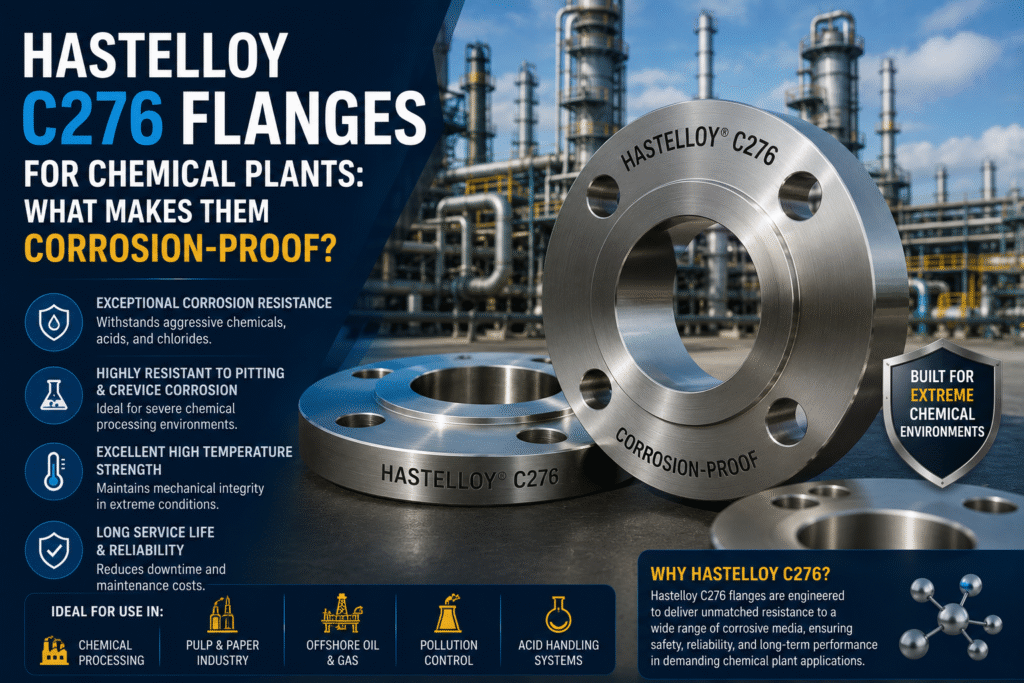
Some of the worst operating environments in contemporary industry are found in chemical processing facilities. Highly corrosive acids, chlorides, oxidizing agents, reducing chemicals, and high temperatures are frequently encountered by equipment. Choosing the right materials is essential for maintaining operating safety, reducing downtime, and prolonging equipment life in such challenging settings.
Hastelloy C276 flanges, one of the several corrosion-resistant alloys on the market today, are known for their outstanding performance in chemical plants. They are a popular option for vital piping systems, reactors, heat exchangers, and process equipment due to their distinct chemical makeup and exceptional resistance to a variety of corrosive fluids.
The characteristics of Hastelloy C276 flanges, their uses in chemical processing, and the main elements that contribute to their exceptional corrosion resistance are all covered in this article.
What Is Hastelloy C276?
Hastelloy C276 is a nickel-molybdenum-chromium superalloy with the addition of tungsten and controlled levels of iron and carbon. It is specifically designed to perform in severe chemical environments where conventional stainless steels and many other nickel alloys may fail.
Its typical chemical composition includes:
Nickel: Balance
Molybdenum: 15–17%
Chromium: 14.5–16.5%
Tungsten: 3–4.5%
Iron: 4–7%
Carbon: 0.01% maximum
The combination of these elements provides excellent resistance to both oxidizing and reducing environments, making Hastelloy C276 one of the most versatile corrosion-resistant alloys available.
What Are Hastelloy C276 Flanges?
Hastelloy C276 flanges are piping components used to connect pipes, valves, pumps, and process equipment in high-performance industrial systems.
These flanges provide:
Secure, leak-proof connections
Easy access for inspection and maintenance
Simplified assembly and disassembly
Reliable sealing under high pressure and temperature conditions
Common types of Hastelloy C276 flanges include:
Weld neck flanges
Slip-on flanges
Blind flanges
Socket weld flanges
Threaded flanges
Lap joint flanges
They are typically manufactured according to standards such as ASME B16.5, ASME B16.47, ASTM B564, and ASTM B366.
What Makes Hastelloy C276 Corrosion-Proof?
Although no material is entirely immune to every form of corrosion, Hastelloy C276 offers one of the highest levels of corrosion resistance among commercially available alloys.
Exceptional Resistance to Pitting and Crevice Corrosion
Pitting and crevice corrosion are common challenges in chemical processing plants, especially in environments containing chlorides.
The high molybdenum content in Hastelloy C276 significantly enhances resistance to localized corrosion, helping prevent:
Pitting attack
Crevice corrosion
Under-deposit corrosion
This makes the alloy particularly suitable for applications involving seawater, brines, and chloride-containing chemicals.
Superior Resistance to Oxidizing and Reducing Media
Many alloys perform well in either oxidizing or reducing environments, but not both.
Hastelloy C276 offers exceptional versatility because it resists a wide range of corrosive chemicals, including:
Sulfuric acid
Hydrochloric acid
Phosphoric acid
Chlorine gas
Acetic acid
Formic acid
Wet chlorine environments
Its balanced nickel-chromium-molybdenum composition enables reliable performance across diverse chemical processes.
Outstanding Resistance to Stress Corrosion Cracking
When piping systems are subjected to corrosive environments and tensile stress, stress corrosion cracking can result in abrupt and disastrous collapse.
Hastelloy C276 is a desirable material for demanding chemical applications because of its high nickel content, which offers exceptional resistance to stress corrosion cracking caused by chloride.
Excellent High-Temperature Stability
Chemical plants often operate at elevated temperatures that can accelerate corrosion and degrade material performance.
Hastelloy C276 maintains its mechanical strength and corrosion resistance over a broad temperature range, allowing it to perform reliably in high-temperature process systems.
Low Carbon Content Reduces Weld Decay
The alloy’s low carbon content minimizes carbide precipitation during welding.
This reduces the risk of:
Intergranular corrosion
Weld decay
Heat-affected zone degradation
As a result, Hastelloy C276 flanges maintain excellent corrosion resistance even after fabrication and welding.
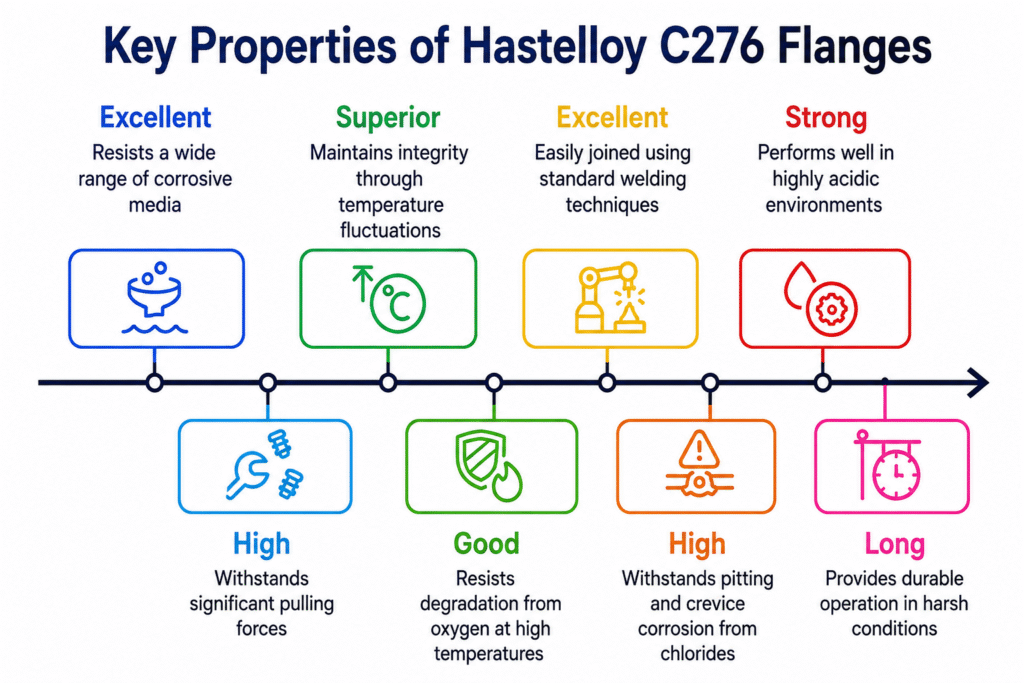
Key Properties of Hastelloy C276 Flanges
Hastelloy C276 flanges offer a combination of mechanical and chemical properties that make them suitable for critical process applications.
Key properties include:
Excellent corrosion resistance
High tensile strength
Superior resistance to thermal cycling
Good oxidation resistance
Excellent weldability
High resistance to chloride attack
Strong performance in aggressive acids
Long service life in harsh environments
These characteristics help reduce maintenance requirements and improve plant reliability.
Applications in Chemical Plants
Hastelloy C276 flanges are widely used in chemical processing facilities where corrosion resistance is a primary concern.
Typical applications include:
Chemical Reactors
Reactors frequently handle aggressive chemicals at elevated temperatures and pressures.
Hastelloy C276 flanges ensure secure and corrosion-resistant connections in these critical systems.
Heat Exchangers
Heat exchangers often experience exposure to corrosive fluids and thermal cycling.
The alloy’s resistance to corrosion and high temperatures helps extend equipment lifespan.
Piping Systems
Process piping used to transport acids, chlorides, and corrosive chemicals benefits from the durability of Hastelloy C276 flanges.
Pollution Control Equipment
Flue gas desulfurization systems and emissions control equipment often operate in highly corrosive environments.
Hastelloy C276 provides excellent resistance to acidic condensates and aggressive gases.
Pharmaceutical and Specialty Chemical Manufacturing
High-purity processes require materials that resist contamination and corrosion.
Hastelloy C276 flanges help maintain product integrity and process reliability.
Advantages Over Conventional Stainless Steels
Compared with standard stainless steel grades such as 304 and 316, Hastelloy C276 offers significant advantages in severe service conditions.
These advantages include:
Better resistance to chlorides
Superior performance in strong acids
Enhanced resistance to pitting and crevice corrosion
Improved resistance to stress corrosion cracking
Greater durability at elevated temperatures
Although Hastelloy C276 flanges involve higher initial material costs, their extended service life and reduced maintenance requirements often result in lower total lifecycle costs.
Selection Considerations
When specifying Hastelloy C276 flanges for chemical plants, engineers should evaluate:
Chemical composition of process fluids
Operating temperature and pressure
Chloride concentration
Flow conditions
Required flange type and pressure class
Applicable industry standards
Proper material selection ensures optimal performance and long-term reliability.
Related Reports
Inconel vs Hastelloy Fittings: Which High Nickel Alloy is Right for Your Project?
What Is Fusion Bonded Epoxy (FBE) Coating? Benefits for Oil & Gas Pipelines & Fittings
What Is Inconel Used For in Oil and Gas? Grades, Properties & Applications
Types of Stainless Steel Fittings: SS 310, 904L, 317L & When to Use Them
Conclusion
The remarkable durability of Hastelloy C276 flanges to some of the harshest chemical conditions found in industrial processing plants is well known.
Their special nickel-molybdenum-chromium composition offers exceptional defense against oxidizing and reducing media chemical assault, stress corrosion cracking, pitting, and crevice corrosion.
Hastelloy C276 flanges are a tried-and-true alternative for demanding situations where traditional materials cannot provide the necessary performance for chemical companies looking to increase equipment life, lower maintenance costs, and improve safety.
How We Support You
Selecting the right Hastelloy C276 flanges is essential for ensuring exceptional corrosion resistance, process reliability, and long-term performance in aggressive chemical processing environments.
Our team helps you choose the most suitable Hastelloy C276 flange solutions based on chemical composition, operating temperature, pressure conditions, and project-specific requirements.
Our Support Includes:
Expert guidance on selecting Hastelloy C276 flanges for highly corrosive process applications
Recommendations based on chemical media, operating temperatures, pressure ratings, and process conditions
Technical support for resistance against strong acids, chlorides, oxidizing and reducing agents, pitting, crevice corrosion, and stress corrosion cracking
Assistance with material selection for applications involving sulfuric acid, hydrochloric acid, phosphoric acid, seawater, and mixed chemical environments
Guidance on choosing the appropriate weld neck, slip-on, blind, socket weld, threaded, and lap joint flange types
Support with compliance to ASTM, ASME, ANSI, NACE, API, and project-specific standards
Assistance with material test certificates (MTCs), PMI reports, quality documentation, and third-party inspections
Recommendations for use in chemical processing plants, fertilizer facilities, pulp and paper mills, pollution control systems, and pharmaceutical manufacturing
Custom solutions for flange sizes, pressure classes, facing types, and project-specific fabrication requirements
Fast quotations and reliable bulk supply support for projects across the chemical, petrochemical, pharmaceutical, and industrial sectors
Whether your project involves chemical reactors, heat exchangers, storage systems, process piping, flue gas desulfurization units, or wastewater treatment facilities, we provide dependable Hastelloy C276 flange solutions designed to deliver superior corrosion resistance, operational safety, and long-term performance in the harshest processing environments.