
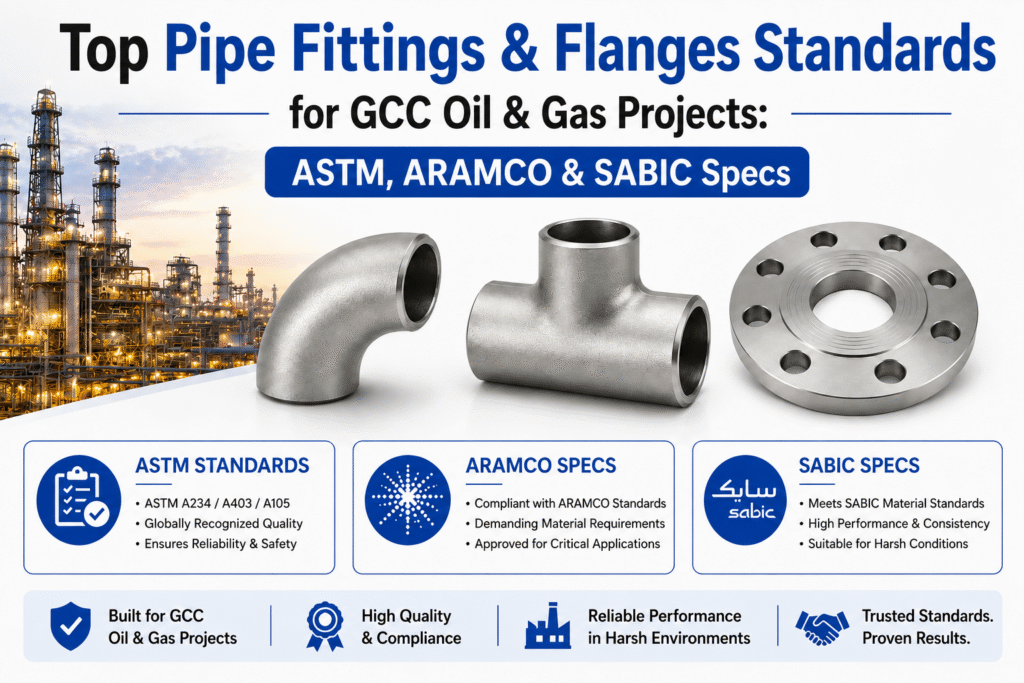
Piping systems in the GCC oil and gas sector must endure high temperatures, caustic chemicals, sour gas exposure, and tremendous pressure. Due to these challenging circumstances, it is crucial for GCC oil and gas projects to adhere to the proper pipe fittings and flanges regulations in order to guarantee operational efficiency, longevity, and safety.
In industrial pipelines, pipe fittings and flanges are essential for joining, managing, and guiding fluid flow. Any malfunction in these parts may result in leaks, shutdowns, hazards to the environment, and significant financial losses. GCC projects adhere to regional specifications from ARAMCO and SABIC in addition to international standards like ASTM and ASME to prevent such problems.
Why Standards Matter in GCC Oil & Gas Projects
Standards ensure that fittings and flanges meet strict quality, pressure, and corrosion-resistance requirements. They also help maintain compatibility between materials supplied by different manufacturers worldwide.
Benefits of Following Approved Standards
Improved operational safety
Reduced leakage and failure risks
Better corrosion resistance
Longer service life
Easier maintenance and replacement
Compliance with EPC and project specifications
Major GCC organizations enforcing these standards include:
Saudi ARAMCO
SABIC
ADNOC
QatarEnergy
Kuwait Oil Company (KOC)
ASTM Standards for Pipe Fittings & Flanges
What is ASTM?
ASTM (American Society for Testing and Materials) develops internationally accepted standards for industrial materials. These standards define:
Chemical composition
Mechanical properties
Heat treatment
Manufacturing methods
Testing procedures
ASTM A105 – Carbon Steel Forged Flanges
ASTM A105 is widely used for forged carbon steel flanges in high-pressure applications.
Key Features
Excellent strength
Good weldability
High-temperature resistance
Cost-effective solution
Common Applications
Oil refineries
Gas processing plants
Petrochemical facilities
Utility piping systems
ASTM A182 – Alloy & Stainless Steel Forged Components
ASTM A182 covers forged alloy steel and stainless steel flanges and fittings.
Popular Grades
F304/F304L
F316/F316L
F11
F22
Duplex & Super Duplex grades
Advantages
These materials provide excellent corrosion resistance and are ideal for offshore and chemical processing applications.
ASTM A234 – Carbon Steel Buttweld Fittings
ASTM A234 specifies carbon steel and alloy steel buttweld fittings for moderate and high-temperature services.
Types of Fittings
Elbows
Reducers
Tees
Pipe caps
Common Grades
WPB
WP11
WP22
These fittings are heavily used in refinery and pipeline projects.
ASTM A403 – Stainless Steel Wrought Fittings
ASTM A403 covers wrought stainless steel fittings for pressure piping systems.
Common Grades
WP304
WP304L
WP316
WP316L
These fittings are preferred in offshore and desalination projects because of their excellent corrosion resistance.
ASME Standards for Pipe Fittings & Flanges
Importance of ASME Standards
While ASTM focuses on material quality, ASME standards define dimensions, pressure ratings, tolerances, and manufacturing requirements.
ASME B16.5 – Pipe Flanges & Flanged Fittings
ASME B16.5 is one of the most important flange standards in GCC oil & gas projects.
It Covers
Pressure classes
Flange dimensions
Facing types
Bolt hole dimensions
Common Flange Types
Weld neck flange
Slip-on flange
Blind flange
Socket weld flange
Threaded flange
ASME B16.9 – Buttweld Fittings
ASME B16.9 standardizes factory-made buttweld fittings.
Components Included
Long radius elbows
Reducers
Equal tees
Eccentric reducers
This standard ensures dimensional consistency and flow efficiency.
ASME B16.11 – Forged Fittings
ASME B16.11 covers socket weld and threaded forged fittings used in high-pressure piping systems.
Typical Applications
Instrumentation systems
Hydraulic lines
Steam piping
Process industries
ARAMCO Standards for GCC Oil & Gas Projects
Why ARAMCO Specifications Matter
Saudi ARAMCO follows some of the strictest quality standards in the oil & gas industry. Suppliers must comply with approved specifications and testing requirements.
Major ARAMCO Specifications
01-SAMSS-005
Covers carbon steel piping materials for industrial applications.
02-SAMSS-011
Applies to stainless steel and corrosion-resistant piping systems.
SAES Standards
SAES standards define:
Material selection
Inspection procedures
Welding qualifications
Engineering requirements
Required Documentation
Approved suppliers usually provide:
Mill test certificates
Hydro test reports
PMI reports
NACE certificates
Third-party inspection approvals
SABIC Specifications for Petrochemical Projects
Understanding SABIC Requirements
SABIC projects require piping materials capable of handling corrosive chemicals and high operating temperatures. Along with ASTM and ASME standards, SABIC also applies additional internal quality requirements.
Key Requirements
Corrosion Resistance
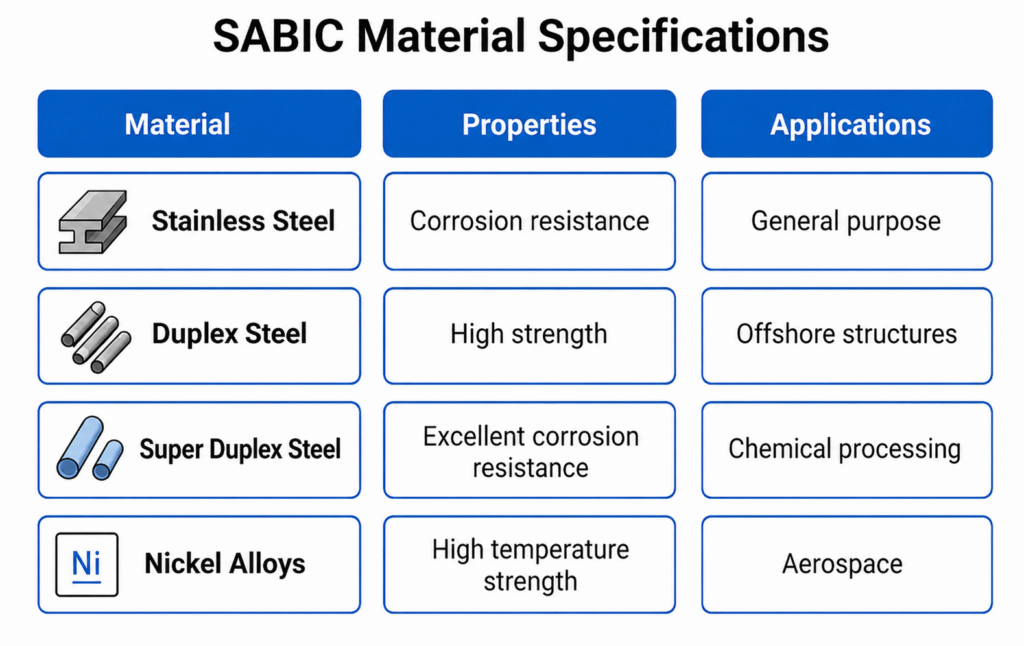
SABIC commonly specifies:
Stainless steel
Duplex steel
Super duplex steel
Nickel alloys
Inspection & Traceability
Manufacturers must maintain records for:
Heat treatment
Material traceability
Welding procedures
Dimensional inspection
Popular Materials Used in GCC Oil & Gas Projects
Carbon Steel
Common grades include:
ASTM A105
ASTM A234 WPB
Advantages
Economical
Strong mechanical properties
Easy availability
Stainless Steel
Popular grades include:
304/304L
316/316L
904L
Benefits
Excellent corrosion resistance
Long service life
Low maintenance
Duplex & Super Duplex Steel
Common Grades
UNS S31803
UNS S32205
S32750
Advantages
High strength
Superior seawater resistance
Excellent chloride corrosion resistance
Nickel Alloys
Common Alloys
Inconel 625
Hastelloy C276
Monel 400
Typical Uses
Offshore platforms
Sour gas systems
Chemical plants
Quality Testing Standards for Pipe Fittings & Flanges
Testing is essential before supplying fittings and flanges to GCC projects.
Important Testing Methods
1. Hydrostatic Testing
Checks pressure resistance and leak-proof performance.
2. Positive Material Identification (PMI)
Confirms material chemical composition.
3. Radiographic Testing (RT)
Detects internal weld defects.
4. Ultrasonic Testing (UT)
Identifies subsurface flaws.
5. Dye Penetrant Testing (DPT)
Detects surface cracks and imperfections.
People Also Ask (PAA)
Which flange standard is most used in GCC oil & gas projects?
ASME B16.5 is the most widely used flange standard because it defines pressure ratings, dimensions, and compatibility requirements.
What is the difference between ASTM and ASME standards?
ASTM standards focus on material properties and testing, while ASME standards focus on dimensions, pressure ratings, and manufacturing specifications.
Why are ARAMCO standards strict?
ARAMCO standards require detailed inspections, testing reports, and approved manufacturing processes to ensure safety and reliability.
Which material is best for offshore applications?
Duplex steel, super duplex steel, and nickel alloys are preferred because of their excellent seawater and corrosion resistance.
Related Reports
Inconel vs Hastelloy Fittings: Which High Nickel Alloy is Right for Your Project?
What Is Fusion Bonded Epoxy (FBE) Coating? Benefits for Oil & Gas Pipelines & Fittings
What Is Inconel Used For in Oil and Gas? Grades, Properties & Applications
Types of Stainless Steel Fittings: SS 310, 904L, 317L & When to Use Them
Conclusion
For GCC oil and gas projects, selecting the appropriate pipe fittings and flanges standards is crucial to preserving dependable, safe, and effective industrial operations. While ARAMCO and SABIC specifications guarantee more stringent regional conformity, ASTM and ASME standards serve as the cornerstone for material quality and dimensional correctness.
Certified fittings and flanges help lower operational risks, increase durability, and guarantee long-term performance in challenging GCC conditions, whether they are utilized in offshore drilling, petrochemical plants, LNG facilities, or refinery operations.
How We Support You
Selecting the right pipe fittings and flanges standards is essential for ensuring safety, compliance, and long-term performance in GCC oil & gas projects. Our team helps you choose industrial piping components that meet international specifications as well as major regional requirements such as ARAMCO and SABIC standards for demanding refinery, petrochemical, offshore, and pipeline applications.
We support you with:
Guidance on ASTM, ASME, ANSI, API, ARAMCO, and SABIC piping standards
Selection of carbon steel, stainless steel, duplex, super duplex, and nickel alloy fittings & flanges
Recommendations for high-pressure, high-temperature, and corrosive service conditions
Support for refinery, petrochemical, LNG, offshore, and pipeline project requirements
Assistance with pressure class, schedule, wall thickness, and material grade selection
Technical documentation, inspection reports, and material test certificate support
Compliance guidance for sour service and corrosion-resistant applications
Custom sizes, special coatings, and project-specific piping solutions
Fast quotations and bulk supply support for GCC & African industries
Whether your project involves offshore platforms, refineries, gas processing plants, petrochemical facilities, or cross-country pipelines, we provide reliable pipe fittings and flange solutions tailored to your operational, technical, and compliance requirements.