
Material selection plays a critical role in the oil & gas industry because pipelines, process systems, offshore equipment, heat exchangers, and pressure vessels often operate in highly aggressive environments. These systems are exposed to extreme temperatures, high pressure, corrosive chemicals, seawater, acidic gases, and chloride-rich conditions that can quickly damage conventional stainless steel materials.
To handle these demanding environments, industries rely on high-performance nickel alloys such as Inconel 625 and Inconel 825. Both alloys are widely used in oil & gas, petrochemical, marine, and offshore industries because they provide excellent corrosion resistance and long-term operational reliability.
However, despite belonging to the same nickel alloy family, Inconel 625 and Inconel 825 differ significantly in mechanical strength, corrosion resistance, chemical composition, temperature capability, and application suitability.
For EPC contractors, procurement engineers, plant operators, and industrial consultants, understanding these differences is essential for selecting the right alloy for long-term performance and operational safety.
What Is Inconel 625?
Inconel 625 is a nickel-chromium-molybdenum alloy known for its exceptional strength, oxidation resistance, and high-temperature performance.
The alloy contains:
Nickel
Chromium
Molybdenum
Niobium
Niobium strengthens the alloy and improves its mechanical performance under extreme operating conditions.
Inconel 625 is widely used in:
Offshore oil & gas systems
Marine engineering
Aerospace industries
High-pressure process systems
Heat exchangers
It is especially valued for its ability to maintain strength at elevated temperatures.
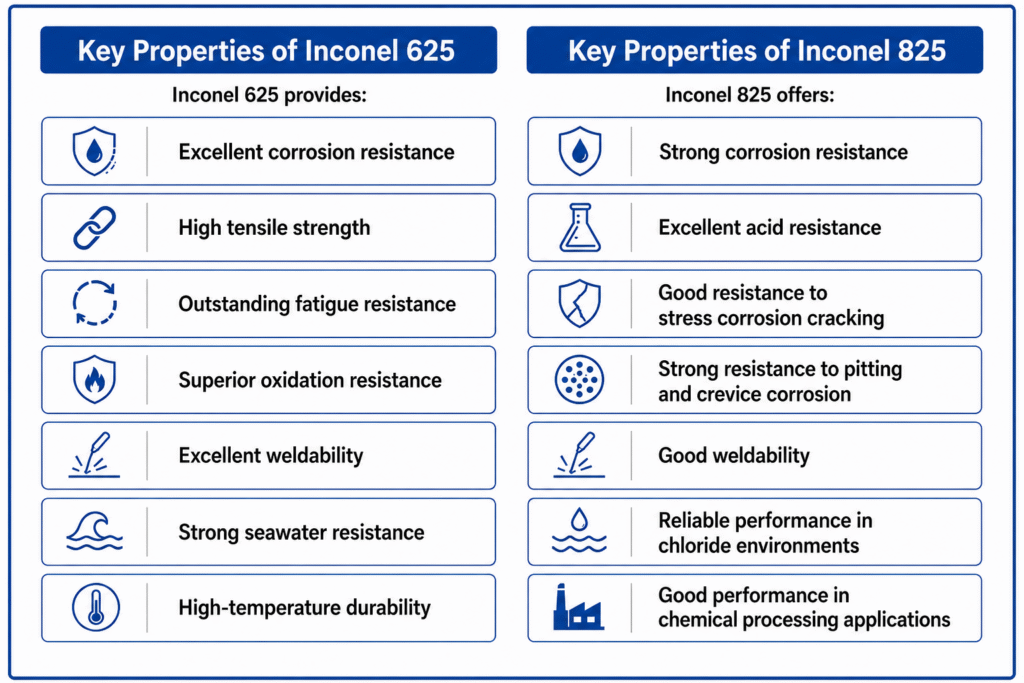
Key Properties of Inconel 625
Inconel 625 provides:
Excellent corrosion resistance
High tensile strength
Outstanding fatigue resistance
Superior oxidation resistance
Excellent weldability
Strong seawater resistance
High-temperature durability
These properties make it ideal for harsh industrial applications.
What Is Inconel 825?
Inconel 825 is a nickel-iron-chromium alloy designed primarily for exceptional corrosion resistance in chemically aggressive environments.
The alloy contains:
Nickel
Iron
Chromium
Molybdenum
Copper
Titanium
Its composition provides excellent resistance against both oxidizing and reducing acids.
Inconel 825 is commonly used in:
Chemical processing plants
Acid production systems
Pollution control systems
Oil & gas processing facilities
Marine environments
The alloy is particularly effective in corrosive chemical environments.
Key Properties of Inconel 825
Inconel 825 offers:
Strong corrosion resistance
Excellent acid resistance
Good resistance to stress corrosion cracking
Strong resistance to pitting and crevice corrosion
Good weldability
Reliable performance in chloride environments
Its primary advantage lies in chemical corrosion protection.
Chemical Composition Comparison
Inconel 625 Composition
Main alloying elements include:
Nickel
Chromium
Molybdenum
Niobium
Niobium significantly improves mechanical strength and high-temperature stability.
Inconel 825 Composition
Main alloying elements include:
Nickel
Iron
Chromium
Copper
Titanium
Molybdenum
Copper improves resistance to sulfuric acid and reducing environments.
Corrosion Resistance Comparison
Inconel 825: Better for Aggressive Chemical Environments
Inconel 825 performs exceptionally well in:
Sulfuric acid environments
Phosphoric acid systems
Chloride-containing environments
Chemical processing plants
Acid handling systems
It offers strong resistance to:
Pitting corrosion
Crevice corrosion
Stress corrosion cracking
This makes it highly suitable for corrosive chemical applications.
Inconel 625: Better for Combined Corrosion and High Strength
Inconel 625 also offers excellent corrosion resistance but is particularly valuable where:
High pressure exists
Mechanical stress is severe
Marine exposure is extreme
Elevated temperatures occur
It performs extremely well in offshore and subsea environments.
High-Temperature Performance
Inconel 625 Has Superior High-Temperature Capability
Inconel 625 maintains:
Structural integrity
Mechanical strength
Oxidation resistance
Even at elevated temperatures.
This makes it ideal for:
Heat exchangers
Exhaust systems
Offshore pressure systems
High-temperature process equipment
Inconel 825 Focuses More on Corrosion Protection
While Inconel 825 performs well under moderate heat conditions, it is not primarily designed for extreme-temperature structural applications.
Mechanical Strength Comparison
Inconel 625 Offers Higher Mechanical Strength
Inconel 625 provides:
Higher tensile strength
Better fatigue resistance
Superior creep resistance
Improved pressure handling capability
This makes it suitable for demanding offshore systems.
Inconel 825 Offers Moderate Strength
Inconel 825 prioritizes corrosion resistance over maximum structural strength.
It performs well in:
Chemical handling systems
Acid processing equipment
Corrosive industrial environments
Weldability and Fabrication
Both alloys provide excellent weldability.
Inconel 625
Offers:
Strong weld integrity
Excellent fabrication properties
High structural reliability after welding
Inconel 825
Provides:
Good weldability
Strong corrosion resistance after fabrication
Reliable performance in chemical environments
Proper welding procedures remain important for both materials.
Marine and Offshore Performance
Inconel 625 Performs Better Offshore
Because of its:
High strength
Seawater resistance
Fatigue resistance
Pressure handling capability
Inconel 625 is widely used in:
Offshore platforms
Subsea systems
Marine piping
Seawater cooling systems
Inconel 825 in Offshore Applications
Inconel 825 is also used offshore, especially where:
Acidic fluids are present
Chemical corrosion is severe
Sulfur-containing compounds exist
Cost Comparison
Inconel 625
Generally more expensive because of:
Higher nickel content
Niobium additions
Superior mechanical performance
Inconel 825
Often slightly more economical in applications where extreme strength is not required.
Pricing depends on:
Pipe size
Market nickel prices
Manufacturing standards
Project specifications
Best Applications for Inconel 625
Inconel 625 is best suited for:
Offshore oil & gas systems
Marine engineering
Heat exchangers
High-pressure pipelines
Aerospace systems
Exhaust systems
Subsea equipment
It performs best in extreme mechanical and marine environments.
Best Applications for Inconel 825
Inconel 825 is ideal for:
Acid processing systems
Chemical plants
Pollution control systems
Pickling operations
Sulfuric acid handling
Oil & gas chemical processing
It excels in aggressive chemical exposure environments.
Which Alloy Should You Choose?
Choose Inconel 625 If:
High pressure exists
Elevated temperatures are involved
Offshore or marine exposure is severe
High mechanical strength is required
Fatigue resistance is important
Choose Inconel 825 If:
Chemical corrosion is the main concern
Acid resistance is critical
Sulfuric or phosphoric acid exposure exists
Stress corrosion cracking resistance is required
The correct selection depends on operational conditions and project priorities.
Industries Using Inconel 625 and 825
These alloys are widely used in:
Oil & gas industries
Petrochemical plants
Marine engineering
Power generation
Chemical processing
Offshore infrastructure
LNG systems
Nickel alloys remain essential for modern industrial operations.
Future Demand for Nickel Alloys
As industries continue expanding into:
Deepwater offshore drilling
LNG infrastructure
Hydrogen energy systems
Advanced chemical processing
High-pressure subsea systems
Demand for corrosion-resistant nickel alloys continues growing rapidly.
Related Reports
Inconel vs Hastelloy Fittings: Which High Nickel Alloy is Right for Your Project?
What Is Fusion Bonded Epoxy (FBE) Coating? Benefits for Oil & Gas Pipelines & Fittings
What Is Inconel Used For in Oil and Gas? Grades, Properties & Applications
Types of Stainless Steel Fittings: SS 310, 904L, 317L & When to Use Them
Conclusion
Both Inconel 625 and Inconel 825 are highly reliable nickel-based alloys used extensively in oil & gas and industrial processing applications. Inconel 625 is known for its exceptional mechanical strength, high-temperature performance, and offshore durability, making it ideal for marine and high-pressure environments. Inconel 825, on the other hand, is optimized for superior corrosion resistance in aggressive chemical and acidic environments. Selecting the right alloy depends on factors such as temperature, pressure, corrosion exposure, seawater conditions, fabrication requirements, and long-term operational reliability. Proper alloy selection helps improve infrastructure lifespan, operational safety, and maintenance efficiency in critical industrial applications.
How We Support You
Selecting the right nickel alloy grade is essential for ensuring corrosion resistance, mechanical strength, and reliable performance in demanding oil & gas environments across GCC and African markets. Our team helps you choose between Inconel 625 and Inconel 825 based on temperature conditions, chemical exposure, pressure requirements, and application performance.
We support you with:
Material selection guidance for Inconel 625 and Inconel 825 applications
Recommendations for offshore, subsea, refinery, and petrochemical environments
Support for resistance against seawater corrosion, acids, chlorides, and high-temperature oxidation
Assistance with ASTM, ASME, ANSI, API, and NACE standard compliance
Guidance for pipelines, heat exchangers, pressure vessels, valves, and downhole equipment
Technical documentation and material test certificate support
Recommendations for high-pressure, sour gas, and corrosive service conditions
Custom sizes, fittings, flanges, pipes, and project-specific alloy solutions
Fast quotations and bulk supply support for GCC & African industries
Whether your project involves offshore drilling platforms, LNG facilities, chemical processing plants, subsea pipelines, or refinery infrastructure, we provide reliable nickel alloy solutions tailored to your operational and corrosion-resistance requirements.