
Introduction
In pipeline engineering, bends are essential for changing direction while maintaining smooth flow and structural integrity. Among various bending methods, induction bending is widely used for creating precise, high-quality bends in pipelines. Understanding what an induction bend is and how 3D, 5D, and 10D bends differ is crucial for procurement engineers, designers, and project managers.
This guide explains the working principle, types, applications, and selection criteria to help you choose the right bend for your pipeline system.
What Is an Induction Bend?
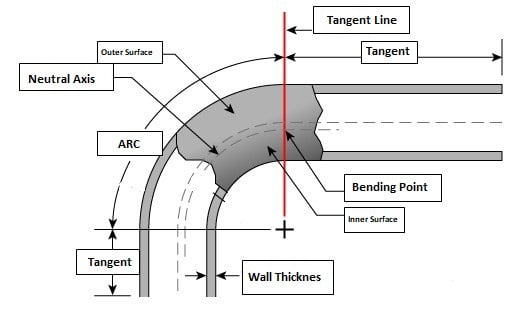
An induction bend is a pipe that is bent using induction heating technology, where a localized section of the pipe is heated and then bent to the desired angle using controlled mechanical force.
How Induction Bending Works
A specific section of the pipe is heated using an induction coil
The heated section becomes flexible
The pipe is bent to the required angle
The bent section is cooled (air or water cooling)
Key Advantage
This process ensures uniform bending without compromising the pipe’s strength or thickness.
Why Use Induction Bends in Pipelines?
Induction bends are preferred in modern pipeline systems due to their precision and performance.
Key Benefits
Smooth flow with minimal pressure drop
High strength and structural integrity
Reduced need for multiple fittings
Suitable for large-diameter pipes
Customizable bend angles
Understanding 3D, 5D, and 10D Bends
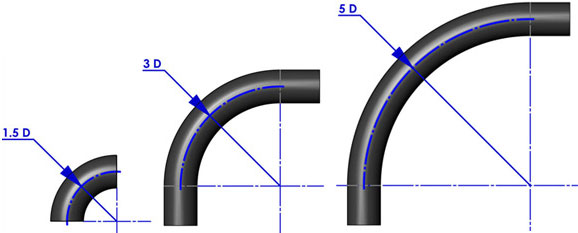
The “D” in 3D, 5D, and 10D refers to the radius of the bend in relation to the pipe diameter.
What Does “D” Mean?
D = Pipe diameter
Bend radius = Number × Pipe diameter
Types of Induction Bends
3D Bend
Definition
The bend radius is 3 times the pipe diameter.
Key Features
Sharp bend
Requires less space
Higher pressure drop compared to larger radius bends
Applications
Compact pipeline systems
Space-constrained installations
5D Bend
Definition
The bend radius is 5 times the pipe diameter.
Key Features
Balanced performance
Moderate pressure drop
Widely used in industrial pipelines
Applications
Oil and gas pipelines
Process industries
10D Bend
Definition
The bend radius is 10 times the pipe diameter.
Key Features
Smooth flow with minimal pressure loss
Reduced stress on pipe walls
Requires more installation space
Applications
High-flow pipelines
Long-distance transmission systems
3D vs 5D vs 10D Bends: Key Differences
Comparison Table
Feature | 3D Bend | 5D Bend | 10D Bend |
Radius | Small | Medium | Large |
Space Requirement | Low | Moderate | High |
Pressure Drop | High | Medium | Low |
Flow Efficiency | Moderate | Good | Excellent |
Cost | Lower | Moderate | Higher |
When Should You Use Each Type?
Choose 3D Bends When:
Space is limited
Compact system design is required
Choose 5D Bends When:
You need a balance between cost and performance
Standard industrial applications
Choose 10D Bends When:
Flow efficiency is critical
Pressure drop must be minimized
Long pipeline systems are involved
Applications of Induction Bends
Common Industries
Oil and gas pipelines
Power plants
Water transmission systems
Chemical processing plants
How to Choose the Right Induction Bend
Step-by-Step Selection Guide
Evaluate Space Availability
Limited space → 3D bend
Ample space → 5D or 10D bend
Check Flow Requirements
High flow → 10D bend
Moderate flow → 5D bend
Analyze Pressure Drop
Critical → 10D
Acceptable → 3D or 5D
Consider Budget
Cost-sensitive → 3D
Performance-focused → 10D
Assess Application Type
Industrial → 5D
High-performance pipelines → 10D
People Also Ask
What is the advantage of induction bending?
It provides precise bends without reducing pipe strength or thickness.
What does 5D mean in pipe bending?
It means the bend radius is five times the pipe diameter.
Which bend is best for flow efficiency?
10D bends are best due to minimal pressure loss.
Are induction bends stronger than welded bends?
Yes, they generally maintain better structural integrity.
Where are induction bends used?
They are widely used in oil & gas, power, and water pipeline systems.
Real-World Example
Pipeline Project Scenario
Project: Long-distance oil pipeline
Requirement: Smooth flow + low pressure drop
Solution: 10D induction bends
Result: Improved efficiency and reduced energy loss
Conclusion
Induction bends play a crucial role in pipeline systems by ensuring efficient flow, structural integrity, and long-term performance.
Final Takeaways
3D bends → Best for compact spaces
5D bends → Balanced performance and cost
10D bends → Maximum efficiency and minimal pressure loss
Procurement Insight
Choosing the right bend type ensures optimized flow, reduced maintenance, and better system reliability, making it a key factor in pipeline design.
Related Reports
Inconel vs Hastelloy Fittings: Which High Nickel Alloy is Right for Your Project?
What Is Fusion Bonded Epoxy (FBE) Coating? Benefits for Oil & Gas Pipelines & Fittings
What Is Inconel Used For in Oil and Gas? Grades, Properties & Applications
Types of Stainless Steel Fittings: SS 310, 904L, 317L & When to Use Them
How We Support You
- Guidance on selecting the right induction bend radius such as 3D, 5D and 10D
- Technical support for high pressure, high temperature and critical pipeline systems
- Assistance in choosing suitable materials including carbon steel, stainless steel and alloy steel
- Recommendations based on flow efficiency, pressure drop and installation requirements
- Custom manufacturing support for seamless and welded induction bends
- Supply of induction bends, pipe fittings, elbows, tees and flanges for industrial projects
Email us: info@trinityalloy.com
Connect with us on WhatsApp for quick assistance